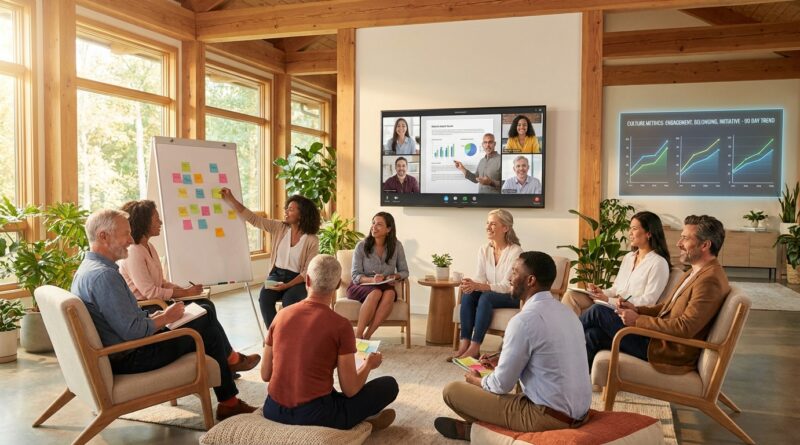
From Annual Offsite To Ongoing Ritual: Why 2026’s Smartest Corporate Retreats Are Designed As 90‑Day Culture Engines
You know the feeling. The company spends months planning a retreat, people fly in, the photos look great, everyone says, “We should do this more often,” and then two weeks later the mood is gone. Slack is quiet again. Old habits are back. Leaders are left staring at a big bill and asking what, exactly, changed. That frustration is driving a big shift in post pandemic corporate retreat trends 2026. The smartest teams are no longer treating retreats like a one-time morale event. They are designing them as the middle of a 90-day culture engine. That means the retreat is not the whole story. It is one moment inside a simple system: prepare people before they arrive, use the in-person time to lock in a few specific behaviors, then keep the momentum alive for the next three months with rituals, check-ins, and proof that something actually improved.
⚡ In a Hurry? Key Takeaways
- The best 2026 retreats are built as 90-day culture programs, not one-off events.
- Start with three phases: pre-work, retreat decisions, and 90 days of follow-through.
- If you cannot name the behaviors you want to change and how you will track them, the retreat is probably just expensive nostalgia.
Why the old offsite model is wearing out
For years, the standard playbook was simple. Get everyone together once a year. Add a nice venue, some workshops, a dinner, maybe a trust fall with better catering, and hope it somehow fixes communication, alignment, and morale.
That model feels shaky now. Teams are more distributed. Travel costs are harder to justify. And because people meet in person less often, every in-person moment carries more pressure. It has to do more than feel nice.
That is one of the clearest post pandemic corporate retreat trends 2026. Companies still want in-person time, maybe more than ever. They just want it to produce something lasting.
If this sounds familiar, you may also like From Retreat to Reset Day: Why 2026’s Smartest Teams Trade Offsites For Quarterly ‘Culture Sprints’, which gets at the same problem from a slightly different angle. The common thread is simple. One big event is rarely enough on its own.
What a 90-day culture engine actually means
Think of the retreat like a product launch, not a party.
You would not launch a product with no prep, no messaging, no owner, and no follow-up. Yet that is how many teams still run retreats. They expect a burst of togetherness to somehow turn into better meetings, faster decisions, stronger trust, and cleaner cross-team work.
A 90-day culture engine is a more grounded approach. It breaks the retreat into three phases.
Phase 1: Before the retreat
This is where you decide what problem you are trying to fix. Not ten problems. One to three at most.
Examples:
- Meetings run too long and end without clear owners.
- Managers give uneven feedback, so employees feel lost.
- Product, sales, and support are solving the same customer issues in silos.
Then gather baseline data. This can be simple. Look at engagement scores, pulse survey results, turnover risk, project delays, meeting satisfaction, manager feedback quality, or even how long it takes teams to make routine decisions.
This matters because “better culture” is too vague. “Cut handoff confusion between teams by 30 percent in 90 days” is something you can actually work on.
Phase 2: During the retreat
The retreat is where people make decisions, practice new behaviors, and agree on a few shared rules. It is not where they sit through 40 slides about values they already know.
The best retreat agendas in 2026 are getting more practical. Less performance. More behavior design.
That means sessions like:
- How we run meetings from now on
- How managers give feedback in the same format
- How cross-functional teams escalate blockers
- What “ownership” means here, in plain English
If people leave inspired but unclear, you have a mood, not a system.
Phase 3: The next 90 days
This is the part many companies skip, and it is why the good energy disappears so fast.
After the retreat, you need rituals. Small, repeatable things. Not a giant new program that everyone will ignore by week three.
Examples include:
- A 15-minute weekly manager check-in using one common template
- A monthly cross-team “blockers review” with clear owners
- A Friday recap where teams share one example of the new behavior in action
- A 30-day, 60-day, and 90-day pulse survey tied to the retreat goals
The retreat starts the change. The ritual keeps it alive.
What leaders should stop doing right away
There are a few patterns that almost guarantee disappointment.
Trying to fix everything at once
If your retreat agenda promises better trust, faster execution, stronger accountability, cleaner communication, happier managers, clearer strategy, and more innovation, you are setting yourself up for a blurry result.
Pick fewer targets. Go deeper.
Confusing emotion with change
A powerful closing speech can make people feel committed. That is not the same as changing how they work on Tuesday morning.
Emotion helps. Structure matters more.
Leaving follow-up to “natural momentum”
Natural momentum is lovely when it happens. It just usually does not. Work rushes back in. Calendars fill up. Managers get distracted. Without scheduled follow-through, the retreat becomes a memory instead of a turning point.
How to plan a retreat that sticks
Here is a practical frame you can use this quarter.
1. Set one business goal and one culture goal
Pair them together.
For example:
- Business goal: improve speed of product launches
- Culture goal: reduce cross-team confusion and unclear ownership
This helps skeptical executives see the point. Culture is not floating above the business. It supports how work gets done.
2. Define 3 behaviors you want to see more often
Not slogans. Behaviors.
Examples:
- Every meeting ends with one owner, one deadline, one next step
- Managers give feedback every two weeks, not just during reviews
- Teams raise risks within 24 hours instead of waiting for the next status meeting
3. Build the agenda around decisions and practice
Ask of every session, “What will be different after this?”
If the answer is fuzzy, cut or rewrite the session.
4. Assign owners before people fly home
Each post-retreat ritual needs a name next to it. Not “leadership.” Not “HR and managers.” A person.
5. Measure at 30, 60, and 90 days
Keep it simple. A short pulse survey. A few operational metrics. A manager check-in. A review of whether the agreed behaviors are actually showing up.
This is how you prove the retreat did more than create good photos and a nice group dinner.
What employees actually want from in-person time now
People are not asking for more awkward icebreakers. Most want three things.
- Clarity about priorities
- Real connection with the people they work with
- Less friction when they go back to remote or hybrid work
That is why the best retreats now mix human moments with practical agreements. Yes, give people space to talk, laugh, and reconnect. That part matters. But also use the room to solve the annoyances that make daily work feel harder than it should.
When people leave saying, “I know who to call, how we make decisions, and what happens next,” that is a win.
How to talk to executives who think retreats are soft spending
This part matters, especially in a tighter budget climate.
Do not sell the retreat as a morale boost alone. Sell it as a structured intervention around known friction.
Try language like:
- “We are using one in-person gathering to standardize three team behaviors.”
- “We will track progress over 90 days with pulse checks and operating metrics.”
- “The goal is to reduce coordination drag, improve manager consistency, and shorten decision cycles.”
That is a very different conversation from, “People deserve a fun offsite.” They may deserve that too, of course. But budget approval usually follows outcomes.
At a Glance: Comparison
| Feature/Aspect | Details | Verdict |
|---|---|---|
| Traditional annual retreat | Big energy, broad goals, little structure after the event | Good for bonding, weak for lasting change |
| 90-day culture engine | Prep before, behavior design during, rituals and measurement after | Best fit for measurable culture improvement |
| Proof of impact | Pulse surveys, manager consistency, meeting quality, decision speed, cross-team follow-through | Important if you need executive buy-in for future events |
Conclusion
The big lesson in post pandemic corporate retreat trends 2026 is not that retreats are dead. It is that they need a job to do. When teams spend less time together in person, that time becomes more valuable, and expectations get much higher. Founders, HR leaders, and ops teams can no longer afford to treat an offsite like a once-a-year burst of inspiration and hope the feeling lasts. If you build your next retreat as the centerpiece of a 90-day culture engine, with a clear pre-plan, a focused in-person agenda, and simple follow-through after everyone gets home, you give that investment a real chance to change behavior. And that is the difference between expensive nostalgia and something you can actually point to three months later and say, yes, this worked.