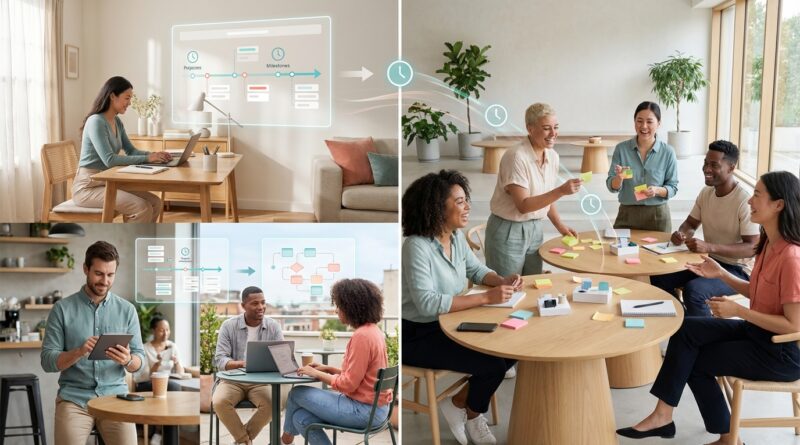
From Offsite To Async Retreat: Why 2026’s Sharpest Teams Dismantle The All-Day Agenda
Everybody knows the feeling. You fly across the country, drag your suitcase into a hotel ballroom, grab a lukewarm coffee, and then spend eight hours watching slide decks you could have read at home. By day two, people are tired, a little cranky, and quietly wondering why this had to be done in person at all. That is the big reason the async corporate retreat is catching on. Smart teams are not giving up on gathering. They are getting rid of the parts that waste everyone’s time. Instead of packing every update, presentation, and icebreaker into a three-day marathon, they send the reading, context, and reflection work ahead of time. Then the live retreat becomes what it should have been all along. A place for real debate, faster decisions, hands-on planning, and actual human connection. In 2026, the sharpest teams are not canceling retreats. They are finally designing them around how people really work now.
⚡ In a Hurry? Key Takeaways
- An async corporate retreat works better because it moves updates and prep work before the trip, leaving in-person time for decisions, collaboration, and relationship-building.
- Start by treating your retreat like a sprint. Send pre-reads, short video briefings, and reflection prompts two to three weeks early.
- This model is often better for neurodivergent staff, caregivers, and global teams because it cuts overload and makes participation more flexible.
Why the old retreat formula is wearing people out
The classic offsite agenda was built for a different era. It assumed everyone worked in roughly the same way, in roughly the same place, on roughly the same schedule. That is not how most teams operate now.
Hybrid work changed expectations. People got used to reading documents on their own time, joining the meetings that matter, and protecting stretches of focused work. So when companies bring them together and fill every hour with presentations, the retreat starts to feel less like a reward and more like a traffic jam.
That is where leaders get stuck. They want culture. They want connection. They want people to leave feeling aligned. But they keep using a format that drains the energy needed to make those things happen.
What an async corporate retreat actually means
Async does not mean remote-only. It does not mean cold. And it definitely does not mean canceling the fun.
An async corporate retreat simply means this. Anything that can be done before the trip should be done before the trip. That includes status updates, project background, market context, team reports, pre-reading, and individual reflection.
Then, when people finally gather in person, they are not hearing everything for the first time. They are ready to react, decide, build, and connect.
Think of it like a product sprint
The best way to picture this is to treat the retreat like a product sprint with three phases.
Phase one: async discovery. Teams review materials, answer prompts, record ideas, and surface concerns before anyone boards a plane.
Phase two: live decision window. The in-person time is used for the things that are genuinely better face-to-face, like debate, trust-building, planning, conflict resolution, and prototyping.
Phase three: follow-through. After the retreat, decisions get documented, owners are assigned, and next steps are tracked so the event has a real afterlife.
Why this works better for hybrid teams
Hybrid workers are often more engaged than many people assume. The problem is not that they cannot connect. The problem is that companies sometimes force connection in the least effective way possible.
When a retreat is built around async prep, it respects how people already work. Quiet thinkers get time to process. Busy managers can review materials when their schedule allows. Global teams are not asked to absorb complex information while jet-lagged in a noisy room.
That matters more than it sounds. Some people do their best thinking after reading quietly. Some need extra time to form opinions. Some are juggling care responsibilities and cannot stretch a two-day event into four days of travel and recovery. An async-first setup gives them a fairer shot at participating well.
What to move out of the room
If you are planning an async corporate retreat, start by asking one simple question. Does this need live airtime, or does it just need to be understood?
These items usually belong in pre-work:
Status updates
If a department head can explain it in a five-minute video or a two-page memo, do that. Nobody needs to fly in for a quarterly update that could live in a shared doc.
Background context
Market overviews, customer research, financial summaries, roadmap history, and project timelines are much easier to absorb before the event.
Solo reflection
Questions like “What is slowing your team down?” or “Where do we need clearer decision rights?” get better answers when people have time to think.
Basic brainstorming
Collect early ideas asynchronously. The live session can then focus on sorting, debating, and choosing.
What should stay in the room
This is the heart of the model. Save the valuable face-to-face time for what really benefits from shared energy.
Decision-making
Once everyone has the same context, leaders can use the room for actual calls, not endless setup.
Healthy disagreement
Complex issues often need tone, nuance, and trust. That is easier in person than in a long comment thread.
Working sessions
Prototype a new process. Map a customer journey. Fix a handoff problem between teams. Build something together.
Relationship-building
This is the part many retreat planners accidentally squeeze out. If every hour is booked, there is no room for the hallway chat, dinner conversation, or walk between sessions where trust usually starts.
How to design the pre-retreat async phase
This is where many companies either save the retreat or sabotage it.
Pre-work should be structured, short, and easy to finish. If you dump 200 slides and call it async, people will resent that too.
Use a simple prep stack
A good setup often includes:
- A short retreat brief explaining goals and what decisions need to be made
- One shared folder with all core documents
- Short recorded updates instead of live presentations
- A survey or form to collect concerns, ideas, and questions
- A deadline for review, ideally one week before travel
Keep each input small
Ask leaders to make concise materials. Five minutes of video. Two pages of notes. Three discussion questions. The point is to prepare people, not bury them.
Make participation visible
If you want people to do the prep, tie it to the live agenda. Open sessions with, “You all saw the feedback trends in the survey. Today we are deciding what to do about them.” That tells everyone the pre-work mattered.
Why this is often better for inclusion
One of the strongest arguments for an async corporate retreat is that it makes participation more humane.
Neurodivergent employees may find long, densely scheduled days exhausting. Caregivers may not be able to add extra travel days without stress at home. International teammates may lose huge chunks of energy to time zones and flights. Introverts may have valuable ideas but need time to process before speaking up.
Async prep does not solve every access issue, but it helps. It spreads the cognitive load. It reduces the pressure to perform on the spot. It gives more than one way to contribute.
That usually leads to better conversations, not just kinder logistics.
A sample two-day live agenda that does not waste the trip
Here is what a smarter retreat can look like once the heavy info-sharing is moved out of the room.
Day one
- Welcome and reset. Confirm goals, decisions to make, and shared ground rules
- Discussion block. Top three issues surfaced during async prep
- Cross-functional workshop. Small-group problem solving
- Decision session. Pick priorities, assign owners
- Dinner or informal social time with no forced games
Day two
- Prototype or planning session
- Breakouts by team, role, or project
- Report-back focused on commitments, not presentations
- Closing session with next steps and accountability
Notice what is missing. No endless executive slideshow. No 90-minute meeting just to “align on context.” No fake-busy filler.
Common mistakes to avoid
Do not turn async into homework overload
If the prep feels bigger than the retreat itself, people will tune out. Be selective.
Do not keep the old agenda and add pre-work on top
This is the trap. If you assign prep and still spend the first half-day repeating it, everyone will wonder why they bothered.
Do not confuse social time with wasted time
Connection often happens in unstructured moments. You do not need to script every laugh.
Do not skip the post-retreat follow-up
A retreat with no follow-through becomes a very expensive memory.
How to sell this idea to skeptical leaders
Some executives still equate full calendars with value. If there is empty space, they think something is missing. The better argument is practical.
Ask them this. Is the goal to prove people were together for 16 hours a day, or to get sharper decisions and stronger relationships?
Framed that way, the async model is easier to defend. It reduces repeat presentations. It makes expensive travel more worthwhile. It creates cleaner documentation. And it gives the company evidence that the retreat led to action, not just applause.
At a Glance: Comparison
| Feature/Aspect | Details | Verdict |
|---|---|---|
| Traditional retreat agenda | Packed with live presentations, updates, and tightly scheduled sessions from morning to night | Easy to plan, but often exhausting and inefficient |
| Async corporate retreat | Moves context, reading, updates, and reflection before the event so in-person time is used for decisions and collaboration | Best fit for modern hybrid teams |
| Inclusion and accessibility | Async prep gives people more ways to participate and reduces cognitive and travel strain | Stronger for neurodivergent staff, caregivers, and global teams |
Conclusion
The big lesson is simple. People are not tired of gathering. They are tired of traveling for things that did not need to happen in person. Hybrid workers can be deeply engaged, even while HR leaders worry about culture and connection. That is exactly why the old all-day retreat agenda is starting to backfire. An async-first retreat respects how work happens now. It moves status updates, background reading, and solo reflection into the weeks before the event, so the live time can be used for alignment, healthy debate, prototyping, and real relationship-building. It also tends to be kinder and more practical for neurodivergent talent, caregivers, and distributed teams who want to take part without burning themselves out. For any team planning its next gathering, the playbook is clear. Treat the retreat like a sprint. Do the discovery async. Use the in-person window for decisions. Then follow through after everyone gets home. That is how a retreat stops feeling like a conference in disguise and starts being worth the trip.