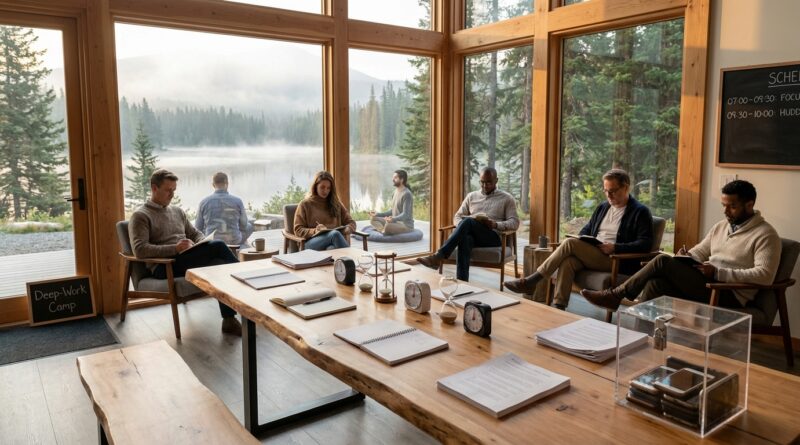
From Offsite To Deep-Work Camp: Why 2026’s Smartest Retreats Protect Focus, Not Just ‘Face Time’
You can feel the eye-roll now. Another team retreat. Another flight, another hotel, another agenda packed with presentations people could have watched at home. The promise is connection. The reality is often a nicer room for the same old meeting overload. Everyone is technically together, but half the group is still answering Slack, checking email, or polishing slides for the next session. If that sounds familiar, your team is not being difficult. They are tired. They are telling you, quietly or loudly, that being in the same building is not the same as doing meaningful work together. That is why the smartest 2026 retreat plans are shifting from offsites built around face time to a deep work corporate retreat model. The goal is not more hours in one room. It is fewer interruptions, better decisions, and enough breathing room for people to think before they speak.
⚡ In a Hurry? Key Takeaways
- A deep work corporate retreat works best when it protects quiet focus blocks, not just group sessions.
- Start by cutting slide-heavy meetings and replacing them with 60 to 90 minute distraction-free work periods tied to real decisions.
- This approach helps reduce burnout and makes travel feel worth it because people leave with finished work, not just notes.
Why the old offsite formula is wearing people out
Most retreats still follow a familiar script. Welcome session. Executive update. Team breakouts. Panel. Workshop. Dinner. More sessions the next day. On paper, it looks productive. In practice, it often turns into calendar overload in a different zip code.
The problem is not that people dislike seeing each other. Most teams still want face-to-face time. The problem is that many retreat agendas confuse attendance with attention. If every hour is scheduled, every topic is discussed in a group, and every discussion gets turned into a slide deck, nobody has enough room to think clearly.
That is especially frustrating after years of hybrid work, when many people learned something simple. They do their best thinking away from constant interruptions. So when leaders ask people to travel and then recreate the same interruption-heavy day, resentment builds fast.
What a deep-work camp does differently
A deep-work camp is not anti-culture. It is not anti-collaboration either. It just treats focus as something worth protecting.
Instead of filling every hour with programmed interaction, it creates a mix of structured quiet work, small-group problem solving, and limited full-team sessions. The key idea is simple. In-person time should be used for work that gets better when people are together, while still giving them enough quiet to process, write, design, decide, and finish.
It changes the question
The old question was, “How do we keep everyone engaged all day?”
The better question is, “What kind of work is so important that it deserves protected, shared focus?”
That might mean product strategy, annual planning, thorny cross-team decisions, customer journey redesign, hiring plans, or narrative work for a new launch. These are not topics that thrive when squeezed between notifications.
It respects different working styles
Some people think out loud. Some need silence first. Some contribute best after they have had an hour to write and sort their thoughts. A deep-work format makes room for all of them.
That also connects well with a broader shift in retreat design. If you want people to feel respected, they need space and choice, not just more mandates. That is why the ideas in From Offsite To Opt‑Out Friendly: Why 2026’s Smartest Retreats Let People Say No Without Losing Culture fit naturally here. A better retreat is not only about what happens on site. It is also about removing the pressure and performance around it.
How to build a retreat agenda that protects focus
You do not need to reinvent the whole event. You just need to stop treating every retreat hour as meeting time.
1. Pick one or two outcomes that truly matter
If your retreat has ten goals, it has none. Decide what needs to be finished, decided, or meaningfully advanced by the end. Keep it tight.
Good examples include:
Finalizing next quarter priorities. Writing a shared strategy memo. Solving one messy cross-functional problem. Mapping a product roadmap. Drafting a hiring plan with owners and deadlines.
2. Replace some presentations with pre-reads
If a leader needs 45 minutes of slides to update the group, that content should probably be read before the retreat. Ask people to review it in advance, then use in-person time for questions, debate, and decisions.
This one change alone can free hours.
3. Add protected focus blocks
This is the heart of the deep work corporate retreat model. Put 60 to 90 minute quiet blocks on the agenda. Make them real. No side chats. No laptops open for messaging. No “quick updates.”
Each block should have a defined purpose. Write. Review. Build. Decide. Prepare. Then bring people back together briefly to share what moved forward.
4. Keep group sessions shorter and sharper
Not every conversation needs the full team. Use small groups where possible. Cap whole-group sessions at the shortest useful length. Thirty minutes with a clear decision point often beats a wandering 90-minute discussion.
5. Create tech rules that support the work
You do not need to ban devices completely. But you do need boundaries. For example, phones away during decision sessions. Slack closed during focus blocks. Email checked only at set times. If people know the rules in advance, it feels less awkward and far more fair.
6. Give people room to breathe
Breaks are not wasted time. Neither are walks, solo reflection periods, or quiet meals. These are often when ideas click. A retreat that treats every empty minute as a scheduling failure usually burns people out before the real work begins.
What a sample day can look like
Here is a simple structure leaders can adapt this week.
Morning
Brief welcome and framing. One short discussion on the main challenge. Then a 90-minute quiet strategy block with a clear output.
Late morning
Small-group sessions to compare ideas, spot gaps, and combine the strongest thinking.
Afternoon
A second focus block for drafting, planning, or working through open questions. Then a short decision meeting with named owners.
Evening
Dinner, informal conversation, maybe one optional social activity. Not a mandatory “fun” session that drains the last bit of energy people have left.
That rhythm matters. Think, discuss, refine, decide. Not present, present, present, then wonder why nothing landed.
Why this format works better for burnt-out teams
Burnout is not always about working too many hours. Often it is about never getting a clean run at the work that matters. Constant context switching wears people down. So does sitting in meetings about work instead of doing it.
A deep-work retreat helps in a few practical ways.
It makes travel feel justified
If people are leaving home, arranging childcare, and stepping away from normal routines, they want a return on that effort. A stronger plan, a solved problem, or a finished document feels real. Another pile of sticky notes does not.
It reduces productivity theater
People are good at looking busy in packed agendas. That is not the same as making progress. Focus blocks make output visible. You can point to what was written, decided, or built.
It improves the quality of discussion
When people have time to think first, meetings get better. The loudest voice has less advantage. Introverts get traction. Discussion gets more specific. Decisions get less fuzzy.
Common mistakes to avoid
Even good intentions can go sideways. Watch for these traps.
Calling it deep work but keeping Slack alive
If people are still reachable every minute, it is not protected focus. It is regular work with a nicer backdrop.
Overpacking the social side
Connection matters. Forced bonding all day and all night does not. People need downtime to be human, especially after intense work.
Leaving outputs vague
“Brainstorm strategy” is too fuzzy. “Draft a one-page decision memo with three recommended priorities” is much better.
Using the retreat to dump information
If half the agenda is status updates, you are wasting the most expensive part of the week. Send the update before people board the plane.
At a Glance: Comparison
| Feature/Aspect | Details | Verdict |
|---|---|---|
| Traditional offsite agenda | Packed with presentations, full-team meetings, and little quiet time for real work | Good for announcements, poor for deep thinking |
| Deep-work corporate retreat | Uses pre-reads, protected focus blocks, short decision sessions, and smaller group collaboration | Best for strategic progress and sharper decisions |
| Tech and attention rules | Phones and chat tools are limited during key sessions so people can stay present | Important if you want the retreat to feel worth the trip |
Conclusion
People are pushing back on return-to-office rules and calendar overload because they can tell when time is being wasted. That frustration does not disappear just because the meeting happens at a resort. Hybrid work already proved that many employees can get more done away from constant interruptions. So the smarter move for 2026 is not to drag teams together for more face time. It is to design in-person time around the kind of focused, strategic work that rarely survives a normal workweek. A deep-work camp gives leaders a practical blueprint. Protect a few real focus blocks. Cut the slide parade. Make social time human, not forced. If you do that, your next retreat can leave people with clearer decisions, less burnout, and actual progress. Not just another notebook full of half-finished ideas.