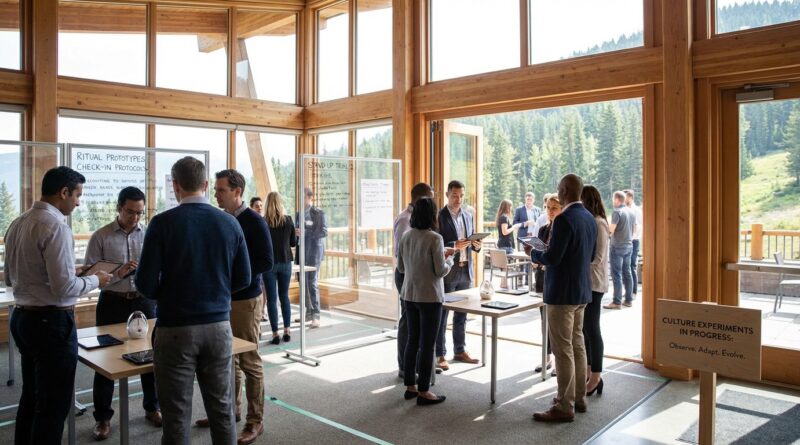
From Offsite To Living Lab: Why 2026’s Smartest Retreats Turn The Destination Into A Culture Prototype
You know the feeling. Everyone comes back from the company retreat smiling, with fresh photos, inside jokes, and a shared promise that this time things will be different. Then Monday arrives. Slack fills up. Meetings sprawl again. Decisions slow down. The old habits walk right back through the front door. That is why so many leaders are rethinking post pandemic corporate retreat trends 2026 living lab destination planning. The problem is not the location. It is treating the retreat like a reward instead of a test site. The smartest teams in 2026 are turning the destination itself into a living lab, a temporary place where they try new meeting rules, decision systems, focus blocks, manager habits, and cross-team workflows in real time. The goal is simple. Do not just bond. Run small experiments, measure what worked, and bring home only the practices that actually survive contact with real work.
⚡ In a Hurry? Key Takeaways
- A Living Lab retreat treats the offsite as a short, real-world test run for culture and operations, not just team building.
- Pick 2 to 4 habits to test on-site, define success before the trip, and measure them again 30 to 45 days later.
- This approach lowers risk because teams try changes in a controlled setting before rolling them out company-wide.
Why the classic offsite is losing its shine
For years, the corporate retreat had a simple job. Get people together. Build goodwill. Give everyone a break from screens. That still matters. People do better work when they trust each other.
But hybrid and distributed work changed the stakes. For many teams, the retreat is now one of the only times people are physically in the same room. That makes every hour more expensive, and more important.
If the whole event is filled with keynote talks, icebreakers, and nice dinners, you may get a morale bump. You probably will not get lasting change. Culture drifts back to whatever your systems reward once people are home again.
What a “Living Lab” retreat actually means
Think of a Living Lab retreat as a pop-up version of your company. Same people. Same pressure points. Same messy handoffs between teams. The difference is that, for a few days, you are intentionally testing better ways to work.
Instead of asking, “How do we make this retreat memorable?” the better question is, “What do we need to learn while everyone is here?”
That shift matters a lot.
The destination becomes a prototype
The venue is no longer just scenery. It becomes a safe place to try things like:
- New meeting formats with stricter agendas and shorter runtimes
- Quiet work blocks to see whether deep work can be protected
- Clearer decision rules, such as who decides, who gives input, and by when
- Cross-functional pairing between departments that rarely solve problems together
- Manager check-in rhythms that reduce status meetings
- Documentation habits that support remote follow-through
You are not pretending the retreat is normal work. You are using the unusual setting to stress-test changes before they hit the normal workweek.
Why 2026 teams are moving in this direction
The big post pandemic corporate retreat trends 2026 living lab destination shift comes down to one blunt reality. Companies are under pressure to prove that offsites are worth the cost.
Flights, hotels, venue buyouts, travel coordination, and lost work time add up fast. Finance teams notice. Employees notice too. People are less impressed by “mandatory fun” if it creates extra work before and after the trip.
So the best retreats now do two jobs at once. They strengthen relationships and produce evidence. Leaders want to know which habits help trust, deep work, and speed once everyone is back in the real world.
What changed after the pandemic
Before widespread hybrid work, culture mostly spread by proximity. People picked up cues in hallways, meetings, and lunches. Now culture has to survive in calendars, docs, chat tools, and video calls.
That means your retreat should test not just how people feel together in person, but how those good intentions translate into systems people can actually use remotely.
The difference between a fun retreat and a useful one
A fun retreat says, “Let’s reconnect.”
A useful retreat says, “Let’s reconnect and test three better ways of working while we are together.”
Those are not the same thing.
Fun-only retreat
- Heavy on inspiration
- Light on operational follow-through
- Few measurable outcomes
- Easy for old habits to return
Living Lab retreat
- Still includes social time
- Focuses on a small number of real work experiments
- Has owners, metrics, and a follow-up window
- Produces evidence for what should continue, change, or stop
How to structure a Living Lab retreat without making it miserable
This is the part leaders often get wrong. They hear “experiment” and turn the retreat into a three-day workshop marathon. Nobody wants that.
A Living Lab retreat should feel focused, not clinical. Human, not stiff.
1. Pick only a few problems
Do not try to fix company culture in one trip. Pick 2 to 4 issues that keep showing up. For example:
- Meetings are too long and end without decisions
- Engineering and product are misaligned on handoffs
- People say they need more deep work time
- New managers are inconsistent in communication
If you try to test ten things, you will learn almost nothing.
2. Define the experiment before anyone boards a plane
Be specific. “We want better collaboration” is too vague. “We will test a 25-minute decision meeting format with written pre-reads and one named decision owner” is much better.
Good retreat experiments need three things:
- A clear behavior change
- A way to observe it during the retreat
- A way to measure whether it survives after the retreat
3. Test in realistic conditions
If you want to improve cross-functional speed, do not just talk about it in a workshop. Give mixed teams a real problem with a deadline. Watch where they get stuck. Watch who dominates. Watch which tools or rituals help.
This is where the “lab” part matters. You are not looking for perfect performance. You are looking for useful truth.
4. Build in reflection while people are still on-site
Do not wait two weeks to ask what people learned. By then, memory gets fuzzy and people are back in survival mode.
At the end of each day, ask:
- What worked better than our usual way?
- What felt forced?
- What would break once we are remote again?
- What do we want to keep for 30 days?
5. Assign owners before checkout
This is where many retreats fail. Everyone agrees something was great, then no one owns the rollout.
Every experiment that moves forward should have:
- An owner
- A written version of the new ritual or rule
- A start date
- A review date 30 to 45 days later
What kind of destination works best?
Not every beautiful place makes a good living lab. The best destination is one that supports the kind of work you want to test.
Choose for behavior, not just vibe
If you want deep strategy sessions, a loud resort with nonstop activities may work against you. If you want teams to build trust through shared challenge, a place designed only for isolated luxury may not help much either.
Ask practical questions:
- Are there spaces for quiet work and small-group problem solving?
- Can teams move easily between breakout rooms and shared spaces?
- Is the tech setup reliable enough for demos, hybrid participants, or documentation?
- Will the environment support the energy level you want?
The destination should make your prototype easier to run. It should not fight it.
What leaders should measure after the retreat
This is the heart of the model. If you do not measure after the trip, you are just hoping. Hope is nice. It is not a management system.
Useful post-retreat signals
- Meeting time reduced per week
- Decision turnaround time
- Cross-team project cycle time
- Manager one-on-one consistency
- Employee sense of trust or clarity in pulse surveys
- Adoption rate of new rituals, templates, or norms
You do not need a giant analytics setup. A few before-and-after measures are often enough to show whether the retreat created a real change or just a temporary mood.
Common mistakes to avoid
Turning every session into work
People still need room to breathe. Informal conversations are often where trust grows. Protect that time.
Testing vague ideas
If the experiment is fuzzy, the result will be fuzzy too. Keep it concrete.
Ignoring remote reality
A ritual that works only because everyone is sitting in one room may collapse once people spread out again. Design for the environment people actually work in.
Skipping documentation
If a new norm is not written down, it often turns into folklore. A few simple docs can save a lot of confusion later.
Declaring victory too soon
The retreat is the start of the test, not the proof. Give changes time to live in the real workflow.
Who benefits most from this approach?
Almost any hybrid team can use it, but it is especially helpful for:
- Fast-growing companies whose culture changes every quarter
- Distributed teams that rarely share physical space
- Organizations with recurring friction between functions
- Leadership teams trying to align on how decisions get made
If your company keeps saying, “We need to work differently,” but cannot agree on what that means, a Living Lab retreat gives you a low-risk way to find out.
At a Glance: Comparison
| Feature/Aspect | Details | Verdict |
|---|---|---|
| Traditional retreat | Strong on morale, networking, and shared memories, but often weak on measurable workplace change. | Good for bonding. Limited long-term impact unless paired with follow-through. |
| Living Lab retreat | Tests specific rituals, workflows, and norms on-site, then measures whether they stick back at work. | Best choice for teams that need proof, not just good vibes. |
| Destination selection | Should support the behavior being tested, with the right rooms, pace, and technical setup. | Pick for fit with the experiment, not just postcard appeal. |
Conclusion
The smartest retreat trend for 2026 is not bigger entertainment or fancier swag. It is using the rare gift of in-person time to test how your team actually wants to work. Post-pandemic, retreats are one of the very few guaranteed face-to-face moments many hybrid and distributed teams get. That makes wasting them on generic team building harder to justify. A Living Lab retreat gives leaders and teams a practical way to turn an expensive gathering into a low-risk R&D sprint for culture and operations. Instead of coming home with vague enthusiasm, you come back with evidence. You learn which rituals improve trust, which meeting rules protect deep work, and which cross-functional habits really speed things up once everyone is back in their normal environment. That is a much better souvenir than a branded tote bag.