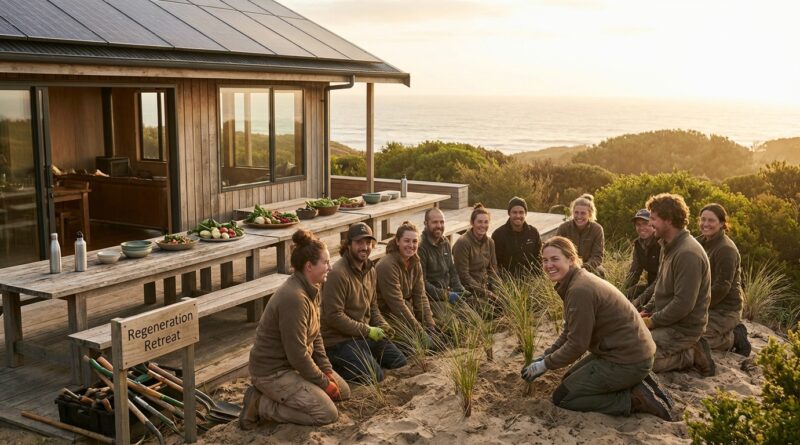
From Offsite To Regeneration Retreat: Why 2026’s Smartest Teams Now Leave Places Better Than They Found Them
You can feel the tension in the planning meeting. Leadership wants somewhere impressive. Employees want a reason to spend days away from home that feels bigger than bad coffee, hotel carpet, and slides they could have watched on Zoom. And if you are the one organizing it, you are probably carrying a quiet extra worry. How do you justify the cost, the flights, and the climate guilt without sounding like you are papering over it with a nice-sounding ESG paragraph?
That is why more teams are shifting from the old offsite model to something smarter. They are building retreats designed to leave a place, and the people in it, better than before they arrived. That is the heart of regenerative corporate retreat ideas. It is not about adding one volunteer hour to a luxury trip and calling it good. It is about choosing the venue, partners, schedule, food, transport, and team activities so the whole event has a useful footprint, not just a smaller one. Done right, it gives employees a real reason to say yes, and gives execs a much stronger story than “we needed face time.”
⚡ In a Hurry? Key Takeaways
- A regenerative retreat is not just less harmful. It is planned to create measurable local benefit for the place hosting your team.
- Start with venue and supplier choices, then add two or three tightly scoped projects your team can actually finish and measure.
- This approach helps with employee buy-in, budget approval, and the optics of business travel in a more climate-aware era.
Why the old offsite formula feels stale now
For years, the template was simple. Pick a nice destination. Book meeting rooms. Add a team dinner, maybe an activity, and call it culture.
That still works on paper. It works a lot less well emotionally.
People now ask sharper questions. Why this trip? Why this location? Why now? Why are we flying across the country to talk about priorities that could have been handled in a half-day workshop?
Those are fair questions. And if the answer is basically “because it is good for morale,” that can land badly when budgets are tight and employees are thinking about climate, family time, and burnout.
What a regenerative retreat actually means
Think of it as the next step after “sustainable.” Sustainable tries to reduce damage. Regenerative aims to improve the system around you.
For a company retreat, that means asking a different planning question. Not just, “How do we make this trip less wasteful?” Ask, “How do we make this trip useful to the host community, visible in its outcomes, and meaningful for employees?”
The simple test
If your retreat disappeared from the calendar tomorrow, would the host location lose anything of value besides room revenue?
If the answer is no, you are probably still planning a standard offsite.
If the answer is yes because local workers were trained, a habitat project moved forward, a school maker space got upgraded, or a community supplier earned long-term business, you are getting into regenerative territory.
Why 2026’s smartest teams are moving this way
Because the pressure is coming from both sides.
Executives need business travel to feel defensible again. Employees need it to feel worth it. Procurement teams want fewer vague promises. HR wants culture-building that is not performative. Finance wants proof the spend did something beyond produce a group photo.
Regenerative corporate retreat ideas work because they answer all of those concerns at once. They turn a retreat into a designed experience with outputs, not just memories.
Start with the venue, not the activity list
Most teams do this backward. They start with destination buzz, then patch in a “give back” session later.
Better move. Start with places already doing the hard stuff well.
Look for venues that already run responsibly
Your best shortlist usually includes venues that:
- Run on renewable energy, or can prove a high share of clean power
- Track water use and waste diversion
- Source food locally and seasonally
- Use refill systems instead of single-use bathroom plastics and bottled water
- Hire locally and invest in training, apprenticeships, or community partnerships
This matters because if the venue itself is doing the basics right, your team does not have to build everything from scratch.
Watch out for the glossy brochure problem
A lot of properties sound green. Fewer can show numbers.
Ask for specifics. What percentage of energy is renewable? How much waste was diverted from landfill last year? What percentage of staff are local hires? Do they publish impact data? If a sales rep gets vague fast, that tells you something.
Choose suppliers that strengthen the local economy
This is where many retreat plans either become meaningful or stay cosmetic.
The airport transfer company, the caterer, the photographers, the guides, the workshop hosts, the gift bag vendors. Every one of these choices sends money somewhere.
If you pick suppliers with local hiring, fair pay, and training programs, your retreat starts helping people before your team even arrives.
Good questions to ask suppliers
- How many of your staff are hired locally?
- Do you offer paid training or career development?
- What local organizations do you work with regularly?
- Can you help us design a team activity with a real outcome, not just a photo op?
Build two or three micro-projects, not one giant vague mission
This is probably the most useful shift of all.
Do not try to save the world in one retreat. Pick two or three small, concrete projects that match your team size, skill set, and time.
Specific beats dramatic. Every time.
Examples of regenerative corporate retreat ideas that actually work
- Habitat restoration sprint: Work with a local environmental group on one defined area. Example: restore 500 square meters of coastal planting, with GPS-marked follow-up reporting.
- School or nonprofit tech upgrade: Your IT and ops staff help inventory, refurbish, and set up donated devices, plus basic training for recipients.
- Local workforce mentoring: Team members run targeted sessions for hospitality students, junior coders, or small business owners, based on skills your company already has.
- Food systems support: Spend half a day with a local farm or food cooperative on irrigation fixes, packing systems, signage, or volunteer labor tied to a known short-term need.
- Trail, watershed, or beach recovery: Work with a conservation partner that can define outputs clearly, such as waste removed, native species planted, or erosion barriers installed.
What makes a good micro-project
It should be:
- Small enough to complete or meaningfully advance in one session
- Led by a real local partner
- Useful even if your team never returns
- Measurable in plain language
Make the retreat agenda feel worth the trip
Here is the balancing act. You still need strategy time. You still need relationship-building. This is not a week-long volunteer camp with a budget code.
The best regeneration retreats mix three things well:
- High-value business work that truly benefits from being in person
- Human connection that is more relaxed and less staged
- Practical contribution with a measurable local result
If one of those is missing, the trip feels off.
A better agenda shape
Try this:
- Day 1: Arrival, shared meal, short framing session on why this retreat exists and what the impact goals are
- Day 2 morning: Strategy workshops and decision-making sessions that actually need a room
- Day 2 afternoon: One micro-project with a local partner
- Day 3 morning: Team problem-solving, roadmap work, manager roundtables
- Day 3 afternoon: Second micro-project or skill-sharing session
- Final session: Review business outcomes and local outcomes together
That last part is important. Put both kinds of results on the same screen. It shows employees this was designed thoughtfully, not bolted together at the end.
Measure outcomes like you would any serious project
If you cannot explain the result clearly, people will assume it was mostly branding.
So decide the metrics before anyone packs a bag.
Useful metrics to track
- Percentage of attendees traveling by rail or shared transport where possible
- Venue energy mix and waste reduction data
- Share of event spend with local vendors
- Number of local workers trained or paid through retreat-related work
- Micro-project outputs, such as trees planted, devices deployed, students mentored, or kilos of waste removed
- Employee feedback on whether the retreat felt worth the travel
The point is not to drown everyone in a dashboard. The point is to be able to say, simply and honestly, “Here is what this retreat changed.”
Do not hide the story. Tell it properly.
A lot of teams get shy here because they do not want to sound self-congratulatory. Fair enough. But if you never explain the design choices, employees may miss the point entirely.
Tell the story with the same care you use for a launch plan.
What to share internally
- Why this destination was chosen
- What standards the venue met
- Which local suppliers were used and why
- What the micro-projects were meant to achieve
- What actually happened, with numbers and photos
- What you would improve next time
That last item matters. Employees trust honesty more than polished perfection.
Common mistakes to avoid
1. Flying far for a tiny impact project
If the trip footprint is huge and the local outcome is tiny, people notice. Sometimes the most responsible answer is a closer destination, even if it is less glamorous.
2. Picking projects your team is not qualified to do
Good intentions can create extra work for local groups. Follow their lead. If they need funding, logistics support, or skilled mentoring more than manual labor, do that instead.
3. Treating the “regenerative” part like entertainment
This is not a themed activity slot between cocktails and karaoke. It needs planning, local input, and follow-through.
4. Promising long-term impact with no long-term relationship
If possible, choose partners you can support beyond one retreat. Even small repeat commitments are better than one dramatic day and silence after.
How to sell this idea to leadership
If your exec team mainly hears “more planning complexity,” they may resist.
So frame it in business terms they already care about.
- Talent: Employees are more likely to support travel when the purpose is clear and values-aligned.
- Brand: A well-designed retreat story is stronger than generic ESG messaging.
- Risk: It reduces the chance of the trip feeling wasteful or out of touch.
- Spend quality: Money goes toward outcomes, not just appearances.
- Culture: Shared work with visible results creates better memories than another trust fall or cocktail mixer.
How to sell it to employees
Be direct. Say what this retreat is for. Say why it could not be remote. Say what the local impact goals are. Say what is optional and what is expected.
People do not need hype. They need a reason.
At a Glance: Comparison
| Feature/Aspect | Details | Verdict |
|---|---|---|
| Traditional offsite | Focuses on meetings, morale, and destination appeal, with little proof of wider benefit | Easy to plan, harder to justify |
| Sustainable retreat | Cuts waste and emissions where possible through better venue, food, and transport choices | Good baseline, but may still feel passive |
| Regenerative retreat | Builds measurable local value through venue selection, supplier choices, and specific community-linked projects | Best fit for teams that want purpose, proof, and better optics |
Conclusion
Business travel is back. But people are not looking at it the way they did in 2019. They want purpose, not just PowerPoints in a prettier room. That is why regenerative corporate retreat ideas are catching on. They help you move from vague ESG talk to practical design choices. Pick venues already running on renewables. Choose suppliers that hire and train locally. Build two or three tightly scoped projects with measurable outcomes. Then tell that story clearly, the same way you would explain a product roadmap or a launch.
Do that, and the retreat stops feeling like a guilty expense dressed up as culture. It becomes something far more useful. Employees have a real reason to go. Leaders have a stronger case for the budget. And your team comes home talking not just about where they went, but what they actually improved while they were there.