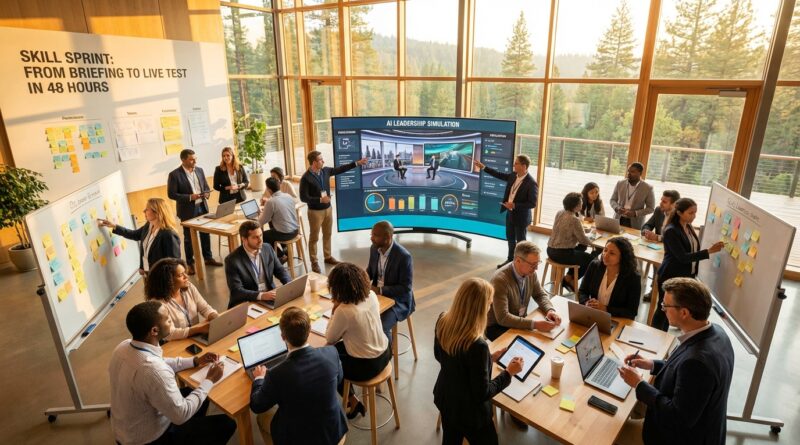
From Offsite To Skill-Sprint Retreat: Why 2026’s Smartest Teams Turn Getaways Into Live-Upgrading Labs
You can feel the problem before the retreat even starts. Someone says “team offsite,” and half the room pictures trust exercises, a keynote nobody remembers, and a slide deck about values that changes nothing by Monday. That frustration is real. Leaders are being asked to fix culture, improve collaboration, build AI confidence, and grow managers, all while keeping budgets tight and attention spans even tighter. A standard retreat cannot carry that load anymore. That is why the smartest teams are moving toward the post pandemic corporate retreat skill sprint. Instead of treating learning like a breakout-room extra, they build the whole gathering around one urgent skill and one practical outcome. The goal is simple. People leave having practiced something they actually need, with a shared language, a clear next step, and proof that the time away from work was not a nice-to-have. It was working time, just in a better format.
⚡ In a Hurry? Key Takeaways
- A Skill-Sprint Retreat works best when you pick one business-critical skill, then design the whole offsite around practicing it.
- Start with a tight arc. Kickoff, live practice, team application, and a 30-day follow-up plan that managers can actually track.
- This format protects budget and attention because it cuts filler, reduces burnout, and gives leaders a clear answer to “What changed on Monday?”
Why the old retreat format is wearing people out
Most retreats try to do too much. A little inspiration. A little strategy. A little bonding. A panel. A workshop. A dinner. Maybe a scavenger hunt. On paper it looks balanced. In real life it often feels blurry.
People come back with tote bags, a few photos, and a notebook full of ideas they never use. That is not because employees are cynical. It is because the event was not built for transfer. It was built for experience.
That difference matters. Experience can be fun. Transfer changes behavior.
Right now, companies need transfer. They need managers who can run better one-on-ones. Teams that can work across time zones without chaos. Staff who know when and how to use AI tools responsibly. Those are skills, not vibes.
What a Skill-Sprint Retreat actually is
A Skill-Sprint Retreat is a short, focused offsite built around one urgent capability. Not five. One.
Think of it as a live-upgrading lab for your team. You pick a skill that matters now, then design the retreat so people learn it, practice it, and apply it to real work before they leave.
The basic formula
One theme. One skill. One clear arc.
For example:
- Theme: Better hybrid collaboration
- Skill: Running faster, clearer decision meetings
- Arc: Learn the method, practice in small groups, use it on a real business issue, then commit to using it for 30 days
That is a completely different energy from a retreat where learning gets squeezed between lunch and karaoke.
Why this format fits 2026 better than a classic offsite
Work has changed. Teams are more distributed. Managers are stretched. People are already buried under micro-courses, Slack pings, and mandatory training links they never finish. Adding more content is not the answer. Giving people one shared, live, memorable learning moment often is.
The post pandemic corporate retreat skill sprint works because it respects three realities.
1. Attention is limited
People do better with a narrow target. If the retreat promises leadership development, AI readiness, culture repair, cross-functional trust, and innovation, it usually lands none of them well.
2. Practice beats passive listening
Most adults do not need another talk about communication. They need a chance to try a better meeting structure, give feedback in a safe room, or use a new AI workflow on an actual task.
3. Leaders need evidence
Executives are asking tougher questions about travel and event spend. Fair enough. A Skill-Sprint Retreat gives you a measurable story. What skill did we teach? Who practiced it? What changed after 30 days?
If your company is also under pressure to tie gatherings to a larger purpose, there is a helpful parallel in From Offsite To Impact Retreat: Why 2026’s Smartest Teams Tie Every Gathering To A Real-World Cause. The core idea is similar. Stop treating the event as a standalone perk. Connect it to a real outcome people can see.
How to choose the right skill for your retreat
This is where many teams get stuck. They pick something broad like “leadership” and then wonder why the agenda gets messy.
Instead, ask a simpler question. What is one behavior, if more people did it well next month, that would noticeably improve work?
Good choices for a skill sprint
- Giving clear feedback
- Running better hybrid meetings
- Using AI tools for first drafts and summaries
- Making faster cross-functional decisions
- Coaching new managers
- Handling conflict early instead of late
Less helpful choices
- Innovation mindset
- Culture transformation
- Future readiness
Those may be important themes, but they are too fuzzy to train in one retreat. Use them as the banner, not the skill.
The four-part structure that makes it stick
If you want this to work, build the retreat like a mini product launch. Not a conference.
1. Pre-work that takes 15 minutes, not 90
Send one short primer before the retreat. Maybe a quick survey, a three-minute video, or a simple self-check. Keep it light. The point is to give people context, not homework dread.
Ask things like:
- Where does this skill break down today?
- What situations make it hard?
- What would “better” look like in your actual role?
2. A kickoff that explains why this matters now
Open with the business case in plain English. Not “we value continuous learning.” Try “Our projects stall because decisions bounce between teams for days. Today we are going to fix one part of that.”
Adults engage when they know the problem they are solving.
3. Live practice on real work
This is the heart of the retreat. Keep theory short. Move quickly into scenarios, role-play, case work, and team exercises built around real situations.
If the skill is AI fluency, do not spend an hour defining AI terms. Give teams a common use case. Draft a client summary. Clean up meeting notes. Build a first-pass FAQ. Then compare outputs and talk through risks.
If the skill is better collaboration, use a current cross-team challenge as the practice ground. Let people work on something that matters.
4. A Monday plan with owners and follow-up
This is the part most retreats skip. Before people leave, lock in what happens next.
- What new behavior starts this week?
- Who owns it?
- What tool or template supports it?
- When will you check progress?
Think 30 days, not 12 months. Short loops win.
What this looks like in the real world
Let’s say your company has a hybrid team problem. Meetings run long. Decisions are muddy. People in the room dominate while remote staff go quiet.
A classic retreat might include a panel on culture, a workshop on collaboration styles, and a keynote on the future of work.
A Skill-Sprint Retreat would do this instead:
- Pick one skill: inclusive decision-making in hybrid meetings
- Teach one method: a repeatable meeting framework with clear roles and time boxes
- Practice it live with realistic scenarios
- Apply it to two real decisions the company already needs to make
- Send teams home with a meeting template and manager check-in plan
Now the retreat is not a break from work. It is a better way to do work together.
How to keep it from turning into training theater
There is a trap here. Once leaders hear “skill sprint,” they may try to cram in every capability gap the company has. Resist that urge.
Keep these guardrails in place
- One primary skill only
- No session longer than needed to keep people active
- At least half the time spent doing, not listening
- Use company examples, not generic case studies
- End with manager reinforcement, not just participant enthusiasm
Also, cut the filler that nobody misses. If an activity does not support the skill, the relationship-building, or the business outcome, it probably does not need to be there.
How HR and ops leads can sell this internally
If you are pitching this idea upward, do not sell it as a more exciting retreat. Sell it as a focused performance investment.
Use language executives understand
- We are concentrating spend on one skill tied to a current business need.
- We will measure adoption after 30 days.
- This reduces wasted agenda time and makes the offsite easier to justify.
- The retreat becomes a pilot for how we handle live learning across the company.
That last point matters. A good Skill-Sprint Retreat can become a template. Once you prove the format with one skill, you can repeat it with another team or another capability.
Measurement does not need to be complicated
You do not need a giant analytics dashboard. You need a few practical signals.
Track things like:
- Attendance and participation in practice sessions
- Confidence before and after the retreat
- Manager-reported behavior change after 30 days
- Use of the new tool, template, or process introduced at the retreat
- A business metric connected to the skill, if possible
For example, if the skill was better meeting decisions, you might track decision turnaround time or the number of meetings needed to close an issue. If the skill was AI drafting, you might look at time saved on recurring tasks.
The point is not perfection. It is credibility.
Budget-friendly ways to do it well
A Skill-Sprint Retreat does not have to mean a fancy resort and custom swag. In fact, a tighter format often works better in a simpler setting.
Smart ways to keep costs under control
- Use a one-day or day-and-a-half format instead of stretching to three days
- Pick one outside expert, not five speakers
- Use internal leaders as coaches for breakout sessions
- Build around one shared workbook or digital template set
- Choose a venue that supports working sessions, not just presentations
People rarely complain that a retreat had too little swag. They do complain, quietly, when it wastes their time.
At a Glance: Comparison
| Feature/Aspect | Details | Verdict |
|---|---|---|
| Traditional offsite | Often mixes culture talks, presentations, and team bonding without one practical learning target. | Good for morale, weak for measurable behavior change. |
| Skill-Sprint Retreat | Built around one urgent skill with live practice, real work application, and short-term follow-up. | Best choice when leaders need proof that the retreat improved how people work. |
| Post-retreat impact | Traditional events often end with inspiration. Skill sprints end with owners, templates, and a 30-day plan. | Skill sprints are far easier to defend when budgets are tight. |
Conclusion
Teams are drowning in change, microlearning links, and competing priorities. Most corporate retreats still treat learning as a side dish when it should be the main meal. A Skill-Sprint Retreat flips that. It gives culture leaders and operations teams a format they can actually ship this quarter. One theme, one skill, one tight arc from kickoff to real-world application. That makes it practical, not preachy. It also respects budget pressure and attention fatigue by cutting the fluff and focusing on what people will use right away. If you are trying to answer the CEO’s favorite question after any retreat, which is “What changed on Monday?”, this is the clearest blueprint I have seen. Keep it short. Keep it focused. Make people practice. Then give them a reason, and a system, to keep using the skill once they are back at work.