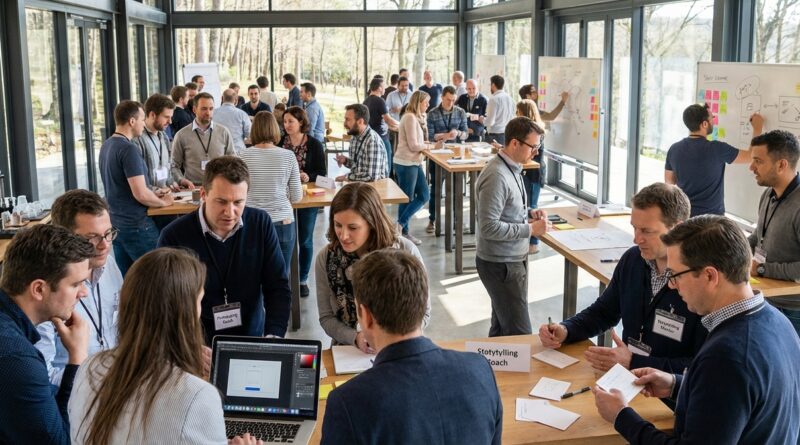
From Offsite To Skillshare Studio: Why 2026’s Sharpest Retreats Turn Employees Into Each Other’s Teachers
You can feel the eye-roll coming the moment the retreat invite lands. Another flight. Another hotel. Another round of slide decks that could have been a PDF. That frustration is real, especially now that teams are scattered, budgets are tighter, and nobody wants to spend company money on a nice backdrop with no real payoff. The smartest retreats in 2026 are fixing that by changing the format completely. Instead of hiring outside speakers to talk at people, they ask employees to teach each other what they actually know. One product manager runs a lab on roadmap writing. A sales lead teaches objection handling. An ops specialist shows everyone the automation that saves five hours a week. Suddenly the retreat stops being a staged event and starts being useful. People come home with skills they can use on Monday, a few new coworkers they trust, and a much clearer reason the trip was worth it.
⚡ In a Hurry? Key Takeaways
- A post pandemic corporate retreat peer to peer learning model works better because employees leave with practical skills, not just inspiration.
- Start by building short employee-led skill labs around real workflows people use every week.
- This format makes retreat spending easier to defend because you can measure what people learned and what changed after the trip.
Why the old retreat model feels tired
For a while, just getting everyone in the same place again felt like enough. It was exciting. It felt overdue. But that novelty has worn off.
Now leaders have a harder question to answer. If we are flying people across the country or across an ocean, what are they actually getting from it?
“Team bonding” is not a bad answer. It is just not a complete one anymore. Finance wants a clearer reason. Remote employees do too. They are giving up time, energy, and often family routines to show up. They want the trip to matter.
That is why the best retreat design is shifting from passive content to active learning. Less keynote. More workshop. Less executive monologue. More peer-to-peer practice.
What a Skillshare-style retreat actually looks like
Think of it as a company retreat built like a maker fair for skills.
Instead of filling the agenda with top-down presentations, you ask employees across teams to host short, practical sessions. Not theory-heavy talks. Not “thought leadership.” Real, hands-on labs.
Examples that make sense fast
A designer teaches non-designers how to give feedback that is clear and useful. A recruiter shows managers how to run a better interview. A customer success lead teaches account handoff notes that do not leave sales and support confused. An engineer walks through a simple prompt library for internal AI tools. A finance partner explains how to build a project proposal that gets approved faster.
These are not random extras. They are the hidden operating system of the company.
Why employees listen differently
People often trust a coworker faster than an outside expert. That is because the coworker knows the actual mess. They know the real tools, the real customers, the real deadlines, and the real bottlenecks.
When someone says, “Here is the template I use every week, and here is why it saves me time,” that lands. It feels tested. It feels immediate. It feels worth copying.
Why this works especially well after the pandemic
The post-pandemic workplace changed what employees expect from in-person time. If people can do status updates on Zoom, they do not want to travel just to repeat them in a ballroom.
What they cannot get as easily through a screen is trust, practice, and those useful side conversations that happen when two teams finally understand how each other work.
A post pandemic corporate retreat peer to peer learning model uses in-person time for exactly that. It gives people space to teach, ask, test, and build together.
It respects attention
Most workers are overloaded. Long presentations feel expensive, mentally and financially. A 45-minute skill lab with a worksheet, a live demo, and time to practice feels much more fair.
It respects distributed teams
When a team is spread across time zones, people often know each other’s job titles better than each other’s strengths. Skill labs fix that. They reveal who knows what. That matters long after the retreat ends.
The business case is stronger than it looks
At first, an employee-led retreat can sound softer than a traditional conference-style offsite. In practice, it is often easier to justify.
You are using talent you already pay for
Your company already has experts. They may not have “Head of Learning” in their title, but they know how things get done. Turning that knowledge into sessions is cheaper than buying a stack of generic talks.
You can point to concrete outcomes
This is the big one. A good retreat should create artifacts, not just memories.
That might include:
- shared playbooks
- new templates
- cross-team workflow maps
- recorded demos
- lists of approved tools and best practices
- pilot groups for new projects
When the trip ends, leaders can say, “Here is what we built. Here is what people learned. Here is what changed.” That is much stronger than “morale seemed better.”
How to design one without turning it into chaos
This part matters. “Let employees teach each other” sounds simple. It is not automatic. You need some structure so the retreat feels useful instead of messy.
1. Pick topics based on Monday value
Ask one question when choosing sessions. Will this help someone do their job better next week?
If the answer is vague, cut it. If the answer is immediate, keep it.
Good topics usually fall into a few buckets:
- communication skills
- tool training
- process shortcuts
- customer insight
- manager coaching
- cross-team handoffs
2. Keep sessions short
No one needs a 90-minute lecture from Greg in RevOps, no matter how smart Greg is.
A better format is 30 to 45 minutes. Ten minutes of context. Fifteen minutes of demo. Fifteen minutes of practice. Five minutes for questions.
3. Coach the teachers
Being good at a job and being good at teaching are not the same thing. Give session leaders a simple template.
- What problem does this solve?
- Who is this for?
- What should people be able to do by the end?
- What file, template, or checklist can they take home?
That little bit of prep makes the whole retreat feel more polished.
4. Mix labs with social time
This does not mean turning the retreat into school. People still want dinners, walks, and the kind of casual conversations that build trust. The trick is balance.
Use mornings for practical labs, afternoons for breakouts or project sprints, and evenings for actual human time.
What employees gain that slide decks never deliver
Slide decks are good at broadcasting. They are bad at transfer. Most people forget them almost immediately.
Teaching each other is different because it creates ownership. If I learn a method from a coworker and try it in the room, I am much more likely to use it later. If I teach something myself, I become even more invested in improving it.
Credibility goes up
Peer-led sessions show expertise that might otherwise stay hidden. That changes internal relationships in a good way. Suddenly the person from legal is not just “the compliance blocker.” She is the person who taught the whole company how to review contracts without slowing deals down.
Collaboration gets easier
When people understand each other’s tools and constraints, they stop making lazy assumptions. Work gets smoother. Fewer handoff errors. Fewer duplicate efforts. Less frustration.
Common mistakes to avoid
There are a few traps here, and they are easy to fall into.
Do not make every session optional
A little choice is good. Too much choice creates FOMO and thin attendance. Build a core track everyone takes, then offer electives.
Do not only ask extroverts to teach
Some of the most useful internal experts are not the loudest people in the room. Managers should nominate strong operators, not just confident presenters.
Do not skip follow-through
If the retreat ends and all the knowledge stays in a notebook, you wasted the momentum. Record what you can. Save templates. Create a shared hub. Assign owners to keep the best ideas moving.
How to measure whether it worked
This is where many retreats fall apart. They stop at vibes.
Vibes matter. They just should not be the only metric.
Measure a few practical things
- How many employee-led sessions were delivered
- How many playbooks, templates, or demos were created
- Which sessions people said they used within 30 days
- What cross-team projects started at the retreat
- What workflows got faster or clearer after the event
You do not need a giant analytics system. A simple 30-day and 90-day check-in can reveal a lot.
Look for signs of reuse
The best sign of success is when material from the retreat keeps showing up later. New hires use the templates. Managers repeat the methods. Teams adopt the checklists. That means the retreat created something durable.
Why 2026 is the right time for this shift
Companies are under pressure from both sides right now. Employees want in-person time to feel meaningful. Leaders need proof that travel is worth the cost. Traditional offsites often satisfy neither group.
A Skillshare-style retreat lands in the sweet spot. It feels human, because people connect face to face. It feels practical, because they leave with tools. And it feels easier to defend, because the value is visible.
That is why this idea is catching on. It is not just a nicer retreat format. It is a smarter use of limited time together.
At a Glance: Comparison
| Feature/Aspect | Details | Verdict |
|---|---|---|
| Traditional retreat agenda | Often built around executive presentations, broad themes, and limited hands-on practice. | Good for alignment, weak for skill transfer. |
| Peer-to-peer skill labs | Employees teach tested workflows, tools, and habits others can use right away. | Best for practical value and cross-team trust. |
| Return on retreat spend | Measured through new playbooks, workflow changes, and collaborations that continue after the event. | Much easier to justify to finance and skeptical staff. |
Conclusion
Retreat fatigue is real, and you are not imagining it. People are tired of expensive gatherings that look great in photos and disappear from memory by Tuesday. Leaders still need in-person time, but now they need it to do real work. That is why a post pandemic corporate retreat peer to peer learning model makes so much sense. It turns the talent you already have into the curriculum, helps employees trust each other faster, and sends everyone home with concrete skills they can actually use. Just as important, it makes the trip easier to defend. People can see what they will learn, what they will teach, and what the company gets back. In a year when everyone talks about engagement but few can prove it, employee-led skill labs offer something refreshingly solid. New workflows. Shared playbooks. Better cross-team habits. In other words, a retreat that keeps paying off long after everyone is back on Zoom.