From Slide Decks to Story Circles: Why 2026’s Smartest Corporate Retreats Are Built Around One Shared Narrative
You can spend six figures on a retreat and still send people home with nothing but photos of the ropes course and a faint headache from the open bar. That is the real frustration leaders are dealing with right now. The schedule looks full. The venue looks great. The activities are “engaging.” But the whole thing feels stitched together, like a playlist made by committee. In hybrid companies especially, that is a costly miss. People are not flying in for more slide decks. They are flying in to answer a deeper question: who are we together now? A narrative driven corporate retreat works because it gives the event an emotional throughline. Instead of cramming in a keynote, wellness hour, team game, fireside chat, and dinner with no clear link, you build every part around one shared transformation. People do not just attend. They move through a story together, and that is what they remember when they get home.
⚡ In a Hurry? Key Takeaways
- A narrative driven corporate retreat gives your offsite one clear purpose, so people remember the change, not just the agenda.
- Start by choosing a single transformation question, then shape sessions, spaces, meals, and rituals around that story.
- This approach cuts waste and burnout because it removes random filler and makes in-person time feel honest, useful, and human.
Why the old retreat format is starting to feel hollow
Most retreat planning still works like packing a suitcase in a panic. Someone adds strategy. Someone else adds bonding. HR adds wellness. Leadership wants inspiration. Sales wants celebration. Before long, the agenda is packed with decent ideas that do not belong to the same story.
That is why so many retreats feel busy but strangely forgettable. The team may have fun. They may even say it was “great.” But ask them two weeks later what changed, and the answers get fuzzy fast.
This matters more in 2026 because the emotional backdrop of work has changed. Hybrid teams are already short on casual connection. People are tired of performative culture moments. Burnout is no longer a private issue. It is a group condition. So when a company finally gets everyone in one place, employees want more than face time. They want meaning.
What a narrative driven corporate retreat actually means
This is not about turning your offsite into a theater production. It is much simpler than that.
A narrative driven corporate retreat starts with one shared arc. You decide what story the team is moving through together. Maybe it is from fragmentation to trust. Maybe it is from survival mode to renewed focus. Maybe it is from “we work in separate lanes” to “we solve problems as one company.”
Once that arc is clear, everything else gets easier.
The retreat has a beginning, middle, and end
The beginning names the truth. What is hard right now? What has changed? What are people carrying?
The middle creates movement. This is where the team talks honestly, works through tension, experiments, reflects, and reconnects.
The end marks a shift. Not a vague high. A real one. People leave knowing what changed in the room and what they are taking back to work.
The agenda stops feeling random
When the story is clear, every session has a job. The opening keynote is not just a speech. It frames the challenge. The workshop is not just an activity. It helps people make sense of the change. Even the dinner setup can support the theme, whether that means mixing departments, creating quieter circles, or making room for storytelling instead of forced entertainment.
Why this works better for hybrid and anxious teams
Remote and hybrid work did not kill culture. It changed where culture lives. A lot of it now lives in assumptions, Slack tone, meeting habits, and how safe people feel speaking up from a square on a screen.
That means an offsite has to do more than gather bodies in a nice location. It has to rebuild shared context.
A narrative driven corporate retreat helps because it gives people a common language. Instead of saying, “remember that retreat in Denver,” they remember, “that was when we got honest about burnout,” or “that was when we stopped acting like five separate teams.”
That is useful. It travels back into daily work.
How to build one without making it feel cheesy
This is where some planners get nervous. “Shared narrative” can sound soft or overly dramatic. It does not have to be either. Think of it as design discipline. You are picking one point of change and refusing to clutter it.
1. Choose one transformation question
Not ten. One.
Good examples:
- How do we rebuild trust after a year of nonstop change?
- What does collaboration look like now that we are hybrid by default?
- How do we move from burned out to sustainably ambitious?
If the retreat cannot answer that question in a believable way, it should not be on the agenda.
2. Name the tension honestly
People can smell fake positivity a mile away. If the company has been through layoffs, reorgs, leadership turnover, or growth chaos, say so. You do not need to be bleak. You do need to be real.
The strongest retreat stories start with an accurate picture of where the team is now. Otherwise the whole thing feels like branding.
3. Design sessions as chapters, not blocks
Most agendas read like airport departure boards. 9:00 keynote. 10:00 breakout. 11:00 coffee. Noon lunch.
Instead, ask what each chapter needs to do. One chapter may surface what people miss in hybrid work. Another may help teams make commitments. Another may create fellowship through shared meals, walks, or quiet reflection instead of more talking.
That word, fellowship, matters. Wellness in retreats has shifted. People are less impressed by spa-day extras and more interested in whether the event helps them feel human with one another.
4. Let the space support the story
Venue layout is not a detail. It is part of the message.
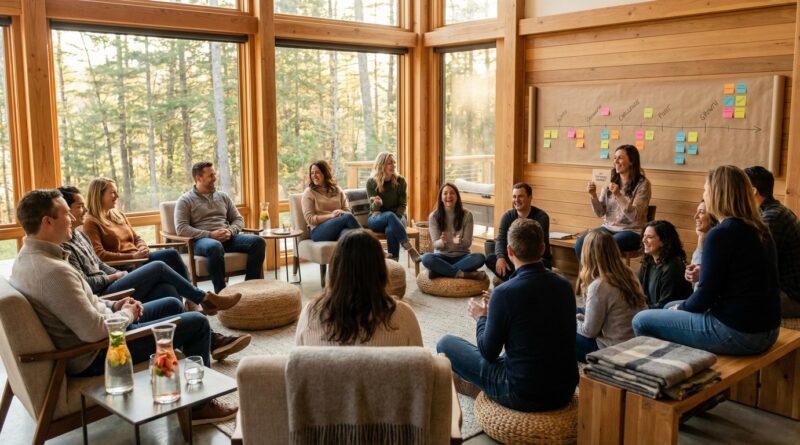
If your retreat is about openness, but every important conversation happens from a stage facing rows of chairs, the format undercuts the goal. Story circles, smaller lounges, shared tables, outdoor walking discussions, and informal corners all help people have the kinds of conversations hybrid work often squeezes out.
5. End with a visible shift
Do not close with “thanks everyone” and airport transfers. Mark the change.
That might be a shared statement written by the group. It might be team commitments posted in the office or intranet. It might be leaders answering hard questions live and putting dates next to promises. The point is simple. People should be able to point to what is different now.
What to cut from your 2026 retreat
If you want a stronger retreat, start by removing things.
Cut the activity that has no job
Not every fun thing is wrong. But if the zipline, cocktail class, or mindfulness session does not support the core transformation, it is just expensive scenery.
Cut the keynote pileup
Executives often assume more stage time means more alignment. Usually it means more sitting. Keep the voices that move the story forward. Drop the rest.
Cut forced vulnerability
People do not build trust because they were told to share something personal in a breakout room with strangers. Trust grows when the environment feels safe, the purpose is clear, and leaders model honesty without oversharing.
What a strong retreat story can look like
Here are three practical narrative arcs culture owners can use.
From scattered to shared
Best for companies that grew fast, merged teams, or changed structure. The retreat goal is to help people understand how their work connects and what being “one company” really means now.
From drained to steady
Best for teams dealing with burnout. The retreat focuses on restoring energy through realistic work design, better team habits, and moments of genuine connection, not just pampering.
From polite to honest
Best for organizations where people are getting along on the surface but avoiding the real conversations. The retreat creates room for truth, repair, and clearer expectations.
How to know if your retreat is working
Forget the smile sheets for a moment. “Great venue” is not the same as “valuable retreat.”
Ask these questions instead:
- Can attendees describe the retreat’s purpose in one sentence?
- Did people have conversations they could not have had over Zoom?
- Is there a shared phrase, commitment, or decision people are still using afterward?
- Did the event create clarity, not just energy?
- Can managers point to one behavior that changed because of the retreat?
If the answers are yes, then the event did more than entertain. It realigned.
At a Glance: Comparison
| Feature/Aspect | Details | Verdict |
|---|---|---|
| Traditional retreat agenda | Mix of keynotes, activities, meals, and wellness add-ons with no clear emotional or strategic thread. | Often enjoyable in the moment, but easy to forget. |
| Narrative driven corporate retreat | Built around one transformation, with each session and space designed to move the team through it together. | Better for alignment, memory, and lasting culture change. |
| Wellness and connection | In a strong format, wellness supports fellowship and recovery instead of acting as decorative programming. | More authentic, and more useful for burned-out hybrid teams. |
Conclusion
The sharpest conversations around post-pandemic retreats keep landing in the same place. People want connection that feels real, not staged. They want authenticity, not corporate theater. They want relief from burnout, not a glossy schedule with yoga bolted on. That is why a narrative driven corporate retreat is worth serious attention for 2026. It gives you a practical way to strip out the gimmicks, choose one change that matters, and design the whole experience so people live through that change together. From the room setup to the closing exercise, every piece has a reason. And when that happens, your offsite stops being an expensive meeting in a nicer zip code. It becomes a landmark moment your team can actually carry back into work.