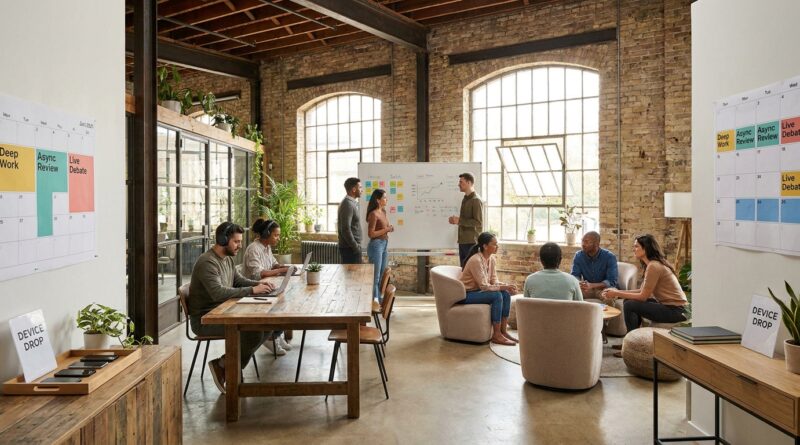
From Offsite To Async-Onsite Retreat: Why 2026’s Smartest Teams Now Design Gatherings Around Deep Work, Not Schedules
You can feel the dread as soon as the retreat invite lands. Three days away from home. A packed agenda. Back-to-back sessions that somehow manage to be more tiring than the meetings you were already trying to escape. For teams that spent the last few years building better async habits, that old offsite model feels like a step backward. It wrecks focus, fills every hour, and often sends people home with a bigger pile of follow-up work than they had before they left.
That is why the smartest teams are moving to the async-first corporate retreat. The idea is simple. Stop treating in-person time like an all-day calendar block that must be stuffed with talking. Start treating it like a scarce resource. Use writing before the retreat to cut meeting time. Protect quiet work blocks during the retreat so people can think. Save face-to-face energy for the stuff that is actually hard to do on Slack or Zoom, like trust-building, debate, messy decisions, and honest alignment. Done right, an onsite should support deep work, not bulldoze it.
⚡ In a Hurry? Key Takeaways
- An async-first corporate retreat works best when live time is reserved for alignment, trust, and hard conversations, not endless status updates.
- Send written briefs in advance, shorten sessions, and block real quiet work time on the retreat calendar.
- This approach protects deep work, cuts meeting fatigue, and makes the trip feel useful instead of expensive and draining.
Why the old offsite model stopped working
Most knowledge teams do not work like it is 2019 anymore. They write more. They record updates. They comment in docs. They work across time zones. They build systems so not every decision needs a meeting.
Then retreat season arrives, and suddenly everyone is shoved back into a hotel ballroom for eight straight hours of talking.
That mismatch is the real problem. Not travel. Not even cost. It is the collision between modern async habits and old-school event design.
A traditional offsite assumes that if you have everyone in one place, every minute must be scheduled. But in practice, that often creates three headaches.
1. It destroys focus
People leave with no time to process what they heard, no space to write, and no chance to turn ideas into actual work.
2. It rewards talking over thinking
The loudest person in the room can shape the day. The quieter people, who may have the best ideas, get less room to contribute.
3. It creates fake progress
A full agenda can feel productive while producing very little. If every topic gets 45 minutes and a slide deck, you may end up with motion, not decisions.
What an async-onsite retreat actually is
An async-onsite retreat does not mean people sit alone in hotel rooms ignoring each other. It means the retreat is designed around the way modern teams already work best.
Think of it this way. Async handles information transfer and first-pass thinking. Onsite time handles the human stuff and the thorny stuff.
That split matters.
Before the retreat, people read briefs, add comments, answer prompts, and review proposals. During the retreat, they use live time for discussion that benefits from tone, body language, trust, and speed. They also get protected quiet time to digest, draft, or build.
If that sounds like a healthier version of the offsite, it is. A good companion read is From Offsite To Async Retreat: Why 2026’s Sharpest Teams Dismantle The All-Day Agenda, which gets at the same core shift. The best teams are not anti-onsite. They are anti-wasting onsite time.
The rule of thumb: Bring people together for what is hard to do apart
This one sentence can save you from planning a terrible retreat.
If a session could have been a doc, a Loom, or a Slack thread, it probably should not be a 60-minute room session at your retreat.
In-person time is best used for:
- Decision-making with real trade-offs
- Conflict resolution
- Trust-building and relationship repair
- Creative work that benefits from fast back-and-forth
- Strategy discussions where context and nuance matter
- Celebration and shared memory-making
It is usually wasted on:
- Status updates
- Long presentations
- Slide narration
- Readouts that could have been shared ahead of time
- Brainstorms with no pre-work
How to design an async-first corporate retreat
Start with written pre-work, not a giant opening presentation
The fastest way to improve a retreat is to send the thinking ahead of time.
That means concise written briefs. Not 70-slide decks. Not vague pre-reads nobody opens. Real documents that explain the question, the context, the options, and what kind of input is needed.
A useful pre-read should answer:
- What are we deciding or solving?
- Why does it matter now?
- What does everyone need to know before we meet?
- Where do we need discussion, not just information?
Ask people to comment in advance. That way the first 20 minutes of the session are not spent getting everyone to the same baseline.
Protect maker time on purpose
This is the part many planners miss. If your team values deep work at home, it should value deep work on retreat too.
Build quiet blocks into the schedule. Label them clearly. Defend them.
That could mean:
- 90-minute solo work blocks in the morning
- Small breakout rooms for drafting and review
- Silent idea generation before discussion
- No-Slack periods during core sessions
People need time to think, write, and connect the dots. Without that, the retreat turns into a blur.
Use shorter sessions with sharper goals
Most sessions are too long because their purpose is fuzzy.
Instead of “Strategy Workshop, 90 minutes,” try this:
- 10 minutes silent review of the brief
- 20 minutes discussion of open questions
- 20 minutes decision-making
- 10 minutes assigning owners and next steps
That is a real session. It has a job to do.
When every block has a clear output, the day gets lighter and more useful.
Reserve live energy for trust and tension
Some things should not be pushed into async tools forever. A retreat is the right place for the messy human parts of work.
This includes:
- Repairing strained working relationships
- Talking through disagreements that keep stalling progress
- Aligning leaders who have drifted apart
- Giving context that is hard to capture in writing
These conversations need care. But they are often where the real value of being together shows up.
What a good retreat schedule looks like now
Not packed. Not loose to the point of chaos. Just balanced.
A simple pattern works well:
Before arrival
- Share briefs 5 to 7 days early
- Collect comments and questions asynchronously
- Trim or cancel any session that no longer needs live time
Day 1
- Arrival and light social time
- Short orientation, not a keynote marathon
- One meaningful alignment session
- Dinner focused on connection, not presentations
Day 2
- Quiet morning work block
- Decision sessions with clear outputs
- Long lunch or walk-and-talk time
- Afternoon breakouts for draft work or problem-solving
- Evening social time with no mandatory “fun” agenda
Day 3
- Short wrap-up
- Written recap in shared docs
- Owners, deadlines, and next async checkpoints
- Travel home without squeezing in six extra sessions
Notice what is missing. No all-day slideshow. No meeting blocks piled on top of each other from breakfast to cocktails. No false belief that every minute must be “maximized.”
Common mistakes that ruin async-onsite retreats
Calling it async, but still over-scheduling everything
If every hour is booked, it is not async-friendly. It is just a regular retreat with nicer branding.
Sending pre-reads too late
If the brief lands the night before, people will skim it on the plane. That is not preparation. That is survival.
Using quiet blocks as overflow time
Protected focus time only works if leaders do not steal it back the moment the schedule gets tight.
Confusing social time with wasted time
Not every valuable retreat moment needs an agenda. Informal meals, walks, and side conversations often solve more than a panel discussion does.
Failing to define what success looks like
A retreat should not end with “great conversations.” It should end with decisions, stronger trust, clearer ownership, and fewer unnecessary meetings afterward.
How to tell if your retreat design is working
You do not need fancy metrics to spot the difference. Look for these signs:
- People arrive prepared because they already know the context
- Sessions start deeper, not slower
- There is room to think between discussions
- Fewer topics spill into extra meetings later
- People leave clear on decisions and owners
- The retreat creates momentum without flooding calendars next week
That last point is huge. A great retreat should reduce drag when everyone gets back. It should not trigger two weeks of cleanup meetings.
Who should care most about this shift
Heads of people. Chiefs of staff. Team leads. Founders. Anyone who plans gatherings and then has to live with the calendar damage afterward.
If your company claims to be async-first in normal work, your retreat design should match that claim. Otherwise, you are telling employees one thing all year, then proving the opposite as soon as travel gets booked.
That inconsistency is why people dread offsites. They do not hate being together. They hate being trapped in a different building doing worse versions of work they already streamlined.
At a Glance: Comparison
| Feature/Aspect | Details | Verdict |
|---|---|---|
| Traditional offsite agenda | Packed days, long presentations, status-heavy sessions, little room to process or work | Feels busy, often creates more follow-up than progress |
| Async-first corporate retreat | Pre-reads, comments in docs, shorter live sessions, protected quiet blocks, focus on trust and decisions | Better fit for how modern hybrid teams actually work |
| Post-retreat impact | Either a flood of cleanup meetings or a clear handoff into async execution | Choose the format that lowers calendar noise, not adds to it |
Conclusion
The point of getting people in the same place is not to prove how much you can fit on a schedule. It is to do the kind of work that benefits from being human, together, in real time. Post-pandemic teams quietly built better ways to think and work across distance. Retreats need to catch up. An async-onsite model gives leaders a practical fix right now. It protects deep work, cuts meeting bloat, and makes room for the conversations that really matter. If you design your next gathering around focus, writing, trust, and clear decisions, the retreat stops feeling like a longer, pricier meeting marathon. It starts feeling useful again.