From Offsite To Co‑Created Story Retreat: Why 2026’s Smartest Teams Now Turn Company Strategy Into Live Experiences
Most company offsites have the same problem. They look polished, they cost a lot, and they disappear from people’s minds by Monday. Leaders know it. Employees know it. Everyone sits through the keynote, claps at the right moments, enjoys the coffee, then goes home still unclear on what the strategy actually means for their team, their work, or their future. That frustration is getting sharper in 2026 because people are already overloaded with change memos, AI announcements, and long strategy decks they barely have time to open.
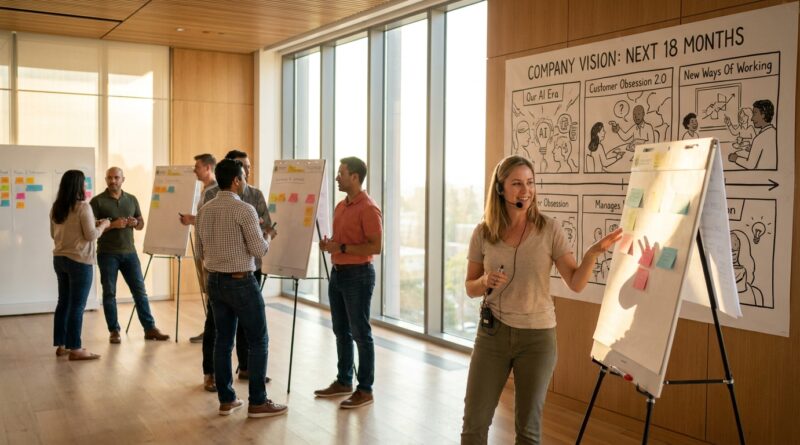
The smarter move is not a fancier offsite. It is a different format. A Co-Created Story Retreat turns strategy into something people help build, question, test, and remember. Instead of passively receiving the company’s next chapter, the team helps write it. That one shift changes everything. It creates emotional connection, lowers resistance to change, and gives people language they keep using long after the event ends. For leaders searching for practical post pandemic corporate retreat ideas experiential storytelling can turn a retreat from a one-time expense into a living piece of company culture.
⚡ In a Hurry? Key Takeaways
- A Co-Created Story Retreat works better than a standard offsite because employees actively shape the company narrative instead of just listening to it.
- Start with one clear strategic question, then build workshops, team challenges, and shared storytelling sessions around it.
- You do not need a luxury venue. The real value comes from participation, clarity, and follow-through, not production gloss.
Why the old offsite model is wearing people out
The classic offsite was built for a different time. Gather everyone in one place. Put executives on stage. Share the plan. Add a panel, a dinner, maybe a team-building activity, and call it alignment.
That format is not useless. It is just not enough anymore.
Post-pandemic teams are more distributed, more skeptical, and more tired. They have lived through reorgs, remote work shifts, return-to-office debates, budget pressure, and now nonstop AI change. When leaders present strategy as a finished product, employees often hear one thing. More change, less context.
That is why so many expensive retreats feel oddly hollow. People receive information, but they do not build ownership.
What a Co-Created Story Retreat actually is
Think of it as part strategy session, part live experience, part culture-making workshop.
Instead of asking, “How do we present the new strategy?” leaders ask, “How do we let people step inside it?”
A Co-Created Story Retreat usually includes:
- A clear company tension or turning point
- Small-group workshops where employees react to and shape future scenarios
- Interactive sessions that connect strategy to daily work
- Shared rituals, visual artifacts, or story moments people remember later
- A final output the company can actually use, not just applaud
That output might be team commitments, a future-state map, a set of AI use principles, customer journey fixes, or a shared language for the next year.
Why storytelling works better than another slide deck
People remember stories because stories help them place themselves inside change.
A slide deck says, “Here are our three priorities.”
A story says, “Here is where we are. Here is what is changing. Here is the risk if we stand still. Here is the role your team plays in what happens next.”
That difference matters. Especially when the strategy includes uncertainty, which it usually does.
Experiential storytelling also gives people something rare at work. A felt experience. They are not just hearing about customer friction, AI adoption, or market pressure. They are moving through exercises, debates, simulations, and team decisions that make those issues real.
If you have been watching the retreat world change, this fits a larger trend toward immersive formats. A useful related read is From Offsite To Immersion Lab: Why 2026’s Smartest Retreats Turn Destinations Into Live Brand Worlds, which gets at the same pressure many leaders feel. Finance wants proof the event mattered. Employees want something more meaningful than a polished presentation.
The big benefit. Buy-in without the corporate theater
Let’s be honest. A lot of offsite language sounds participatory while changing very little. “Breakout sessions” often mean discussing a plan that was already locked.
A Co-Created Story Retreat works when the contribution is real.
That does not mean every employee votes on company strategy. It means leaders are honest about what is fixed, what is flexible, and where employee input will shape the next move.
What that can look like
The executive team might define the destination. For example, becoming AI-enabled, reducing customer churn, or entering a new market.
The retreat then invites employees to co-create:
- What blockers will slow adoption
- What customer stories should guide priorities
- What team behaviors need to change first
- What success should look and feel like six months from now
When people help make the map, they stop feeling like strategy is something done to them.
Why this helps with AI change in particular
AI rollout is a perfect example of why old retreats fall short.
Leaders often announce tools, policies, and timelines. Employees hear concerns they may not say out loud. Is my job changing? Am I behind? Are we using this safely? Is this just another trend that will disappear in six months?
A story-based retreat gives those fears somewhere to go.
You can run scenario labs. Show real workflows. Ask teams to redesign tasks with and without AI. Let people name risks. Let them test boundaries. Let them help write the rules of good use.
That turns AI from an abstract corporate message into a shared working reality.
How to design a Co-Created Story Retreat without making it feel cheesy
This is where some leaders get nervous. The phrase “story retreat” can sound a little too theatrical.
It does not need costumes, actors, or forced fun.
It needs structure.
1. Start with one strategic question
Keep it focused. Good examples:
- What must change in how we work if AI becomes part of every team?
- How do we want customers to describe us one year from now?
- What habits do we need to leave behind to grow in the next market?
If you try to solve everything, the retreat turns fuzzy fast.
2. Frame the retreat as a chapter, not a conference
Language matters. People respond differently when they are entering “Chapter Two of how we work” instead of “the annual strategy summit.”
That chapter framing helps every session connect to one larger narrative.
3. Mix executive clarity with employee authorship
Executives should set the stakes. Then get out of the way enough for teams to respond, challenge, and build.
The best sessions are not speeches. They are guided collisions between vision and reality.
4. Make the work visible
Use walls, boards, maps, sketches, customer quotes, prototypes, team charters, or even simple printed cards. People trust participation more when they can see it taking shape in the room.
5. End with something concrete
Every table should leave a mark. A decision. A statement. A pilot idea. A list of no-longer acceptable behaviors. A team promise.
If the retreat produces only vibes, it will be forgotten.
A simple format any people leader can copy
You do not need a giant production team to do this well. Here is a practical structure.
Day 1. Set the story
- Opening session on where the company is now
- Honest review of what has changed since 2020
- Customer, market, or team reality check
- One strategic question introduced to everyone
Day 2. Build the next chapter
- Cross-functional workshops
- Scenario planning exercises
- AI or process simulations tied to real work
- Team storytelling sessions on future success and likely friction
Day 3. Commit and carry it home
- Teams present practical commitments
- Leadership responds in real time
- Shared language and rituals are captured
- Owners and timelines are set before anyone leaves
That last part is critical. If there is no owner, there is no outcome.
What makes people remember the retreat months later
Not the stage lighting.
It is the moment where something clicks. A customer story that lands. A hard truth spoken plainly. A team exercise that reveals why the old workflow is broken. A shared phrase that becomes shorthand across the company.
Those moments become cultural anchors. People refer back to them in meetings. New hires hear about them. Managers use them to explain decisions.
That is when a retreat stops being an event and starts becoming a reference point.
Common mistakes to avoid
Making participation fake
If people can tell the outcome is already decided, trust drops fast.
Overloading the agenda
Every hour does not need content. People need time to talk, process, and connect dots.
Confusing entertainment with engagement
A flashy experience is not the same as a meaningful one. Nice production can help, but it cannot replace substance.
Skipping follow-up
If outputs from the retreat never show up again, people will treat the next event as performance art.
How to measure whether it worked
You do not have to guess.
Look for:
- Can employees explain the strategy in plain language afterward?
- Did teams create usable commitments or pilot ideas?
- Are managers repeating retreat language in later meetings?
- Did the event reduce confusion around changes like AI adoption?
- Are cross-functional relationships stronger 30 to 90 days later?
The best proof is behavioral. What changed after people got home?
Budget reality. Yes, this can work without a luxury resort
This matters because many leaders hear “experiential” and think “expensive.”
It can be expensive. It does not have to be.
A destination property may add energy and focus. But the heart of the format is not the zip code. It is participation, narrative structure, and practical outputs.
A regional hub, a well-planned hotel meeting space, or even a multi-room local venue can do the job if the design is thoughtful.
Spend money where it counts:
- Strong facilitation
- Clear pre-work
- Well-designed workshop materials
- Good documentation
- Post-retreat follow-through
At a Glance: Comparison
| Feature/Aspect | Details | Verdict |
|---|---|---|
| Traditional offsite | Executive presentations, passive listening, limited employee input, often high polish with weak follow-through. | Good for announcements, weak for lasting buy-in. |
| Co-Created Story Retreat | Employees actively shape responses to strategy through workshops, scenarios, and shared story-building. | Best for alignment, trust, and real ownership. |
| Budget and setup | Can scale from a resort experience to a regional gathering if the facilitation and structure are solid. | More flexible than most leaders assume. |
Conclusion
Right now, teams are buried in strategy PDFs, AI updates, and change messages that blur together. That is exactly why the old offsite playbook is losing its punch. People do not need more information thrown at them in a ballroom. They need a way to make sense of change together. A Co-Created Story Retreat does that by giving employees an active role in shaping the company’s next chapter. It builds buy-in faster, makes hard shifts like AI adoption feel less threatening, and creates a shared reference point people keep coming back to all year. The best part is that this is not reserved for companies with giant event budgets. Any people leader can use the format, whether the setting is a destination resort or a simple regional hub. If you want your retreat to matter after the plane ride home, start there.