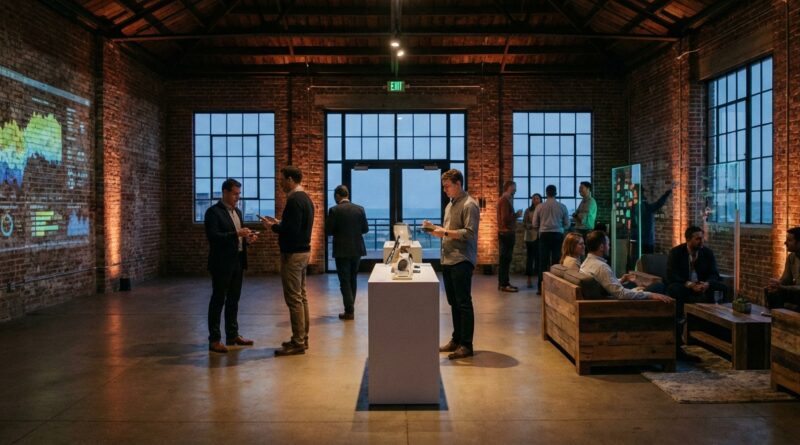
From Offsite To Immersion Lab: Why 2026’s Smartest Retreats Turn Destinations Into Live Brand Worlds
You can feel the squeeze from both sides. Finance wants proof that a retreat did more than pay for flights, and employees can spot a recycled ballroom agenda from a mile away. That old formula, keynote, breakout, buffet, trust fall, goodbye, now feels expensive and oddly forgettable. People want in-person time to matter. They want to make something, test something, solve something, and remember where they were when it happened. That is why the big shift in immersive corporate retreat trends 2026 is not toward fancier offsites. It is toward immersion labs. These are retreats built like temporary brand worlds where the destination itself becomes part workshop, part prototype space, part culture reset. Done right, they do more than entertain. They create visible output, stronger team memory, and a much better answer when someone asks what the retreat actually accomplished.
⚡ In a Hurry? Key Takeaways
- Smart retreats in 2026 work best when they feel like live brand worlds, not hotel meetings with a nicer dinner.
- Start with one business problem, then design every room, activity, and local experience to help teams solve it together.
- The safest way to justify budget is to build in measurable outputs such as prototypes, hiring stories, customer ideas, or process fixes before anyone books a venue.
Why the old offsite formula is breaking down
A lot of teams are half-remote, overstretched, and picky about travel for good reason. If they are going to leave home, miss school pickup, sit on a plane, and burn two workdays, they want more than PowerPoint and polite networking.
CFOs are asking a fair question too. What changed because everyone traveled? If the answer is mostly morale, that can still matter, but it is getting harder to sell on its own.
That is where immersive corporate retreat trends 2026 start to make sense. Companies are moving away from generic meeting space and toward retreats that feel like a temporary operating system for the brand. The location is not just scenery. It becomes a tool.
What an immersion lab retreat actually is
Think of it as a retreat designed like a pop-up world. Every part of the experience connects to the company’s mission, current challenge, or next big bet.
It has a clear problem to solve
Not “improve communication.” That is too vague. Better prompts look like these:
- How do we make onboarding feel human for remote hires?
- What should our next customer experience look like in retail?
- How can product, sales, and support cut handoff delays by half?
It turns the venue into a working environment
The lobby becomes a live customer journey map. Guest rooms include reflective prompts or team assignments. Meals are used for hosted discussions with rotating topics. Outdoor spaces become testing zones, story circles, or prototype stations.
It ends with visible output
That might be mockups, new rituals, manager playbooks, video stories, culture commitments, or a shortlist of ideas ready for pilots. People leave with proof that the trip was not just a mood board.
Why destinations are becoming live brand worlds
Venues have noticed the change. Resorts, campuses, boutique hotels, and even cultural properties are getting much better at co-designing experiences instead of just renting rooms. They know planners need something stronger than “we have a nice ballroom and decent coffee.”
The smart properties now offer modular spaces, local maker partnerships, wellness programming, outdoor work zones, and tech setups that support creation instead of passive listening.
This is also why related formats are gaining traction. If your team is burned out, the wellness side matters too. A good example is Why 2026’s Best Corporate Retreats Feel Like Pop‑Up Wellness Labs, Not Offsites, which shows how planners are reworking retreats around recovery, focus, and actual human energy instead of packed agendas.
The playbook: How to plan an immersion lab retreat
1. Start with one sentence of intent
If your team cannot explain the retreat goal in one clean sentence, the agenda will sprawl. Try this formula:
We are bringing this group together to solve X, test Y, and leave with Z.
Example: “We are bringing product, service, and operations together to redesign the first 30 days of the customer journey and leave with three pilot-ready fixes.”
2. Build around three tracks only
Too many retreats try to do everything. Keep it to three lanes:
- Connection. Trust, belonging, shared context.
- Creation. Workshops, prototyping, problem-solving.
- Reset. Space for recovery, reflection, and informal conversation.
If an activity does not fit one of those, cut it.
3. Use the destination on purpose
This is where many planners miss the moment. Do not just pick a place that looks good in photos. Pick a place that supports the story.
If your company talks about innovation, host sessions in studios, labs, kitchens, maker spaces, or outdoor environments where people can test ideas with their hands. If your company is trying to reconnect with customers, use local business owners, artists, guides, or community partners as part of the program.
4. Design for participants, not just presenters
People remember what they do, not what they sit through. Shift the ratio. Less stage time. More small-group work, field observation, build sessions, peer coaching, and live response.
A useful gut check is simple. If attendees are passive for more than 30 to 45 minutes at a stretch, energy drops fast.
5. Make the brand physical
The best immersion labs take abstract company values and turn them into something people can walk through.
- A customer promise wall where teams rewrite weak language.
- A failure museum where teams share lessons from launches that went wrong.
- A future room showing what the company wants to look and feel like in two years.
- A local experience tied directly to the company mission, not just tourism for its own sake.
6. Build proof into the schedule
This matters if budget approval is getting tougher. Decide ahead of time what proof looks like:
- Number of pilot ideas approved
- Cross-functional teams formed
- New manager practices adopted
- Employee sentiment before and after
- Stories captured for recruiting or internal comms
- Follow-up projects launched within 30 days
Now the retreat has outputs, not just impressions.
What this looks like in the real world
Example 1: Product and customer support retreat
Instead of keynote-heavy sessions, the venue is set up as a live customer journey. Different rooms represent onboarding, friction points, service recovery, and renewal. Teams move through the space in mixed groups, listening to recorded customer stories, reviewing support transcripts, and redesigning weak moments on the spot.
By the end, they have three process changes, one updated messaging framework, and a list of service bugs to fix. That is a retreat a CFO can understand.
Example 2: Culture reset after rapid growth
A company that hired fast and went hybrid uses a destination retreat to rebuild shared norms. Mornings focus on team rituals, decision-making, and manager expectations. Afternoons are built around wellness, reflection, and peer circles. Evenings use hosted tables instead of random mingling, so conversations are more useful and less awkward.
The result is not vague “better culture.” It is a new manager toolkit, a decision charter, and team agreements people can use the next Monday.
Common mistakes that make “immersive” feel fake
Too much theme, not enough substance
A branded scavenger hunt is not an immersion lab if it does not connect to real work. Nice visuals help, but they cannot carry the whole thing.
Overstuffed schedules
If every minute is booked, nobody has time to think, process, or connect naturally. Leave breathing room. Some of the best retreat moments happen between sessions.
Ignoring introverts and remote norms
Not everyone wants to perform in a loud room. Use mixed formats. Quiet reflection, paired discussions, walking meetings, and asynchronous input can make the retreat better for everyone.
No follow-through
This is the classic failure. People leave energized, then nothing happens. Lock in owners, timelines, and the first checkpoint before the final dinner.
How to sell this idea internally
If leadership thinks “immersion” sounds fluffy, use plain language. Call it a working retreat with measurable outputs. Frame it around problems solved, decisions made, and collaboration speed.
Good phrases for internal buy-in:
- “We are replacing passive meeting time with facilitated working sessions.”
- “The destination is being used as a design tool, not a perk.”
- “We will track what the retreat produces in the first 30 and 90 days.”
This shifts the conversation from travel cost to business value.
How to choose the right venue partner
Ask better questions than room size and menu options.
- Can they rework spaces quickly for different modes, workshop, quiet, prototype, showcase?
- Do they have local partners who can support hands-on experiences?
- Can they help create branded environments without making it feel cheesy?
- What technology do they have for hybrid capture, recording, and live collaboration?
- Can wellness and recovery be built into the flow, not tacked on at sunrise?
The best venue partners act more like co-producers than landlords.
At a Glance: Comparison
| Feature/Aspect | Details | Verdict |
|---|---|---|
| Traditional offsite | Hotel ballroom, slide-heavy agenda, generic team-building, limited connection to live business challenges | Easy to book, hard to defend if results are weak |
| Immersion lab retreat | Destination and venue are used as part of the work, with workshops, prototyping, storytelling, and measurable outputs | Stronger memory, stronger buy-in, better business case |
| Wellness-infused retreat | Adds recovery, focus, and human energy management through rest, movement, quiet space, and thoughtful pacing | Best when paired with clear work goals, not used as a stand-alone fix |
Conclusion
The retreat bar is higher now, and honestly, that is not a bad thing. Post-pandemic expectations have gone up while attention spans and travel tolerance have gone down. That leaves planners in a tough spot. Finance wants measurable impact, and employees only want to show up in person if it feels worth the trip. The good news is that immersive corporate retreat trends 2026 offer a practical way forward. If you treat the destination as a live brand world, build the agenda around one real business challenge, and leave with visible output, your retreat stops feeling like an expensive pause and starts acting like a catalyst. That is the real win. You get out of hotel-template thinking, work with venues that are already moving toward experiential formats, and come back with moments that actually shape culture instead of another takeaway deck nobody opens again.