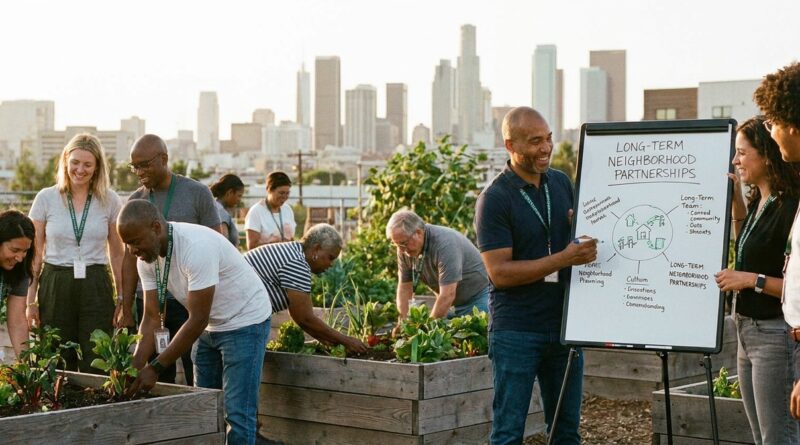
From Offsite To Impact-Retreat: Why 2026’s Smartest Teams Now Build Social Good Into Every Company Gathering
People are done pretending a nice hotel and a few icebreakers are enough. That is the real problem behind the post pandemic corporate retreat social impact trend. Teams finally get time together in person, then spend half the event wondering why the company paid so much for something that feels shallow. Leaders feel it too. They are being asked to defend six-figure retreat budgets to finance, while employees quietly ask a harder question: could this time and money do some actual good? That tension is why the smartest companies in 2026 are moving from offsites to impact-retreats. The idea is simple. Keep the strategy sessions, keep the relationship-building, but build in a real community outcome that matters to the host city. When done right, these gatherings feel less like staged culture theater and more like proof that the company’s values mean something beyond a slide deck.
⚡ In a Hurry? Key Takeaways
- Impact-retreats work because they mix team time with measurable local service, making retreats feel purposeful and easier to justify.
- Start small. Pick one local partner, one realistic project, and one clear metric such as volunteer hours, kits assembled, or funds matched.
- Do not treat community groups like props. The safest, smartest approach is to co-plan with a local nonprofit and focus on useful work they actually need.
Why the old offsite model is wearing people out
For a while, simply getting everyone in one room again felt exciting. That phase is over.
Employees want in-person time to count. They want learning, connection, and a reason to be there that goes beyond “it’s good for culture.” Finance teams want the same thing in a different language. They want proof that travel spend produced something tangible.
That is where impact-retreats come in. They answer both complaints at once. The company still gets alignment, planning, and relationship-building. The team also leaves behind something useful for the community hosting them.
This shift fits neatly with another change in corporate events. Retreats are becoming more practical and outcome-focused overall. If you have seen the move toward training-first gatherings, that same logic shows up here too in From Offsite To Skills Lab Retreat: Why 2026’s Smartest Teams Now Treat Gatherings As Live-Fire Training, Not Perks. The common thread is simple. Stop paying for vibes alone. Start paying for results.
What an impact-retreat actually is
An impact-retreat is not a volunteer day awkwardly stapled onto a conference agenda.
It is a company gathering designed around three goals at the same time:
- Business outcomes, such as planning, training, or cross-team trust
- Employee meaning, so people feel their time mattered
- Community benefit, with a real local result that can be measured
Think of it as replacing performative team-building with useful shared work.
What it can look like in real life
A sales kickoff includes a half-day with a food security nonprofit where teams build distribution plans and pack meal kits.
An engineering retreat partners with a school district to refurbish devices, set up Wi-Fi hotspots, or teach digital safety workshops.
A leadership offsite works with a housing nonprofit on a practical project, then uses the afternoon to talk about resource allocation, decision-making, and local economic reality.
Notice the pattern. The activity is connected to the company’s skills or values. It is not random.
Why employees respond better to this format
Most adults can spot fake culture from across the room. They know when an event is trying too hard.
Impact-retreats usually land better because they answer the silent question hanging over many company gatherings: why does this matter?
When teams spend part of the retreat helping a local group solve a real problem, the day has weight. People have better conversations afterward. They remember it longer. They often feel prouder of the company too.
That matters more than many leaders think. Pride is sticky. Cynicism is sticky too. Retreats can create either one.
Why CFOs and executives are paying attention
Let’s be honest. “Everyone had a great time” is not enough anymore.
Travel, lodging, production, and lost work time add up fast. If a retreat costs a lot, leadership wants a clear story about what came out of it. Impact-retreats make that story easier to tell.
Better ROI, in plain English
You can measure the usual retreat goals, like alignment, retention, and engagement. But now you can also measure community outputs:
- Volunteer hours completed
- Number of kits assembled or devices refurbished
- Scholarships funded or classrooms supported
- Cash or in-kind donations tied to the event
- Skills-based work delivered to a nonprofit partner
That creates a more solid case for the spend. It also gives HR, ESG, DEI, and communications teams something more credible than a highlight reel.
The biggest mistake companies make
They treat social impact like event decor.
If the nonprofit partner is just there for optics, people can feel it. If the project creates extra work for the community group, that is even worse. Good intentions do not fix bad planning.
Watch for these red flags
- The activity was chosen because it photographs well, not because it is needed
- The nonprofit had little say in the plan
- The company drops in for two hours, posts on LinkedIn, then disappears
- The project has no follow-up, no metric, and no local relevance
If any of that sounds familiar, stop and reset.
A practical playbook for planning an impact-retreat
1. Start with the business goal
Do not begin with “What charity should we support?” Begin with “Why are we gathering at all?”
Maybe you need cross-functional trust. Maybe you need managers trained. Maybe you need product and customer teams in one room. Get clear on that first. Then choose a social impact piece that fits the purpose.
2. Pick one local issue, not five
Focus helps. Food access, digital inclusion, housing, youth education, environmental cleanup. Choose one issue connected to the city you are visiting and stick with it.
The best impact-retreats are specific. Broad good intentions are hard to execute.
3. Co-plan with a local nonprofit early
This part is important. Ask the community partner what would genuinely help. Not what would be fun for your team. What would help.
Sometimes that means hands-on work. Sometimes it means funding supplies. Sometimes it means offering skills-based support like marketing, operations, or tech help. Let the partner guide this.
4. Match the activity to your team’s abilities
If your team includes older employees, people with disabilities, or folks who are not comfortable with physically demanding work, plan for that. You want meaningful participation, not a setup that quietly excludes people.
Offer more than one way to contribute if needed.
5. Put clear numbers on the plan
Do not wait until after the event to figure out success. Set metrics in advance.
- 200 care kits assembled
- 50 laptops refurbished
- 300 volunteer hours logged
- $25,000 in matched donations
- 3 nonprofit process problems solved by your internal experts
Now the retreat has a scoreboard. People understand that.
6. Build reflection into the agenda
This is the part many planners skip. Do not rush from service activity straight into cocktails.
Give teams time to talk about what they saw, what surprised them, and how it connects to the company’s work. Reflection is what turns a nice activity into a meaningful shared memory.
7. Follow up after everyone flies home
If the retreat is the end of the relationship, it will feel thin. Share outcomes with staff. Thank the local partner. Consider funding a second phase or offering ongoing support.
One small act of continuity can make the whole thing feel real.
How to make it feel genuine, not preachy
This part matters more than the venue.
Employees do not want to be guilted into caring. They want to see that the company made a thoughtful choice. The tone should be respectful and practical.
Use these simple rules
- Do not oversell the company’s role
- Center the local partner’s expertise
- Share outcomes without turning people in need into marketing material
- Keep the activity proportional to the retreat, not bolted on as a stunt
If the company sounds humble and organized, trust goes up fast.
What kinds of companies benefit most
Almost any company can do this, but some have an especially strong fit.
- Remote-first companies that need in-person time to feel worth the travel
- Fast-growing firms trying to build culture without forcing fake bonding
- Public-facing brands under pressure to show real community value
- Companies with ESG or DEI goals that need proof, not slogans
Even smaller firms can run a smart version of this. It does not require a giant production budget. It requires intention.
At a Glance: Comparison
| Feature/Aspect | Details | Verdict |
|---|---|---|
| Traditional offsite | Nice venue, meetings, dinners, team-building games, limited proof of lasting value | Still useful for some teams, but easier to question when budgets tighten |
| Impact-retreat | Combines planning and connection with a measurable local service project or skills-based contribution | Best choice when you need morale, meaning, and a stronger ROI story |
| Poorly planned impact add-on | Token volunteer moment, weak partner input, little relevance, lots of photo ops | Avoid. This creates cynicism faster than doing nothing at all |
Conclusion
The post pandemic corporate retreat social impact trend is not just another event fad. It is a response to a real shift in what employees and leaders expect from time together. People want gatherings that feel purposeful, not performative. CFOs want a clear reason for the spend. A well-planned impact-retreat gives both sides something solid. It can support DEI and ESG goals, create honest employee pride, and leave behind a local result you can point to without cringing. That is a much better story than another slideshow of rooftop cocktails and trust falls. If your team is going to get on a plane, give them a reason to come home feeling they built something that mattered.