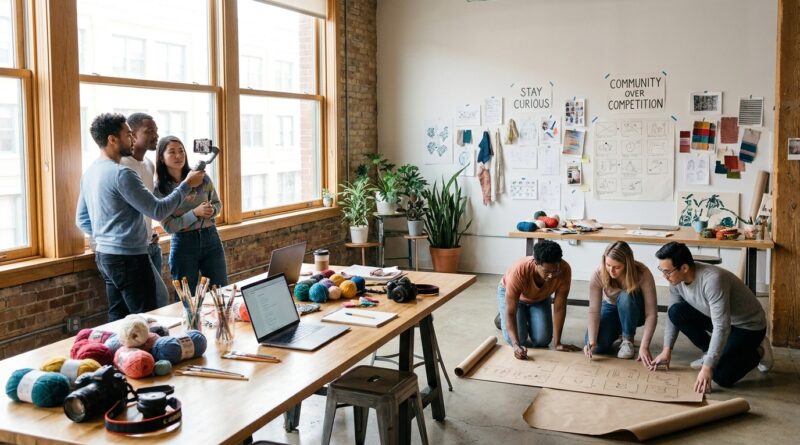
From Offsite To Creative-Residency Retreat: Why 2026’s Smartest Teams Now Make Art Instead Of Slide Decks
Your team knows the routine by heart. Fly in. Sit in a hotel ballroom. Watch slides about strategy, synergy and next-quarter goals. Maybe there is a trust fall or a panel that somehow feels longer than the flight home. By the second afternoon, people are checking Slack under the table and wondering why “reconnection” feels so much like homework. That fatigue is real. And in 2026, the smartest answer is not a fancier venue. It is a different kind of gathering altogether. More teams are swapping passive offsites for creative residencies where people make something together, like a short film, a photo series, a zine, a mural, a sound piece or even a company cookbook. The point is not to turn engineers into painters overnight. The point is to give burned-out humans a safe way to play, build trust through doing, and leave with artifacts that mean more than another deck nobody opens again.
⚡ In a Hurry? Key Takeaways
- Creative corporate retreat ideas for 2026 work best when teams make a real artifact together, not just sit through presentations.
- Start with one guided creative project, like a team zine, community mural or podcast, tied to a business question your team cares about.
- This format is safer and more useful than forced fun because people can participate at different comfort levels and still leave with something memorable.
Why the old offsite formula is wearing people out
Most teams do not hate gathering in person. They hate gathering badly.
People are tired of being talked at. Tired of being over-scheduled. Tired of the strange corporate magic trick where changing cities is supposed to make the same stale agenda feel fresh.
That is why creative corporate retreat ideas 2026 are getting so much attention. They fix the real problem. Not the catering. Not the keynote. The emotional flatness.
A creative residency retreat asks a better question. Instead of “How do we keep everyone engaged for eight hours?” it asks, “What can we make together that says something true about who we are, what we are building, and what we are trying to change?”
That shift matters. People remember what they made. They rarely remember slide 47.
What a creative-residency retreat actually is
Think less “arts and crafts hour.” Think more “temporary studio for the company.”
You bring in artists, makers, filmmakers, writers, designers, chefs or musicians as facilitators. Then you give teams a prompt, a process and enough time to experiment. The work can connect to culture, brand, product vision, customer stories or future bets.
The finished piece does not need to belong in a museum. It just needs to be honest, shared and made by the group.
Examples that work in real companies
A product team creates a mini documentary about customer pain points and what the product should feel like in three years.
A leadership group works with a printmaker to create a visual “manifesto wall” built from stories about risk, failure and repair.
A remote-first company produces a team zine with essays, sketches and field notes on how work changed after the pandemic.
A sales and marketing group records a short podcast series around the question, “What do we want clients to feel after working with us?”
An operations team builds a community art installation from discarded packaging or hardware, turning waste into a conversation about process design.
Why this works better than forced fun
Because it gives people a job to do together.
That sounds simple, but it is the magic. Teams bond faster when they are solving a creative problem side by side than when they are asked to “be vulnerable” on command.
Art also changes the social rules in a useful way. The loudest person in the room is not always the most helpful. The intern who quietly notices color, rhythm or language might suddenly shape the whole project. The engineer who never speaks in all-hands might become the person who helps the group turn a messy idea into a working thing.
That is good for morale. It is also good for leadership. You get to see people in a different light.
The business case, without the corporate jargon
Yes, this sounds warmer and more human. It is also practical.
Creative retreats help teams do four things that standard offsites often fail to do.
1. They rebuild trust after years of weird work
Post-pandemic teams are still carrying a lot. Remote habits. Zoom fatigue. Reorg scars. Quiet uncertainty. Making something together lowers the temperature. It creates connection without forcing confession.
2. They surface better stories for change
Leaders often struggle to talk about change in plain language. A creative exercise gives them fresh metaphors. A collage about product direction can reveal more than another roadmap slide. A short film about customer friction can say more than a spreadsheet full of sentiment scores.
3. They make risk feel safer
When people sketch, prototype, record, revise and try again, they practice experimentation in a low-stakes setting. That mindset carries back into product work, planning and problem-solving.
4. They create artifacts people keep
A deck is dead the second the meeting ends. A printed book, wall piece, audio story or team film keeps working long after the retreat. It becomes part of company memory.
If your team is already rethinking how in-person time should work, this pairs nicely with the ideas in From Offsite To Async-Onsite Retreat: Why 2026’s Smartest Teams Now Design Gatherings Around Deep Work, Not Schedules. The best gatherings now leave room for focus, reflection and actual creation, not just wall-to-wall sessions.
How to plan a creative retreat without making people nervous
This is where many companies get spooked. They picture employees panicking because they “aren’t creative.” Good news. You do not need to run an art school.
Start with a question, not an activity
Bad prompt: “We’re all painting today.”
Better prompt: “What are we building together, and what is getting in the way?”
The creative medium should serve the question. Not the other way around.
Pick formats with multiple ways to contribute
Choose projects where people can write, edit, interview, sketch, organize, produce, narrate or document. That way, no one feels trapped into performing talent they do not have.
Use real facilitators
Bring in artists or creative leads who know how to guide mixed-skill groups. The right facilitator keeps the room calm, makes the process feel safe and stops perfectionism from taking over.
Keep the stakes low and the structure clear
People do better when they know the time box, the goal and the output. “By 4 p.m., each group will produce one three-minute audio story and one poster” is much less stressful than “Let’s see where inspiration takes us.”
Make room for reflection
The artifact matters. So does the conversation after it. Ask teams what surprised them, where they got stuck, who stepped up, and what the process says about how they work.
Best creative corporate retreat ideas 2026
If you want a shortlist you can actually use, start here.
Team zine studio
Each person contributes writing, photos, sketches or found objects around a shared theme. Then the group edits and prints a small publication on-site.
Why it works: low pressure, highly personal, easy to archive and share.
Mini documentary lab
Teams script, shoot and edit short videos about customers, company myths, lessons learned or future goals.
Why it works: builds storytelling skills and creates strong internal content.
Soundwalk and podcast workshop
Groups capture audio, interview one another and produce short episodes around a business theme.
Why it works: good for introverts, strong for distributed teams, easy to replay later.
Mural or visual manifesto
Teams work with an artist to create a large visual piece that reflects values, tensions or a turning point in the company.
Why it works: public, symbolic and lasting.
Recipe book or shared meal residency
People bring family recipes, stories and cultural context, then cook or curate a company cookbook together.
Why it works: warm, inclusive and good for multicultural teams.
Future artifacts lab
Instead of discussing strategy in abstract terms, teams create “objects from the future,” like mock packaging, user guides, campaign posters or customer letters from 2028.
Why it works: makes strategy tangible fast.
How to keep it from turning into corporate theater
This matters.
A creative retreat can be powerful. It can also become cringe if leadership treats it like a branding stunt.
A few rules help.
Do not fake authenticity
If the culture has trust issues, one mural will not fix it. Be honest about what the retreat can and cannot do.
Do not over-script the outcome
If every artifact has to match the executive message perfectly, people will sense it. Leave room for surprise.
Do not make participation feel like a talent contest
This is not “who can paint best.” It is collaborative meaning-making. Big difference.
Do not skip follow-through
Display the work. Publish the zine. Share the film. Refer back to the themes in later meetings. Otherwise the retreat becomes just another nice moment that disappears.
Who this format is best for
Not every team needs the same kind of offsite. But this model is especially good for companies that are:
Going through change and need a more human way to talk about it.
Rebuilding trust after layoffs, mergers or fast growth.
Trying to reconnect hybrid teams who know each other mostly as rectangles on screens.
Tired of over-programmed events that leave people drained.
Looking for internal storytelling material that feels real.
If your event goals are still mostly status updates and calendar choreography, solve that first. Then move into creation.
At a Glance: Comparison
| Feature/Aspect | Details | Verdict |
|---|---|---|
| Traditional offsite | Agenda-heavy, presentation-led, often built around meeting blocks in generic venues | Useful for updates, but easy to forget and hard on burned-out teams |
| Creative residency retreat | Teams make a shared artifact with guidance from artists or facilitators, tied to a real business question | Best choice for trust-building, reflection and memorable culture moments |
| Take-home value | Slides disappear. Artifacts like films, zines, murals and audio pieces keep telling the story afterward | Higher emotional value and better long-term recall |
Conclusion
Creative retreats are taking off in travel because people are done passively consuming experiences. They want to make something. That same idea works beautifully at work. Instead of dragging your team to another offsite that feels like a meeting with worse coffee, you can give them a shared creative challenge, a little room to experiment, and a finished piece they actually care about. That does more than fill time. It helps people reconnect, practice risk in a safe way, and discover new language for talking about change, product bets and what the company is becoming. For Corporate Event readers, this is the real opportunity in creative corporate retreat ideas 2026. You are not just booking a nicer room. You are building an internal artist residency, and the result is a landmark cultural moment your people will remember long after the lanyards are gone.