From Offsite To Sensory-Lab Retreat: Why 2026’s Smartest Teams Now Prototype The Future Office In 3 Days
You can feel the frustration in almost every hybrid-work meeting now. One leader wants more desks. Another wants fewer. HR wants fairness. Finance wants proof. Employees want a workweek that does not feel like a loyalty test. And somehow, huge office decisions are still being made from slide decks and strong opinions instead of watching how real people actually focus, meet, reset, and get through a normal day. That is why a new kind of retreat is getting attention in 2026. Instead of treating the offsite as a reward trip, smart teams are turning it into a three-day sensory lab. They mock up future office layouts, test noise levels, meeting formats, commute rhythms, food timing, and collaboration rules in real time. It is one of the most useful post pandemic corporate retreat ideas for hybrid workplace design because it replaces guessing with evidence. Better still, employees help build the answer, so the final plan feels shared, not imposed.
⚡ In a Hurry? Key Takeaways
- A sensory-lab retreat lets teams test office layouts, hybrid rules, and collaboration habits in three days before spending big money on permanent changes.
- Start small. Prototype two or three workplace setups, observe how people behave, and collect simple feedback on focus, stress, energy, and ease of teamwork.
- The big value is not just design accuracy. It is buy-in. People are far more likely to accept changes they helped shape and test themselves.
Why the old way is failing
Most office redesigns still start backwards. A leadership group picks a target attendance policy, facilities draws a floor plan, then everybody hopes people will adapt.
Sometimes they do. Often they do not.
The reason is simple. Hybrid work is not only about space. It is about human timing, attention, comfort, noise tolerance, social energy, childcare reality, meeting load, and whether a Tuesday in the office actually helps someone do better work.
That is a lot to figure out from a spreadsheet.
When leaders skip the live testing stage, they end up arguing over abstract questions. How many collaboration zones do we need? Should team days be fixed or flexible? Do people want quiet booths or open tables? These sound like design questions, but they are really behavior questions.
A sensory-lab retreat flips that around. It asks people to live the options first.
What a sensory-lab retreat actually is
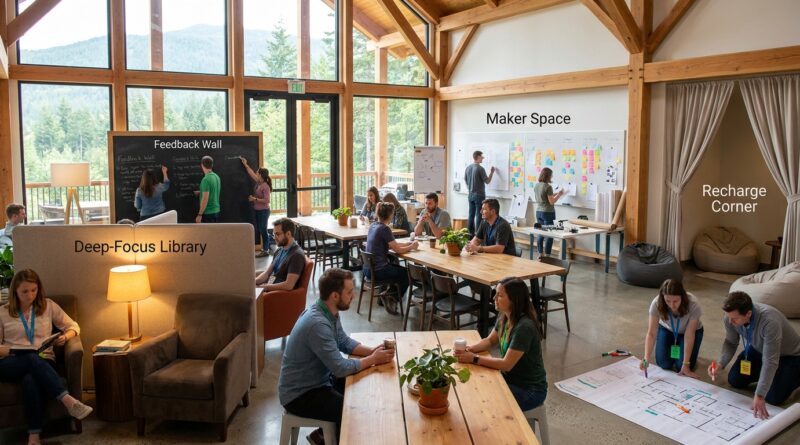
Think of it as a pop-up future office built inside a retreat.
Over three days, teams rotate through different ways of working. One room may be set up as a quiet library zone. Another as a high-energy collaboration area. A third might test hybrid meetings with remote participants on screen, while another explores no-laptop brainstorms or staggered start times.
The point is not to make the retreat fancy. The point is to make work patterns visible.
What gets tested
A good sensory-lab retreat usually tests a mix of physical and behavioral choices, such as:
- Desk density versus more open breathing room
- Quiet zones versus social zones
- Assigned seating versus neighborhood seating
- Core office hours versus flexible arrival windows
- Meeting-free blocks
- Tech setups for mixed remote and in-person meetings
- Lighting, acoustics, temperature, and screen placement
- Food, break timing, and recovery space
These details sound small until you watch how quickly they change energy, patience, and output.
Why three days is often enough
You do not need six months to spot obvious friction.
By day one, people will tell you where the noise is annoying, which room helps them focus, and whether a meeting format leaves remote colleagues stranded.
By day two, patterns start repeating. The same bottlenecks show up. The same layouts attract people. The same rules either reduce confusion or create it.
By day three, you can usually separate preference from proof.
That is what makes this approach powerful. It compresses months of debate into a short, structured experiment.
What leaders learn that surveys alone miss
Surveys are useful. They are just not enough on their own.
If you ask employees what they want from the office, many will answer based on memory, hope, or politics. That is human. But what people say they want and what helps them work best are not always identical.
Live prototyping reveals the gap.
Example: quiet space
A team may say they want more collaborative seating. Then, during the retreat, half the group keeps drifting into the quiet room to finish tasks between sessions. That tells you something important. They do want collaboration, but they also need protected focus time on office days.
Example: team attendance rules
Leaders may assume fixed office days are best for culture. Then the retreat shows that some departments work better with one shared anchor day plus one flexible team-chosen day. Same goal. Better fit.
Example: hybrid meetings
Everyone may say their current setup is “fine.” Then you watch remote participants get ignored for 20 minutes because cameras are badly placed and side conversations take over. Suddenly the problem is no longer theoretical.
How this fits with the broader shift in offsites
This is part of a bigger change in what retreats are for. The smartest companies are moving away from offsites that are all inspiration and no operating value.
They still want connection, of course. But they also want outcomes.
That is why this trend sits nicely next to ideas like From Offsite To Hybrid-Hub Retreat: Why 2026’s Smartest Teams Turn ‘Midweek Office Days’ Into Culture Festivals, which looks at making in-office time feel more intentional and worth the commute. The sensory-lab version goes one step further. It tests the conditions that would make those office days successful in the first place.
How to run one without turning it into chaos
The idea sounds ambitious, but it does not need to be messy.
1. Pick the decisions you actually need to make
Do not test everything. Choose the two to five questions that matter most in the next six to twelve months.
For example:
- How many quiet work areas do we need?
- Should we set team anchor days?
- What meeting setup works best for hybrid participation?
- Do people need more social areas or fewer?
2. Build rough prototypes, not perfect ones
You are not opening the new office tomorrow. Cardboard signs, movable tables, lighting changes, portable dividers, and borrowed tech are enough to test a concept.
Cheap beats polished at this stage. You want honest behavior, not a showroom effect.
3. Measure more than opinion
Ask people how they feel, yes. But also watch what they do.
Track things like:
- Where people choose to sit
- How long they stay focused
- How often they move rooms
- Whether meetings start and end cleanly
- Whether remote participants can contribute easily
- Energy dips across the day
4. Include calendars, not just furniture
This is where many workplace tests go wrong. They focus on chairs and forget schedules.
A future office is also a timing system. Test arrival windows, lunch spacing, collaboration blocks, quiet periods, and no-meeting hours. Sometimes the real fix is a calendar rule, not a renovation.
5. End with decisions
A retreat should not produce a giant pile of sticky notes and no next step.
Before people leave, name what will be adopted, what needs another test, and what should be dropped.
What employees usually appreciate most
People are tired of having workplace changes done to them.
When they are invited into a sensory-lab retreat, the mood changes. They can see that leaders are trying to learn, not just announce. They get to point out friction while it is happening. They can suggest tweaks on the spot. And because they are physically experiencing each setup, the feedback gets more grounded and less abstract.
That matters for trust.
It also matters for speed. If your employees have already tested a new meeting rule or workspace setup during the retreat, adoption later feels familiar. Resistance drops because the idea is no longer coming from nowhere.
Common mistakes to avoid
Treating it like a branding event
If the retreat is all slogans and mood boards, people will smell that immediately. This needs to feel practical.
Only inviting executives
You need a mix of roles, work styles, ages, and accessibility needs. Otherwise, you are just creating a polished version of the same old blind spots.
Confusing preference with performance
Some setups feel fun for 20 minutes and become draining by hour three. Test long enough to catch that.
Ignoring sensory details
Noise, glare, stale air, seating comfort, and screen angle all affect cognition more than many leaders realize. They are not side issues.
Failing to follow up
If people give honest input and nothing changes, the retreat becomes a trust drain. Share findings quickly and explain what comes next.
Who should consider this approach first
This works especially well for companies that are:
- Renovating or downsizing office space
- Rewriting hybrid attendance policies
- Trying to improve underused office days
- Struggling with complaints about meetings, noise, or fairness
- Growing fast and unsure what kind of workplace culture to build
It is also useful if your team has become oddly emotional about office discussions. That usually means the issue is not really about desks. It is about autonomy, identity, and whether work life feels designed with actual humans in mind.
At a Glance: Comparison
| Feature/Aspect | Details | Verdict |
|---|---|---|
| Traditional office planning | Boardroom-led decisions, surveys, floor plans, and delayed rollout with limited real-world testing. | Fast on paper, risky in practice. |
| Sensory-lab retreat | Three-day live prototype using real teams, mock layouts, schedule tests, and observed behavior. | Best for evidence, buy-in, and smarter spending. |
| Employee adoption | Traditional changes feel imposed. Retreat-tested changes feel co-designed and easier to accept. | Big advantage for the retreat model. |
Conclusion
Right now, too many companies are wasting months debating hybrid rules and burning culture capital on office choices that do not match how people actually work. A sensory-lab retreat is a much smarter move. In one gathering, you can test multiple workplace scenarios, watch what real humans do with them, and leave with data-backed rituals, layouts, and norms your team already helped shape. That makes adoption faster, resistance lower, and the retreat itself more valuable than a generic perk trip. If you are looking for practical post pandemic corporate retreat ideas for hybrid workplace design, this one stands out because it turns anxiety into evidence. And that is exactly what leaders need when the future office still feels up for grabs.