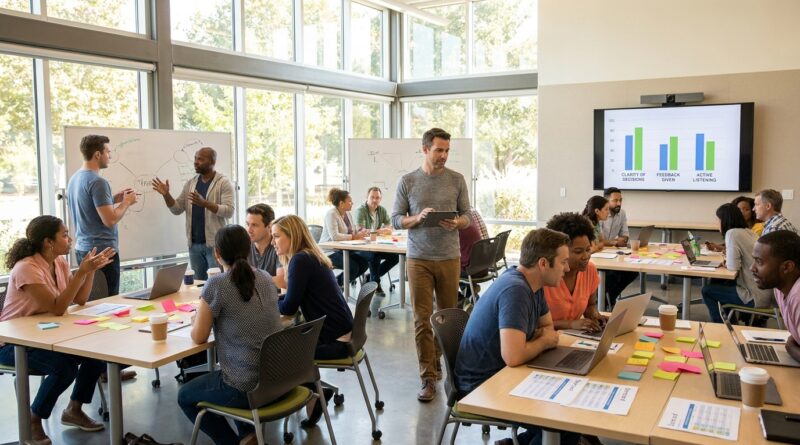
From Offsite To Skills Lab Retreat: Why 2026’s Smartest Teams Now Treat Gatherings As Live Training Grounds
You know the feeling. The retreat looked great on paper. Nice venue, smart speaker, team dinner, a few breakout sessions, and plenty of photos for Slack. Then Monday arrives, and almost nothing is different. Meetings still wander. Feedback still gets avoided until it becomes a problem. Decisions still get stuck because nobody knows what should happen live and what should happen async. That is why the post pandemic corporate retreat skills lab idea is catching on fast in 2026. Teams are getting tired of paying for inspiration that fades before people unpack their bags. They want proof that in-person time changed how people work. A skills-lab retreat is built for that. Instead of broad themes and motivational talks, it gives teams repeated practice on real work situations, clear scoring before and after, and follow-up habits that stick once everyone is back home. It treats gathering time like a gym for team skills, not a field trip with catering.
⚡ In a Hurry? Key Takeaways
- A skills-lab retreat works better than a traditional offsite when your goal is measurable behavior change, not short-term excitement.
- Start with 2 or 3 team skills, then build short practice rounds around real scenarios like tough feedback, async decision-making, and meeting facilitation.
- The value is easier to defend because you can track simple before-and-after metrics instead of relying on vibes, photos, and a recap deck.
Why the old offsite format is starting to feel wasteful
Most teams do not hate gathering in person. They hate wasting the chance.
Hybrid work changed the math. When people are spread across cities and time zones, face-to-face time is expensive. Flights, hotels, lost work hours, event planning, all of it adds up. So the big question from leadership is fair. What did we get for that money?
If the answer is “people felt energized,” that is nice, but it is not enough anymore.
The real pain is simpler than most companies admit. Teams are surrounded by software, playbooks, and training videos, yet they still struggle with a few basic abilities. Running a clean meeting. Writing a clear async update. Disagreeing without making it personal. Giving direct feedback without setting off a week of tension.
Those are not information problems. They are practice problems.
What a skills-lab retreat actually is
Think of it as less conference, more workshop bench.
A skills-lab retreat is an in-person gathering designed around repeated practice. People do not just hear what “good” looks like. They try it, get feedback, adjust, and try again. Usually several times in one day.
The best versions focus on real situations the team deals with every week, such as:
- Leading a 25-minute project meeting with a clear outcome
- Making a decision asynchronously without endless comment threads
- Giving corrective feedback to a peer or direct report
- Handling healthy disagreement between functions
- Writing updates people can actually scan and understand
This is the key shift. You stop asking, “What theme should our retreat have?” and start asking, “What should people be able to do better by Friday at 4 p.m.?”
Why this works better than online courses alone
Online learning is useful. It is cheap, flexible, and easy to assign. But it has one obvious weakness. Watching a lesson about feedback is not the same as looking a colleague in the eye and practicing a hard conversation.
Some skills need live reps.
That is where in-person retreats still shine. They create a safe, focused space for awkward first attempts. People can pause, reset, and try again. That is hard to recreate on Zoom, especially with the usual screen fatigue and home-office distractions.
A good skills lab also creates shared standards. After practicing together, the team has a common idea of what a solid meeting, a useful document, or a fair disagreement looks like. That cuts a lot of confusion later.
The three signs your retreat should become a skills lab
1. The same friction keeps showing up
If your team keeps complaining about meetings, slow decisions, weak follow-through, or unclear ownership, you do not need another inspiring keynote. You need drills.
2. Leaders want proof
If budget approval now comes with hard questions about outcomes, a skills lab gives you something stronger than anecdotes.
3. Your team is hybrid by default
Hybrid teams need stronger communication habits than office-first teams, not weaker ones. If those habits are shaky, in-person time should be used to build them.
How to design a post pandemic corporate retreat skills lab
This does not need to be fancy. It needs to be specific.
Pick only 2 or 3 skills
This is where many companies go wrong. They try to fix culture, communication, leadership, trust, strategy, and innovation in two days. Nobody can absorb that much.
Choose the few skills that cause the most daily friction. For most hybrid teams, that means some mix of:
- meeting facilitation
- async decision-making
- feedback and conflict handling
Use real scenarios, not generic role-play
People learn faster when the examples feel familiar. Use actual situations from the business. A product launch delay. A client escalation. A missed deadline between departments. A manager avoiding a tough performance conversation.
You are not trying to entertain people. You are trying to make Monday easier.
Keep practice rounds short
A strong format is 10 minutes of setup, 10 minutes of practice, 5 minutes of feedback, then a reset and repeat. Short rounds keep energy up and create more reps.
Give people a simple scorecard
This matters. If “good communication” stays fuzzy, improvement stays fuzzy too.
For example, a meeting facilitation scorecard might track:
- Was the goal stated in the first two minutes?
- Was there a clear owner for each next step?
- Did the facilitator stop side topics?
- Did the meeting end with a decision or a stated next action?
Now you can compare round one with round three. That is a lot more useful than “the session went well.”
Build in peer feedback rules
Feedback helps only when people know how to give it. Keep it plain:
- name the behavior
- say the effect
- suggest one change
That structure keeps comments useful and lowers the chance of drama.
Simple metrics that make retreat budgets easier to defend
You do not need a research department to measure this.
Track a handful of before-and-after numbers for 30 to 60 days.
Before the retreat
- Average meeting length
- Percent of meetings with agendas sent in advance
- Time to reach a cross-functional decision
- Self-rating confidence on giving feedback
- Manager rating of communication clarity
After the retreat
- How many meetings now end with named owners and deadlines
- How many decisions get made async without extra meetings
- How often feedback conversations happen within a week of an issue
- Whether people use the agreed templates and routines
These are not perfect measurements, but they are honest and practical. They show movement in behavior, which is what leaders actually care about.
What a two-day format can look like
Day 1 morning: Baseline and demonstration
Start by showing what “good” looks like. Not in abstract language. In a live demo. Then let teams do a first practice round so they can see where they struggle.
Day 1 afternoon: High-repetition drills
Break into small groups. Rotate roles. Facilitator, participant, observer. The observer uses a scorecard. Everyone gets multiple reps.
Day 2 morning: Real-world scenarios
Raise the difficulty. Add interruptions, missing data, disagreement, time pressure. Real work is messy, so the practice should be too.
Day 2 afternoon: Commitment and follow-through
Each team leaves with three things only:
- one shared standard
- one template or tool
- one weekly habit to keep practicing
That might be a meeting brief template, a decision log, or a monthly feedback drill. Small beats grand.
Do not turn the whole retreat into homework
There is a balance here.
A skills lab should not feel like punishment. People still need meals together, free conversation, and some room to breathe. That social time matters because trust makes practice safer. Just do not let the social part pretend to be the outcome.
If you want your retreat to carry a broader purpose too, there is room for that. Some companies are pairing training with service or community work, which can make the gathering feel more grounded and less performative. That is part of why pieces like From Offsite To Neighborhood-Impact Retreat: Why 2026’s Smartest Teams Now Trade Swag Bags For Real Local Change are getting attention. The common thread is simple. People want in-person time to mean something.
Mistakes to avoid
Trying to fix everything
If you pick too many skills, people remember none of them.
Using fake examples
Generic role-play gets polite participation and weak transfer back to work.
Skipping managers
If managers do not model the new behaviors after the retreat, the old habits come back fast.
No reinforcement after the event
One retreat cannot carry six months on its own. You need follow-up practice in regular team routines.
What happens after the retreat is the whole game
This is where many plans quietly fail. The retreat is not the finish line. It is the launch.
For the next eight weeks, teams should keep the new skills alive with light structure:
- one meeting each week scored against the new meeting standard
- one async decision documented in the agreed format
- one short feedback practice in a manager huddle
That ongoing repetition is what turns a good event into a real shift in behavior.
At a Glance: Comparison
| Feature/Aspect | Details | Verdict |
|---|---|---|
| Traditional offsite | High on inspiration, bonding, and presentations, but often light on repeated skill practice and measurable change. | Good for morale. Weak for skill transfer. |
| Skills-lab retreat | Focused on 2 or 3 behaviors, real scenarios, short practice rounds, peer feedback, and before-and-after tracking. | Best choice when leaders want proof and teams need better habits fast. |
| Online training only | Cheap and scalable, useful for concepts and refreshers, but limited for live interpersonal skills that need repetition and correction. | Great support tool. Not enough on its own. |
Conclusion
Hybrid work exposed a gap a lot of companies tried to ignore. Teams have more tools, more advice, and more content than ever, yet many still struggle with the basics that make work smoother: clear meetings, async decisions, and feedback without unnecessary tension. That is why the post pandemic corporate retreat skills lab format makes so much sense right now. It trades vague inspiration for structured practice, repetition, and simple metrics you can actually show to leadership. Better still, it respects the cost of gathering in person by using that time for what it does best. Building muscles people cannot build on Zoom. If your retreat budget keeps getting questioned, this is the clearest answer I have seen. Stop treating offsites like short-lived morale events. Start treating them like live training grounds that make Monday better.