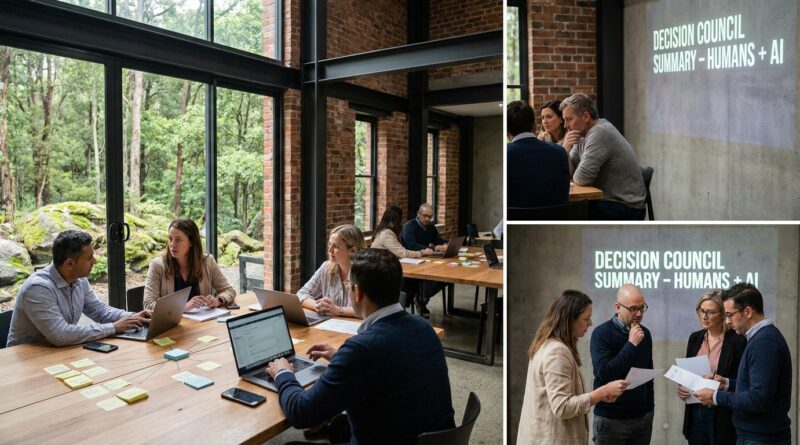
From Offsite To AI-Ready Retreat: Why 2026’s Smartest Teams Now Use Getaway Time To Train For Human + AI Collaboration
Your team does not need another breathless AI keynote. It does not need a three-hour prompt workshop where half the room nods politely and the other half quietly wonders if their job is about to disappear. Leaders are being pushed to “do something about AI” at the same time they are trying to fix culture, burnout, turnover and the odd little frictions that come with hybrid work. No wonder so many retreats feel confused. They try to be strategy summit, therapy session and tech boot camp all at once. People go home with a tote bag, a few slides and a growing suspicion that nobody actually knows what happens next. The smarter move for 2026 is different. Treat the retreat as a real-world practice ground for human + AI collaboration. Not theory. Not slogans. A place where teams can test new ways of working together, ask uncomfortable questions in person and leave with a few clear rules for Monday morning.
⚡ In a Hurry? Key Takeaways
- An AI-focused retreat works best when it helps teams redesign real workflows, not just learn trendy tools.
- Build the agenda around live experiments, role clarity and a short list of “starting Monday” agreements.
- People need safety as much as training. If staff cannot talk honestly about fear, trust and accountability, the AI plan will stall.
Why the old offsite format is breaking
The usual retreat formula is starting to crack. A keynote in the morning. Breakout sessions after lunch. Maybe a panel. Maybe a trust fall with better branding.
That was already wearing thin. AI just exposed the problem faster.
Most teams are not struggling because they have never heard of ChatGPT or copilots. They are struggling because nobody has clearly answered the practical questions. Which tasks should AI handle? Which ones should stay fully human? Who checks the output? What happens when AI is fast but wrong? How do junior staff learn if the draft work is now done by a bot?
Those questions are messy. They touch power, identity, trust and job design. A webinar cannot solve that. A generic trainer usually cannot either.
That is why the best ai focused corporate retreat ideas 2026 are less about inspiration and more about rehearsal.
What smart teams are doing instead
The better retreat model looks a lot more grounded. Instead of asking, “How do we get people excited about AI?” teams ask, “Where does our actual work get stuck, and how could humans and AI share it better?”
That shift matters.
It turns AI from a side topic into a work design topic. It also lowers the eye-roll factor. People are more willing to engage when the session is about fixing real pain, not worshipping a new tool.
Think of the retreat as a collaboration lab
At a good retreat, people can finally sit in the same room and sort out the stuff that is too awkward for Slack. The marketer can tell the legal team where approvals drag. The product lead can show how much time gets lost turning meeting notes into action. The operations manager can explain why “just automate it” is not a serious plan.
Then the group can test what AI should do in those situations, and what humans still need to own.
That is the heart of it. Not AI replacing people. People and AI splitting work more intentionally.
The retreat should answer three human questions first
Before you get into tools, start here.
1. What are people afraid of?
Some are worried about job loss. Some are worried about being left behind. Some are worried that low-quality AI output will be shoved into their workflow and they will be blamed for the mistakes.
If that fear stays underground, it poisons everything.
Give it room. Name it. Let managers hear it without getting defensive.
2. What work feels pointless right now?
This is usually where AI can help fastest. Repetitive summaries. First drafts. Pulling patterns from messy notes. Turning long meetings into action items. Cleaning up research. These are not glamorous wins, but they are real.
3. What kind of judgment must stay human?
Teams need to say this out loud. Client trust. Sensitive hiring decisions. Brand voice. Conflict resolution. Ethical calls. Final approvals on risky content. AI can assist, but not own those areas.
That simple line drawing can remove a lot of anxiety.
What an AI-ready retreat agenda actually looks like
If you want useful ai focused corporate retreat ideas 2026, skip the packed agenda full of passive sessions. Build around a few practical blocks.
Block 1: Workflow mapping
Ask each function to map a real process. Not an ideal one. The messy current version.
Example questions:
- Where do handoffs break?
- Where do people wait too long for answers?
- Which tasks are repetitive but still need care?
- Where do errors usually start?
This gives the retreat a concrete base. You are not discussing AI in the abstract anymore.
Block 2: Human + AI role testing
Now take one or two workflows and redesign them.
For each step, ask:
- Should a human do this?
- Should AI draft it?
- Should AI summarize options while a human decides?
- Who reviews the output?
- What counts as good enough?
This is where people start to see AI as a teammate with limits, not magic.
Block 3: Live experiments
Do not just talk about possible use cases. Test them on real work.
Use actual meeting notes, customer emails, planning docs or project briefs. Let teams compare their current method against an AI-assisted version. Time both. Review quality. Spot risks.
That creates healthy realism fast.
Block 4: Rules, boundaries and escalation
Every team needs simple operating rules. For example:
- AI can draft internal summaries, but not final client language without human review.
- All AI-generated analysis must include source checking.
- Employees must disclose when a decision memo was AI-assisted.
- No confidential data goes into unapproved tools.
If you skip this part, the retreat may feel fun but it will not change behavior.
Block 5: Monday commitments
Finish with only two or three changes the team will actually start next week. That is enough.
Too many retreats die because they produce a giant list nobody owns.
Do not ignore the energy problem
There is another reason many AI retreats fail. People are tired. Not fake-tired. Deeply tired.
When a team is running on fumes, even a smart agenda can land badly. People cannot think clearly about major work changes if their nervous system is already overloaded. That is why some companies are pairing AI work with a more recovery-aware retreat design. If that sounds familiar, this piece on From Offsite To Nervous-System Reset Retreat: Why 2026’s Smartest Teams Now Trade Agendas For Actual Recovery is worth a read.
The point is simple. You do not get honest conversation, good judgment or creative problem-solving from a fried team. Build in actual breathing room. Shorter sessions. Walks. Reflection time. Smaller groups. Less stage time. More thinking time.
What people should leave with
A successful retreat does not send people home saying, “That was interesting.”
It sends them home saying, “I know what changes now.”
Good outputs include:
- A shared list of tasks where AI can save time right away
- A clear list of human-only responsibilities
- One approved tool stack, not six random experiments
- Draft standards for review, privacy and accountability
- Two or three pilot workflows with owners and deadlines
That is enough to build momentum. And it gives employees something many are missing right now, which is a believable picture of how their work is changing.
Common mistakes to avoid
Making it all about tools
Tools matter, sure. But if the retreat becomes a product demo parade, people will tune out. Workflow design matters more.
Forcing positivity
If leaders only want upbeat discussion, they will miss the truth. People need space to say what feels risky or unfair.
Leaving managers out of the hard conversations
Frontline employees cannot carry this alone. Managers need to help define standards, approve new habits and model responsible use.
Trying to solve everything in one event
The retreat should start the next chapter, not finish the whole book. Keep the scope tight.
Best-fit retreat activities for 2026
If you are planning around ai focused corporate retreat ideas 2026, these formats tend to work well:
- Workflow clinics: Small groups bring one broken process and redesign it with AI in the mix.
- Red team sessions: Teams test where AI output could go wrong, from bias to hallucinations to privacy issues.
- Role swap exercises: Employees walk through how a manager, coordinator or analyst might use AI differently.
- Draft-and-review labs: AI creates a first pass, then humans critique it against quality standards.
- Decision boundary workshops: Teams agree which calls can be AI-assisted and which must stay fully human.
Notice what these all have in common. They are active. They are specific. And they connect directly to real work.
Why this matters more for hybrid and distributed teams
When people work apart most of the time, confusion multiplies quietly. One person is using AI every day. Another has barely touched it. One manager encourages experimentation. Another bans it informally. One department has standards. Another is winging it.
A retreat is often the only moment when everyone can get on the same page together.
That is what makes it valuable now. Not because retreats are trendy perks. Because they are one of the few places where a scattered team can look each other in the eye and agree how work will actually happen.
At a Glance: Comparison
| Feature/Aspect | Details | Verdict |
|---|---|---|
| Traditional AI keynote retreat | Big ideas, broad inspiration, little connection to daily workflows or team fears | Easy to run, low impact |
| Hands-on human + AI workflow lab | Teams test real tasks, define review steps and agree where AI fits | Best option for practical change |
| Recovery-aware retreat design | Adds rest, reflection and psychological safety so people can think clearly and speak honestly | Important if your team is already stretched |
Conclusion
AI is no longer a novelty session tucked between lunch and happy hour. It is quietly changing jobs, expectations and workflows while many companies still treat it like a side project. That is why the retreat matters more now, not less. Used well, it becomes a safe place to test new human + AI roles, debate the scary parts in person and leave with a few concrete agreements about how work will happen starting Monday. That gives teams something they badly need, which is a coherent story about their future together that is based on practice, not slogans. It also turns the retreat from a nice perk into something much more useful. A chance for a distributed team to rehearse the next version of collaboration, decision-making and shared accountability with AI in the loop.