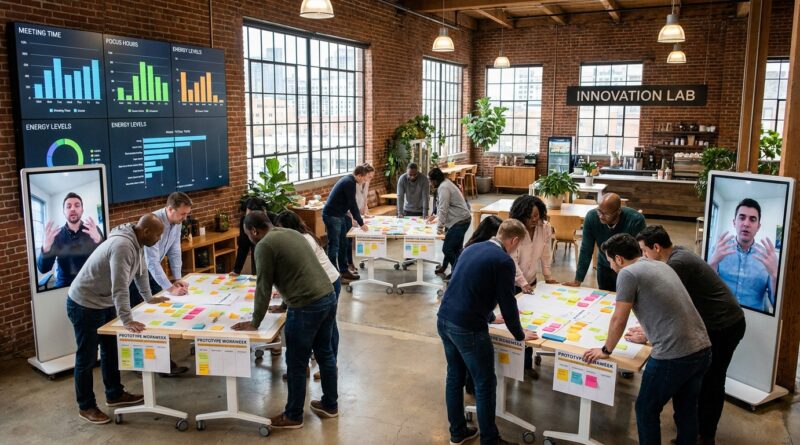
From Offsite To Experiment-Lab Retreat: Why 2026’s Smartest Teams Now Prototype Their Future Of Work In 3 Days
Most team retreats fail for a simple reason. They are trying to inspire people back into a work model that is already broken. Leaders know the feeling. You fly everyone in, book a nice venue, put up slides about culture and collaboration, get a few hopeful nods, then watch the same calendar overload, meeting bloat and hybrid tension return by Tuesday. It is frustrating, and expensive.
That is why one of the biggest post pandemic corporate retreat trends future of work experiment lab planners are watching in 2026 is the shift from offsite as presentation to offsite as prototype. The smartest teams are using three-day retreats to test how they actually want to work. Not in theory. In practice. They run live experiments with async communication, meeting limits, office rituals, focus blocks and manager access. Then they measure what worked, what annoyed people and what should become the new normal. Suddenly the retreat is not a morale event with snacks. It is a short, structured lab for designing a better week.
⚡ In a Hurry? Key Takeaways
- Smart teams now use retreats to test future work habits in real time, not just talk about them.
- Pick 3 to 5 work experiments for the retreat, measure them daily, and leave with one 30-day pilot plan.
- This format cuts guesswork and gives leaders safer, team-owned answers to hybrid and burnout problems.
Why the old offsite format is wearing people out
The classic retreat agenda looks polished, but it often solves very little. A keynote. A strategy deck. A breakout on values. A dinner. Maybe a trust fall if someone got carried away.
None of that is automatically bad. The problem is that most work pain today is operational. People are not mainly confused about the mission. They are drowning in the mechanics of how work happens. Too many meetings. Slack all day. No clear rules on when to come in. Managers who want responsiveness and deep work at the same time.
You do not fix that with another panel discussion.
You fix it by trying a different system long enough to learn something useful.
What an experiment-lab retreat actually is
Think of it like a pop-up version of your future workplace.
For three days, the team does not just discuss better habits. It lives inside them. You create a temporary operating system and test it under real conditions. That means setting clear rules for communication, decision-making, collaboration windows and recovery time, then watching what happens.
The point is not perfection. The point is data.
At the end of the retreat, you should be able to answer questions like:
- How many meetings can we remove before work starts breaking?
- What needs to happen live and in person, and what clearly does not?
- Can leaders step back from instant replies without slowing decisions?
- What kind of schedule helps people do good work without feeling fried?
Why this matters more in 2026
By now, most companies are past the emergency phase of hybrid work. But that does not mean they have figured it out. In many offices, people are still living in a messy in-between state. More office visits, more pushback, more mixed signals.
Employees were changed by the pandemic. Their expectations were reset. A lot of leaders were changed too, even if they do not always say it out loud. They want performance, yes. But they also know the old model had serious cracks.
That is why this shift is getting attention in the corporate event world. It takes a huge, vague topic like “the future of work” and turns it into something teams can actually run this quarter.
The 3-day format that works
Day 1: Diagnose the real friction
Start with honesty, not branding.
Map the current week. Where does time go? What interrupts focus? Which meetings are useful, and which ones survive mostly because they have always existed? When do people feel most connected? When do they feel most drained?
Keep this grounded. Use whiteboards, sticky notes or a simple shared doc. Ask for specifics. “Tuesdays are a disaster because we stack all our status meetings before noon” is helpful. “Communication could improve” is not.
By the afternoon, narrow the group down to a few testable problems.
Examples:
- Too many approval steps
- Noisy chat channels that create fake urgency
- In-office days with no real reason for being together
- Managers becoming bottlenecks
- No protected focus time
Day 2: Run live work experiments
This is the heart of the retreat.
Pick 3 to 5 experiments and try them for several hours at a time. Make them concrete and slightly uncomfortable, because safe little tweaks rarely teach much.
Good examples include:
- Async-first morning. No internal meetings until 1 p.m. Updates happen in writing.
- Decision sprint. Limit approvals to one owner and one reviewer for the day.
- Office-worth-it challenge. Any in-person session must produce something that would be weaker on Zoom.
- Focus block. Two hours with chat muted, phones away and no taps on the shoulder.
- Manager-lite window. Teams solve problems without asking a leader first unless risk is truly high.
Then observe. Did work move faster? Did anyone feel lost? Did written updates improve clarity or create more confusion? Which people struggled, and why?
Day 3: Debrief, choose, and commit
Now turn the experience into a plan.
Each experiment gets three ratings:
- What helped
- What hurt
- What needs adjusting before a 30-day pilot
This is also the moment to separate preference from evidence. Some people may dislike a change that still improves work. Some may love a change that only works in retreat conditions. The job is to be fair, not romantic.
End with one clear next step. Not ten.
For example: “Starting next month, Tuesdays and Thursdays become async mornings for 30 days. We will review response times, meeting load and employee energy weekly.”
What to measure so this does not become another vibe-only event
If you want a retreat to shape real policy, measure more than enthusiasm.
Track simple signals such as:
- Number of meetings avoided
- Time to decision
- Hours of uninterrupted focus
- Quality of written updates
- Self-reported stress or energy at the end of each day
- How clear people felt about priorities
This is where retreat design is getting smarter. Some teams are also paying attention to energy, not just output. If that angle interests you, the piece From Offsite To Biofeedback Retreat: Why 2026’s Smartest Teams Now Track Nervous Systems, Not Name Tags shows how some events are starting to track strain and recovery in a more direct way. That is not required for every company, but the broader idea is useful. A work model that looks efficient on paper can still leave people wrung out.
Experiment prompts you can use at your next retreat
If you are planning one of these, here are prompts that actually help.
For hybrid work
- What work gets better when we are physically together?
- What office ritual are we keeping out of habit, not value?
- If we reduced in-person time by 20 percent, what would break first?
For burnout and pace
- Which part of our week creates the most pointless urgency?
- What counts as a true emergency here?
- Where do high performers lose time because our system is messy?
For communication
- What should be written down instead of repeated in meetings?
- Which channels create noise but not clarity?
- How quickly do people really need a response?
Common mistakes to avoid
Turning the retreat into theater
If leaders already know the answer they want, employees will spot that in five minutes. Then the whole thing becomes political.
Testing too many things at once
Five experiments are plenty. If you test fifteen, you will learn nothing clearly.
Skipping the follow-through
The retreat is only the start. Without a 30-day or 60-day pilot after the event, the data goes stale fast.
Confusing comfort with success
Some of the best experiments feel awkward at first. That does not mean they failed. It may simply mean people are adjusting.
Why employees tend to trust this format more
There is a quiet reason this approach works. It gives employees shared ownership.
Instead of being told, “We have decided everyone should be in on Tuesdays,” they get to test whether Tuesday in-person time actually improves anything. Instead of hearing another speech about resilience, they can point to moments in the schedule that create exhaustion.
That changes the tone. People stop arguing only from ideology. They start responding to lived experience.
Why this is good news for planners and event teams
For the corporate event community, this is a useful shift because it gives retreats a clearer job to do. You are not just planning logistics and hoping for chemistry. You are building a temporary environment where a team can test new behaviors safely.
That affects everything from room setup to facilitation. You need spaces for quiet work, not just plenary sessions. You need stronger debrief structures. You need a way to capture observations without drowning everyone in forms.
The retreat becomes less about entertainment and more about design. Still warm. Still human. But sharper.
At a Glance: Comparison
| Feature/Aspect | Details | Verdict |
|---|---|---|
| Traditional offsite | Talk-heavy, slide-driven, often ends with broad promises and little operational change. | Good for alignment. Weak for fixing hybrid work habits. |
| Experiment-lab retreat | Runs live tests on async work, meetings, focus time, office rituals and decision flows over 3 days. | Best for getting real answers quickly and building team buy-in. |
| Post-retreat follow-up | Uses a 30-day pilot, simple metrics and weekly check-ins to turn retreat learning into policy. | Essential. Without this, even a smart retreat fades fast. |
Conclusion
Executives are being asked to solve a very modern headache with very old retreat formats. That is why the experiment-lab model feels so timely. It accepts that RTO backlash, rising office visits, hybrid confusion and post-pandemic expectations are not abstract culture issues. They are design problems. And design problems respond well to short, structured tests. A three-day retreat can help a team answer, in days not quarters, how much async it can really handle, which in-person rituals actually matter and what a humane high-performance week looks like for that specific group. For planners, HR leaders and event teams, this is practical, not theoretical. You can build the agenda, run the experiments, debrief the results and leave with hard data instead of hopeful slogans. That makes the retreat worth the airfare, and gives everyone a shared hand in building the next version of work.