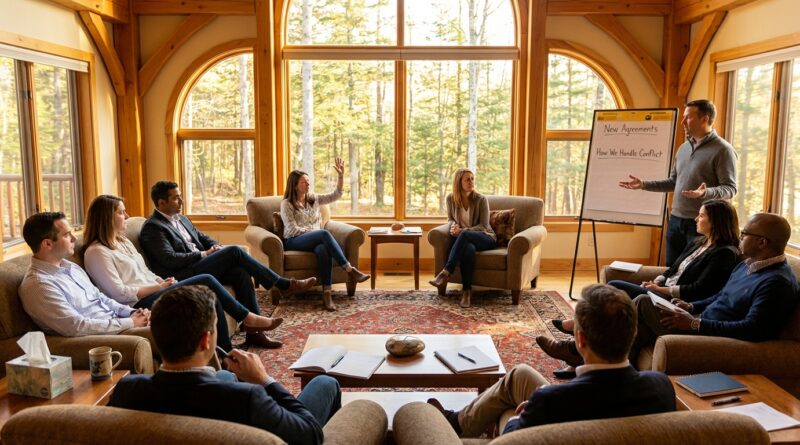
From Offsite To Healing-Through-Conflict Retreat: Why 2026’s Smartest Teams Use Offsites To Repair Trust, Not Just Celebrate Wins
You can feel it the moment everyone arrives. The smiles are there. The name tags are there. The dinner reservation is there. But the ease is not. A lot of teams are traveling together again, and many leaders are learning a hard truth. A retreat cannot fix what the workday keeps avoiding. If your group has been through layoffs, awkward return-to-office policies, hybrid resentment, or months of polite but icy meetings, a standard offsite can actually make things worse. People do not want another forced-fun agenda when trust is already cracked. They want honesty, fairness, and some sign that the room is safe enough to say what has been building up. That is why the smartest teams in 2026 are changing the goal. They are not using offsites just to celebrate wins. They are using them for post pandemic corporate retreat conflict resolution, with structure, boundaries, and practical ways to repair trust before talking strategy.
⚡ In a Hurry? Key Takeaways
- Modern offsites work best when they focus on repairing trust first, not pretending conflict is already gone.
- Use short trust-sprints, guided story circles, and a team-written conflict playbook instead of vague bonding activities.
- This approach protects your retreat budget by turning a risky gathering into a clear process for alignment, not a temporary mood boost.
Why the old offsite playbook is failing
For years, the company retreat had a pretty simple job. Get everyone out of the office. Put them in a nicer setting. Mix in some team bonding, a few presentations, maybe a dinner with good wine, and hope people came back recharged.
That formula breaks down when the real problem is not burnout alone. It is unresolved tension.
Post-pandemic teams are carrying a lot. Some workers still feel punished by return-to-office rules. Others feel remote colleagues have more freedom. Some stayed through rounds of cuts and now carry survivor’s guilt. Some managers say they want openness, but employees remember exactly who got ignored during the last restructuring.
So when a retreat agenda says, “Let’s reconnect,” many people hear, “Let’s act like none of that happened.”
That is why a healing-through-conflict retreat feels different. It starts from a more honest place. Something is off. People know it. The goal is not to force harmony. The goal is to repair enough trust that the team can work well again.
What a healing-through-conflict retreat actually is
It is not group therapy in a hotel ballroom. That is the fear many leaders have, and it stops them from doing anything useful.
A healing-through-conflict retreat is a structured, time-boxed offsite designed to help a team name tension, understand what caused it, and agree on better ways to work together. It is practical. It is planned. It is built around clear prompts and boundaries.
Think of it like deferred maintenance on a building. If you ignore the cracks, the paint job will not help much.
What it includes
Most successful versions include three simple parts.
- Short trust-sprints. Small exercises that test and rebuild reliability in manageable steps.
- Guided story circles. Structured sharing about what the last few years felt like, with ground rules.
- Conflict playbooks. A written team agreement for how disagreement, feedback, and decisions will work going forward.
What it avoids
- Forced vulnerability with no safety net
- Fake positivity
- Trust falls, ropes courses, and gimmicks standing in for real repair
- Executive speeches about “moving forward” before people feel heard
The hidden conflicts showing up at retreats in 2026
If you are planning an offsite, it helps to name the most common fault lines before people are in the same room.
Return-to-office scars
Some employees feel leaders used office attendance as a loyalty test. Others feel in-office workers carried more day-to-day burden. Both sides can feel resentful, and both can believe the other side had it easier.
Layoff aftershocks
Teams often say they are “past” a restructuring because the org chart is stable again. That does not mean the emotional impact is gone. People may still feel grief, guilt, anger, or fear that another cut is coming.
Generational friction
Younger workers may want more transparency and flexibility. Older workers may be tired of constant process changes and public emotional language. Neither view is automatically wrong. But if nobody says this out loud, every small disagreement starts to feel bigger than it is.
Hybrid trust gaps
When people work in different places, they often create different stories about who is committed, who gets noticed, and who has access to decision-makers. Retreats bring those assumptions into one room very quickly.
How to design an offsite that repairs trust
This is where many leaders get nervous. The good news is you do not need to turn your retreat into a weekend-long confession session. In fact, that would be a mistake.
You need structure. You need limits. And you need to start small.
1. Set the purpose before anyone packs a bag
Tell people what this retreat is for. Be direct.
Try language like this: “We are not meeting just to celebrate milestones. We are meeting to improve how we work together after a difficult few years. That includes talking honestly about trust, communication, and conflict.”
This matters because vague agendas make people defensive. Clarity lowers anxiety.
2. Gather input privately first
Do not wait until everyone is onsite to discover what hurts.
Use an anonymous pre-retreat survey with questions like:
- What tension on this team feels unresolved?
- Where has trust improved, and where is it still weak?
- What behavior makes collaboration harder than it should be?
- What would make this retreat feel worth the trip?
This gives facilitators a map. It also helps quieter people contribute before louder voices take over.
3. Use trust-sprints, not trust falls
Trust is not rebuilt by asking people to perform closeness. It grows when people experience follow-through.
A trust-sprint is a short, low-drama exercise that focuses on one thing at a time. For example:
- Pairs summarize each other’s biggest current work frustration, then ask, “Did I get that right?”
- Small groups identify one recent misunderstanding and map how it happened without assigning blame.
- Managers state one commitment they can keep in the next 30 days, and teams define how they will measure it.
These sound simple. That is the point. Trust often returns through consistency, not spectacle.
4. Run guided story circles
People need room to talk about what the last few years were actually like. But they also need guardrails.
A story circle works well when each person gets a short prompt and equal time. Think 3 to 5 minutes each. No interrupting. No fixing. No debate.
Useful prompts include:
- What was hardest for you about the last three years at work?
- When did you feel most disconnected from this team?
- What helped you keep going?
- What do you want teammates to understand about your experience?
This changes the tone fast. People stop arguing with stereotypes and start hearing real experiences.
5. Co-author a conflict playbook on site
This may be the most useful part of the whole retreat.
A conflict playbook is a short written agreement that answers practical questions like:
- How do we raise concerns early?
- What should happen before a disagreement gets escalated?
- When do we use chat, email, video, or in-person discussion?
- How do we handle decisions when some people are remote?
- What behaviors are not acceptable when tension is high?
Do not let leadership write this alone and present it as a finished product. Teams trust rules more when they help build them.
What leaders often get wrong
Even well-meaning executives can sabotage this kind of retreat without realizing it.
They rush to solutions
If someone names a painful issue and the leader instantly says, “Here’s what we’ll do,” the room may shut down. People often want to feel heard before they hear the fix.
They make it one giant session
Too much emotion, too fast, can backfire. Mix heavier sessions with breaks, walks, meals, and lighter working blocks.
They confuse openness with safety
Just because a leader says, “Speak freely,” does not mean people believe there will be no cost. Safety is built by facilitation, ground rules, and visible respect.
They skip follow-up
This is a big one. If people speak honestly at the retreat and nothing changes afterward, trust usually drops further than before.
A practical one-day format that works
If budget is tight, you do not need a three-day luxury event. A focused one-day offsite can do more good than a bloated two-night retreat with no real purpose.
Morning
- Welcome and clear purpose
- Review of retreat rules and confidentiality boundaries
- Short data snapshot from pre-retreat survey
- Small-group trust-sprints
Midday
- Guided story circles
- Lunch with intentionally mixed seating
Afternoon
- Identify top 3 sources of team friction
- Work in groups on solutions and communication norms
- Draft conflict playbook
- Leadership commitment round with specific next steps
After the retreat
- Share the playbook within 48 hours
- Set 30-day and 90-day check-ins
- Track 2 or 3 trust indicators, such as response times, meeting participation, or cross-team handoff issues
When to bring in an outside facilitator
Sometimes an internal HR lead can handle this. Sometimes that is not realistic.
Bring in outside help if:
- There was a recent layoff or public internal conflict
- Senior leadership is part of the trust problem
- Employees are unlikely to speak honestly in front of internal managers
- The team includes strong personalities who dominate discussion
An outside facilitator is not a sign of failure. It is often the smartest way to keep the process fair.
How to know if the retreat worked
Do not judge success by whether everyone looked happy at dinner.
Better signs include:
- People named hard issues without the room falling apart
- The team produced specific agreements, not just good intentions
- Leaders made visible commitments with deadlines
- Follow-up conversations became easier, not harder
- Conflict started surfacing earlier and more calmly back at work
That last point matters. Healthy teams do not avoid conflict. They get better at having it.
At a Glance: Comparison
| Feature/Aspect | Details | Verdict |
|---|---|---|
| Traditional offsite | Focuses on celebration, presentations, and light bonding while avoiding unresolved tension. | Fine for healthy teams. Risky for strained ones. |
| Healing-through-conflict retreat | Uses guided discussion, trust-sprints, and a written conflict playbook to repair working relationships. | Best choice when trust is low but the team still needs to move forward together. |
| Budget value | A shorter, more focused retreat can produce clearer outcomes than a more expensive event built around optics. | Stronger return on travel spend if follow-up is real. |
Conclusion
Right now, a lot of companies are bringing back retreats while quietly skipping the conversations that matter most. That is a mistake. Return-to-office scars, survivor’s guilt after restructurings, generational friction, and the strain of years of uncertainty do not disappear because everyone shared appetizers at a resort. A healing-through-conflict approach gives teams something far more useful than a temporary morale boost. It offers a practical way to turn an offsite into a repair process. Short trust-sprints instead of trust falls. Guided story circles instead of vague sharing. Clear conflict playbooks that the team writes together, not just leadership. That matters even more now because every retreat budget is being questioned. If people are going to travel, the gathering should do real work. Done well, a post pandemic corporate retreat conflict resolution plan does not just make the room feel better for a day. It helps the team leave with more honesty, more clarity, and a better shot at trusting one another again.