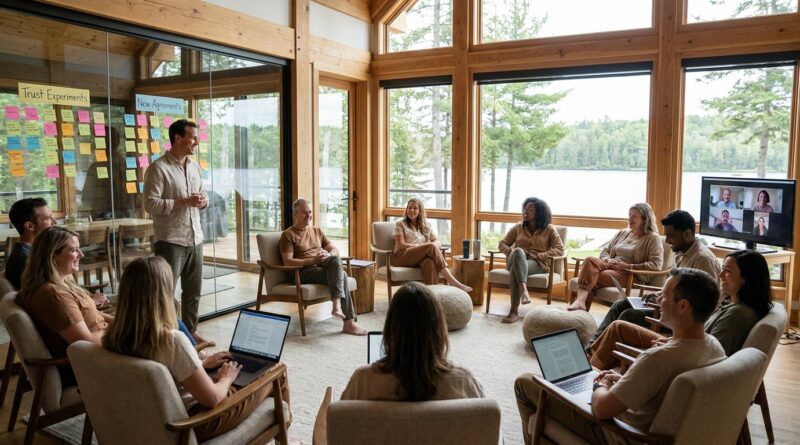
From Offsite To Psychological-Safety Lab: Why 2026’s Smartest Teams Now Use Retreats To Rebuild Trust After RTO Whiplash
People can smell a fake-fun offsite from a mile away. If your team has been jerked between remote, hybrid and back-to-office rules, trust is probably thinner than anyone wants to admit. Morale looks fine on Slack. Then one calendar change, one vague leadership update, or one awkward meeting blows the lid off. That is why the smartest post pandemic corporate retreat ideas to rebuild trust and psychological safety are not built around zip lines, cocktail hours or another keynote about resilience. They are built like a lab. A short, focused, well-facilitated space where people can say what has become hard to say at work, without the usual political risk. Done right, a 48-hour retreat will not magically fix a broken culture. But it can reset the temperature. It can give people language for conflict, clearer team rules, and proof that leaders are willing to hear the truth without punishing it.
⚡ In a Hurry? Key Takeaways
- A retreat rebuilds trust only when it is designed for honest conversation, not forced bonding.
- Use a 48-hour format with clear prompts, ground rules, small-group sessions and specific follow-up commitments.
- Psychological safety is not coddling. It is what helps teams give feedback, make decisions faster and reduce day-to-day drama.
Why the old offsite model is falling flat
Most teams are not starving for snacks, swag or inspirational slides. They are starving for clarity. People want to know what the rules are, whether those rules will change again, and whether speaking up will cost them.
That is the part many leaders miss. After years of mixed return-to-office messages, layoffs across industries, and calendars packed with performative check-ins, employees are often less worried about tools than about safety. Not physical safety. Social safety. Career safety. The safety to say, “This process is not working,” or “I do not understand why we changed course again.”
A traditional offsite often avoids that tension. It tries to smooth it over with energy. But teams can feel the dodge. If trust is bruised, too much fun can actually make people more cynical.
What a “psychological-safety lab” retreat actually looks like
Think less pep rally, more guided reset.
A psychological-safety lab is a retreat format built around structured honesty. It gives people room to talk about friction, workload, decision-making, communication gaps and RTO pain points in a way that is contained and useful.
It has a few key traits
It is time-boxed. People know when a hard conversation starts and when it ends.
It is facilitated. Someone neutral helps keep the room honest, calm and on track.
It is specific. The focus is not “let’s trust each other more.” The focus is “what happens here when someone disagrees with a manager?”
It ends with agreements. Not vague intentions. Real behaviors, scripts and meeting norms.
The real goal is not catharsis
This is important. A trust-building retreat is not a giant vent session. If people leave feeling heard but nothing changes, you have just staged expensive disappointment.
The goal is practice.
Practice saying hard things clearly. Practice receiving feedback without getting defensive. Practice making decisions in a way that people understand, even when they do not get their preferred outcome.
That is why some of the best post pandemic corporate retreat ideas to rebuild trust and psychological safety look a little more like workshops than parties. They create muscle memory.
What to include in a 48-hour trust reset
1. A brutally clear opening
Start with the truth. Name the awkwardness in the room. Something simple works best: “A lot of teams have had whiplash since 2020. We are not here to pretend that did not happen. We are here to talk about how we want to work now.”
That one move matters. It tells people they do not have to play along with a fake script.
2. Ground rules that protect candor
Before any deep conversation, agree on how the room works. Keep it plain:
- Speak from your own experience.
- Critique systems and behaviors, not people’s character.
- No interrupting.
- No punishing honesty later.
- Confidential examples stay private. Patterns can be shared.
If leaders will not agree to those rules, do not run the retreat. The team will see right through it.
3. Small-group honesty sessions
Big-room vulnerability is overrated. Small groups of four to six usually work better. Give people prompts like:
- What has felt hardest about how we work together this year?
- What do you wish leadership understood about the RTO experience?
- Where do meetings, messages or decision-making break trust?
- What helps you feel safe enough to disagree?
Write patterns down. Not names. Not gossip. Patterns.
4. A “stop, start, continue” session for leadership
This is where the retreat starts earning its keep.
Ask the team what leaders should stop doing, start doing and continue doing. Then have leaders reflect back what they heard. No rebuttal. No “just to add context.” Just listening first.
That moment often does more for trust than a dozen culture campaigns.
5. Rehearsed brave conversations
Yes, role-play. Done well, it works.
Give people real workplace scenarios:
- A manager changes priorities without explanation.
- A teammate dominates meetings.
- An employee is anxious about flexibility but afraid to ask.
- Someone disagrees with an RTO expectation.
Then practice the conversation. Keep it simple and short. The point is not acting. The point is giving people words they can actually use next Tuesday.
6. Decision-making rules
Many trust problems are really decision problems. Teams get upset when they do not know who decides, how input is used, or whether a discussion was ever truly open.
Use the retreat to answer basic questions:
- Which decisions need team input?
- Which decisions belong to the manager?
- How will we communicate changes?
- What response time should people expect?
When the rules are fuzzy, people fill in the blanks with fear.
7. One-page team agreements
End with a shared working agreement. One page. Short sentences. Easy to revisit. Include things like:
- How we raise concerns
- How we handle meeting overload
- How we disagree respectfully
- How we explain priority changes
- When in-person time is actually worth the commute
What leaders often get wrong
They make it too glossy
If the retreat feels overproduced, people may assume the truth is not welcome. A polished event is fine. A sanitized one is not.
They ask for openness, then get defensive
This is the fastest way to break trust twice. If you invite honesty, you have to survive hearing it.
They confuse comfort with safety
Psychological safety does not mean every conversation feels nice. Sometimes it feels awkward. Sometimes people disagree. Safety means that disagreement does not turn into humiliation or retaliation.
They skip follow-through
If nothing changes after the retreat, the next invitation will land with a thud. People do not need another promise. They need evidence.
How to make the retreat feel worth the trip
Make every in-person hour do something Zoom cannot.
That means fewer presentations, more interaction. Fewer updates people could read in a memo, more moments where nuance matters. If a session could have been an email, cut it.
A simple test helps. Ask, “Why must this happen in the same room?” If there is no strong answer, it does not belong on the agenda.
Good retreat ideas that do not feel cheesy
You do not need to ban fun. You just need to earn it.
Try these instead of forced bonding
- Manager ask-me-anything sessions. Anonymous questions, direct answers.
- Conflict pattern mapping. Teams identify where work tends to go sideways.
- Commute-worth-it workshop. Define which activities deserve in-person time.
- Feedback drills. Short, guided practice rounds with scripts.
- Red flag and green flag boards. People post behaviors that hurt trust and behaviors that build it.
- Decision diary review. Look at recent big calls and ask what communication helped or hurt.
Then, after the hard work, do something relaxed. Dinner. A walk. A low-pressure activity. Not every minute has to be intense. But trust the order. Honesty first. Fun second.
How to know if it worked
Do not judge success by whether everyone looked happy. Judge it by whether people got clearer.
Look for these signals in the weeks after
- Meetings get shorter because decision roles are clearer.
- Managers explain changes earlier and better.
- People raise concerns sooner instead of simmering quietly.
- Feedback sounds more specific and less personal.
- In-person gatherings feel more purposeful.
You can also run a short pulse check two weeks later and ask:
- I understand how our team will handle disagreement.
- I know what to do when priorities change suddenly.
- I believe I can raise a concern without negative fallout.
- I see at least one behavior from leadership that changed after the retreat.
If trust is badly damaged, bring in help
Some teams can run this themselves. Some should not.
If there has been a messy layoff, a major leadership change, ongoing conflict, or deep frustration around return-to-office policy, a neutral facilitator is worth the money. Not because your team is broken. Because hard conversations go better when no one in the room has to protect their title while guiding the process.
At a Glance: Comparison
| Feature/Aspect | Details | Verdict |
|---|---|---|
| Traditional offsite | Heavy on presentations, light on honest discussion. Fun activities try to boost morale fast. | Fine for celebration. Weak for repairing trust. |
| Psychological-safety lab retreat | Structured conversations, facilitation, behavior practice and written team agreements. | Best choice when morale is fragile and communication needs a reset. |
| Follow-up after the retreat | Leaders repeat new habits, report progress and keep agreements visible in regular work. | This is what turns a good 48 hours into lasting trust. |
Conclusion
Teams are tired. Tired of wellness slogans. Tired of AI noise. Tired of pretending mixed RTO messages did not leave a mark. Underneath all that, many people are still quietly asking one question: does my manager actually have my back? A retreat built as a psychological-safety lab is one of the few ways to answer that question in a concrete, visible way. In one focused 48-hour window, leaders can make hard conversations structured, time-boxed and safe enough to be useful. That matters because the biggest productivity problem right now is not a lack of software. It is a lack of safety. When teams practice brave conversations, feedback rituals and decision rules in person, they go back to work with less guesswork, less drama and more trust. And for once, the commute feels like it was for something real.