From Offsite To Regenerative-Leadership Retreat: Why 2026’s Smartest Teams Now Train Executives Like Climate‑Era Stewards
Your executive team wants the magic of an offsite. Fresh thinking. Better trust. A strategy reset. But here’s the awkward part. If the retreat means long-haul flights, generic luxury hotels, and a few polished sustainability slides between steak dinners, people notice. Employees notice. Boards notice. Even the leaders in the room notice. It starts to feel like a conversation about the future that is strangely stuck in the past. That frustration is real, especially now that companies are being asked to cut carbon, show real social value, and still justify every line of the travel budget. The good news is that a smarter model is taking shape. The post pandemic regenerative corporate retreat for executive teams is less about getting away and more about learning how to lead inside real-world limits. Done well, it becomes a working session, a leadership lab, and a credibility test all at once.
⚡ In a Hurry? Key Takeaways
- A regenerative leadership retreat replaces the old “destination offsite” with an experience designed to change executive behavior, not just produce slides.
- Start with a site close enough to cut travel emissions, build in local community learning, and measure success by decisions made after the retreat.
- This approach helps lower reputational risk and gives boards and employees clearer proof that sustainability is shaping leadership, not just marketing.
Why the old offsite model suddenly looks dated
For years, the executive offsite followed a familiar script. Fly everyone somewhere impressive. Book a private room with good coffee and better views. Bring in a facilitator. Talk about transformation.
That formula is not fully dead. But in 2026, it feels thin.
The reason is simple. The world leaders are trying to manage has changed faster than the way many companies gather leaders together. Climate shocks are affecting supply chains. Employees are more vocal about company values. Hybrid work has changed what “connection” even means. A retreat that ignores all that can feel tone-deaf fast.
People are asking a basic question. If leadership is serious about resilience, sustainability, and responsibility, why does the retreat itself look like an artifact from 2019?
What “regenerative leadership” actually means, in plain English
This phrase can sound a bit airy, so let’s make it concrete.
Sustainability often means doing less harm. Regenerative thinking goes a step further. It asks how leaders can help restore, strengthen, and renew the systems they depend on. That includes natural systems, local communities, employee trust, supplier relationships, and the company’s own culture.
So a regenerative-leadership retreat is not just an offsite with recycled notebooks and a plant-based lunch option.
It is a retreat designed to help executives practice a different kind of decision-making. One that asks:
- What are the long-term effects of this choice?
- Who benefits, and who absorbs the hidden cost?
- How do we build resilience instead of just efficiency?
- How do we leave a place, community, or team stronger than we found it?
That may sound lofty. It is not. It is deeply practical when your business is dealing with risk, regulation, talent retention, and public trust.
Why smart teams are changing the retreat itself, not just the agenda
The old way focused on content. The new way focuses on context.
That shift matters more than most companies realize. Executives can sit in a ballroom and talk about water risk, land use, worker well-being, or community impact. But when they spend time in a landscape dealing with drought, restoration, agriculture, flood protection, energy transition, or local enterprise, the conversation changes.
It gets less abstract. More honest.
This is why the post pandemic regenerative corporate retreat for executive teams is catching on. It treats place as part of the curriculum. Not as scenery.
What that can look like in practice
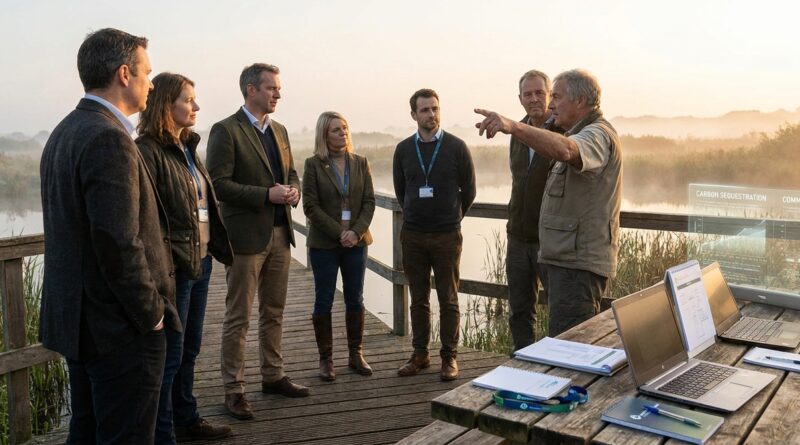
A leadership team might meet at a working farm, restoration site, regional innovation hub, or community-based campus rather than a standard conference resort. They may spend one session with local operators dealing with resource pressure. Another with community leaders or scientists. Another translating those lessons into capital allocation, procurement, workforce planning, or product choices.
The point is not to perform humility for a day. The point is to connect strategy to reality.
Why employees and boards care more now
Because the easy claims are over.
A few years ago, a company could get away with broad ESG language and a polished annual report. Now stakeholders want to see whether those values show up in decisions. Retreats are a surprisingly visible test case.
Employees see executive travel choices as signals. Boards see them as governance issues. Investors see them as culture clues. And in a tighter economy, everyone sees them as a spending decision that should produce more than a nice group photo.
That is why a regenerative retreat works better as a story inside the company. You are not saying, “We spent money to reward the C-suite.” You are saying, “We created a leadership environment built to improve judgment under climate, social, and operating pressure.”
The big difference between a green-themed offsite and a regenerative one
This is where many firms slip.
Green-themed offsite
Add a keynote on sustainability. Serve local food. Maybe buy carbon offsets. Fine as far as it goes, but mostly cosmetic.
Regenerative offsite
Start by redesigning the purpose, the location, the stakeholders in the room, the travel footprint, and the follow-through. Then ask whether the retreat changes how executives make trade-offs afterward.
That last part is the whole game.
How to plan one without making it feel preachy
If you are pitching this to a CEO, CHRO, chief sustainability officer, or chief of staff, keep it grounded. You do not need a manifesto. You need a plan.
1. Pick a business problem first
Do not start with, “We should do a climate retreat.” Start with the pressure the leadership team is already feeling.
- Supply chain volatility
- Talent and culture drift in hybrid teams
- Board pressure on ESG credibility
- Need for better cross-functional decisions
- Reputation risk around travel, sourcing, or operations
Then position the retreat as a way to improve leadership response to that pressure.
2. Choose a place that teaches something
The venue should not just be “nice.” It should help the work. That could mean a regional site connected to food systems, water systems, restoration, manufacturing transition, clean energy, or community enterprise.
Ideally, it is reachable with less flying and more rail or short-haul travel. That matters for both emissions and optics.
3. Build the schedule around experience, not back-to-back presentations
People remember what they saw, felt, and wrestled with. Not slide 47.
A good structure often includes:
- Field-based learning or site immersion
- Facilitated executive reflection
- Cross-functional problem-solving sessions
- Conversations with local experts or community partners
- A decision workshop tied to actual company priorities
4. Keep the group smaller than you think
Not every leader needs to be there. A tight senior group often gets better results than a larger, more ceremonial gathering.
5. Define what happens 30, 60, and 90 days later
This is the part most offsites miss. If nothing changes after the retreat, it was a field trip.
Before the event, decide what post-retreat proof will look like. Maybe it is a new travel policy. Maybe it is a different procurement standard. Maybe it is a revised capital review process that includes resilience and community impact.
What to measure besides “people liked it”
Post-event surveys are fine. They are not enough.
If you want this retreat to survive budget scrutiny, measure outcomes that matter.
Useful success metrics
- Travel emissions compared with the previous offsite model
- Percentage of agenda time spent in applied decision sessions versus presentations
- Number of post-retreat policy or planning changes adopted
- Executive commitments reviewed by the board or leadership committee
- Employee perception of leadership credibility on climate and social responsibility
- Local economic or community value created by the event itself
That gives you a far stronger story than, “The team had good energy.”
Common mistakes that quietly ruin the idea
Making it feel like a branding exercise
If every moment is over-produced, people can smell it. The retreat should create honest discussion, not polished optics.
Flying halfway around the world to talk about reducing impact
This is the obvious one. If the carbon cost is wildly out of step with the message, the retreat undermines itself.
Inviting local communities in as props
This matters. If local partners, land stewards, or community leaders are involved, pay them fairly, give them real voice, and design the exchange with respect.
Forgetting the hybrid team reality
Even a powerful in-person retreat should connect back to the wider organization. Think about what gets shared afterward, and how managers and employees see the learning translated into action.
How to sell this idea internally
If you are the one pushing for change, do not pitch it as a moral upgrade alone. Pitch it as a smarter leadership investment.
Try language like this
“We need an offsite that matches the decisions leaders now have to make. The goal is not just alignment. It is better judgment under climate, cost, talent, and reputation pressure. A regenerative retreat gives us a lower-impact format with clearer outcomes and stronger internal credibility.”
That framing usually lands better with finance, HR, and the board.
What a strong 2026 retreat structure might look like
Day 1: Context and reset
Short arrival window. Lower-impact travel. Opening session on business pressures, not slogans. Small-group discussion on where leadership habits are out of date.
Day 2: Place-based learning
On-site visits and conversations with experts, operators, or community stakeholders. Reflection focused on systems thinking, trade-offs, and blind spots.
Day 3: Decision lab
Executives work through actual company choices using regenerative principles. Procurement, operations, people strategy, investment, product design. End with clear commitments.
Day 4: Translation and accountability
Decide what changes now. Assign owners. Set a board update. Build the internal communication plan so employees see proof, not just pictures.
At a Glance: Comparison
| Feature/Aspect | Details | Verdict |
|---|---|---|
| Traditional executive offsite | Destination-led, presentation-heavy, often weak on follow-through and hard to defend on climate optics | Still common, but increasingly outdated |
| Sustainability-themed retreat | Adds green content and some lower-impact choices, but may leave core leadership behavior untouched | Better than old-school, but often too surface-level |
| Regenerative leadership retreat | Place-based, lower-impact, tied to real business decisions, and measured by actions taken afterward | Best fit for 2026 leadership pressure |
Conclusion
If your company is going to spend real money bringing executives together, the bar is higher now. Boards and employees are both watching how seriously leadership treats climate and social responsibility, and budgets are back only in a cautious, slightly nervous way. That is exactly why a regenerative retreat makes sense. It gives you a clearer reason for the spend, lowers reputational risk, and creates the kind of serious, values-aligned experience hybrid teams have been missing. More importantly, it turns the offsite into proof. Proof that leaders can work in the real world, not just talk about it. Proof that sustainability can shape decisions, not just annual reports. And proof that your 2026 retreat does not have to be another forgettable hotel ballroom event. It can be a practical template you hand to your CEO or HR lead this quarter, with a fresh success metric and a much stronger story behind it.