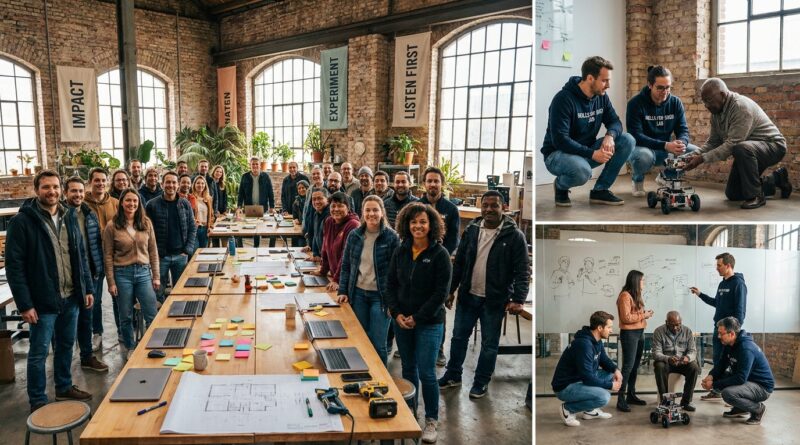
From Offsite To Skills‑For‑Good Retreat: Why 2026’s Smartest Teams Now Trade Trust Falls For Real‑World Impact
Planning a retreat in 2026 can feel like a no-win job. If you book another nice hotel and fill the agenda with slide decks, people will quietly wonder why they left home. If you go too hard on “fun,” leadership may ask what exactly the company got for the spend. That tension is real. Employees now judge every trip by one simple question. Was it worth the commute? A skills based corporate retreat post pandemic gives you a better answer. Instead of asking people to pretend-build trust with icebreakers, you put them on a real challenge with a community partner. They have to listen, solve problems, make decisions fast, and work across roles. That is where culture actually shows up. Done well, this kind of retreat creates something useful for others and something measurable for your business. You get shared purpose, sharper teamwork, and outcomes you can report without stretching the truth.
⚡ In a Hurry? Key Takeaways
- A skills-for-good retreat is often a smarter choice than a traditional offsite because it builds teamwork through real work, not staged activities.
- Start with one clear partner problem, one business skill to practice, and one measurable outcome you can review after the retreat.
- If you want exec buy-in, track both human results and business results, such as cross-team collaboration, process improvements, and community impact.
Why the old offsite model is wearing thin
People are not being difficult when they groan at the word “retreat.” They are reacting to experience.
Too many offsites still follow the same script. Travel. Sit in a conference room. Watch presentations that could have been a video call. Do one awkward bonding activity. Eat dinner. Go home with a tote bag and no real change.
That model was already shaky before remote and hybrid work became normal. Now it looks even weaker. If you are asking people to leave their routines, family time, and focused work blocks, the trip has to feel important. Not just pleasant. Important.
This is why the idea of a skills based corporate retreat post pandemic is getting traction. Teams want time together that feels useful, human, and grounded in something bigger than themselves.
What a skills-for-good retreat actually is
Think of it as a working session with real stakes.
Instead of fake scenarios, your team works with a nonprofit, school, local service group, startup incubator, or civic organization on a real challenge. That challenge should match the strengths your people already have or the skills you want them to build.
Examples that make sense
A product team could help a community health group map user pain points and build a simple prototype.
An operations team could help a food bank redesign intake or routing so volunteers can move faster.
A marketing and design group could create clearer outreach materials for a local youth program.
A data team could help a workforce nonprofit build a clean dashboard that finally answers the right questions.
The point is not charity theater. The point is applied collaboration. Your people practice listening, prioritizing, deciding, and adapting while doing work that matters to someone outside the company.
Why this works better for culture than trust falls ever did
Culture is not built when people catch one another during a staged exercise. Culture is built when people are under a little pressure, have limited time, and still find a way to solve a problem together.
That is why skills-for-good retreats tend to land so well. They bring out the habits teams actually need back at work.
1. They create a shared mission fast
Nothing cuts through cynicism like a real problem. When the work has an actual user, a real deadline, and visible consequences, people focus quickly.
2. They reveal how teams really operate
You see who listens. Who dominates. Who connects dots. Who keeps calm when plans change. That is valuable information for managers and for the team itself.
3. They give quieter people room to shine
Traditional offsites often reward the loudest voice in the room. Community-based problem solving often rewards empathy, observation, and practical thinking. Different people get to lead.
4. They make the trip feel worth it
People can forgive a packed day if it felt meaningful. They rarely forgive travel for another passive meeting block.
If this shift sounds familiar, it lines up with the thinking in From Offsite To Civic-Impact Retreat: Why 2026’s Boldest Teams Trade Trust Falls For Real-World Change, which makes the same basic point. Teams want real-world work, not corporate theater.
How to plan one without turning it into a mess
This idea sounds great until someone asks the obvious question. Fine, but how do we run it without wasting everyone’s time?
Here is the simple version.
Start with one business goal
Do not begin with “let’s do something good.” That is too vague. Start with the capability you want to strengthen.
Maybe your goal is better cross-functional decision-making. Maybe it is faster customer listening. Maybe it is improving manager judgment under time pressure.
Pick one. Two at most.
Choose a partner problem that fits that goal
The partner challenge should naturally call for the skill you want your team to practice.
If your business goal is better product discovery, pick a problem that requires user interviews and rough prototyping.
If your goal is process improvement, pick a partner who needs workflow mapping and simple operational fixes.
This is where many retreats go wrong. The activity is nice, but disconnected from the team’s actual work.
Keep the scope small
Small is not boring. Small is finishable.
A one- or two-day retreat should aim for something concrete. A tested prototype. A clearer intake flow. A content toolkit. A pilot dashboard. A process map with next steps.
If you promise a grand transformation, you set everyone up for disappointment.
Prepare the partner well
Your community partner is not a prop. They need a briefing, a clear point of contact, agreement on scope, and a realistic sense of what your team can deliver.
The best retreats treat the partner like a client. Respectful. Structured. Clear on outcomes.
Build in reflection, not just activity
The work matters. So does the debrief.
Ask teams what they noticed about how they made decisions. Where they got stuck. What helped them move faster. What they would copy back into their normal work.
That is where a good retreat turns into lasting behavior change.
How to prove ROI to skeptical leadership
This is usually the sticking point. Execs are not wrong to ask what they are getting.
The answer should not be “better vibes.” It should be specific.
Track three kinds of outcomes
Team outcomes: Did cross-functional groups work better together? Did managers practice delegation? Did communication improve under time pressure?
Business outcomes: Did the retreat produce a usable prototype, process fix, or tested idea that can move into normal workflow?
Community outcomes: Did the partner receive something they can actually use? Can they point to time saved, clarity gained, or a better service experience?
Use simple before-and-after measures
You do not need a giant research project. Use practical checks.
Survey confidence in cross-team problem solving before and after.
Track how many ideas move into real pilots within 30 days.
Ask the partner what changed for them.
Note whether teams resolve post-retreat work faster because they built trust through doing.
Report it in business language
Do not frame the retreat as a feel-good event. Frame it as applied learning with measurable outputs.
For example:
“The retreat produced a user-tested prototype, surfaced two process bottlenecks we later fixed internally, and improved collaboration between product, support, and operations.”
That is much easier to defend in a QBR than “people seemed energized.”
Common mistakes to avoid
Even a strong idea can fall flat if the setup is sloppy.
Do not overpack the agenda
If every hour is scheduled, people have no room to think, adjust, or reflect. Leave breathing space.
Do not pick a problem that needs experts your team does not have
Your engineers should not be doing trauma counseling. Your sales team should not be redesigning a public health system from scratch. Match the challenge to the skills in the room.
Do not make the community piece purely symbolic
People can tell when the “impact” is mostly for photos. The work should be useful, not decorative.
Do not forget follow-through
If the retreat creates good work and then no one touches it again, the momentum dies. Decide before the event who owns next steps.
What a good agenda can look like
You do not need a five-day production. A compact format often works better.
Day 1
Briefing on the partner and challenge.
Small-group discovery sessions.
User or stakeholder interviews.
Problem framing and idea selection.
Day 2
Build, map, or draft solutions.
Test with partner feedback.
Final handoff and team debrief.
Internal reflection on what to bring back into daily work.
That structure is simple enough to run, but rich enough to produce real insight.
Why this matters more after the pandemic
Work has changed. People have changed with it.
Employees are more protective of time. They are less impressed by performative culture. They want flexibility, yes, but they also want purpose when they do gather in person.
Leadership has changed too. Budgets are watched more closely. Travel has to earn its place. Team events are expected to support retention, performance, and brand, not just morale.
A skills based corporate retreat post pandemic speaks to both sides. It respects employee time because the gathering has meaning. It respects leadership scrutiny because the work produces evidence.
At a Glance: Comparison
| Feature/Aspect | Details | Verdict |
|---|---|---|
| Traditional offsite | Often heavy on presentations, light on real collaboration, and hard to tie to business outcomes. | Easy to run, but often weak on meaning and ROI. |
| Skills-for-good retreat | Teams solve a real community challenge using work skills like research, design, planning, and communication. | Best option for culture building that also creates measurable results. |
| Executive reporting | Can include output delivered, skills practiced, partner feedback, and ideas carried into normal business. | Strongest when you define success before the trip starts. |
Conclusion
If you are being asked to plan a retreat that does more than burn budget, this is the shift worth making. Post-pandemic, employees are ruthlessly filtering every trip through a “worth the commute” lens, while leadership needs proof that retreats drive performance rather than just morale. A skills-for-good retreat turns your offsite into a compact lab where people practice collaboration, decision-making and resilience under real stakes by helping a community partner, which research and common sense both suggest is exactly the kind of purpose-driven, experiential time together teams now want. Better still, it gives you hard outcomes you can point to in QBRs. A product prototype co-designed with users. A faster internal process tested in the field. A measurable impact story that strengthens employer brand and local relationships. That is not forced fun. That is time together with a point.