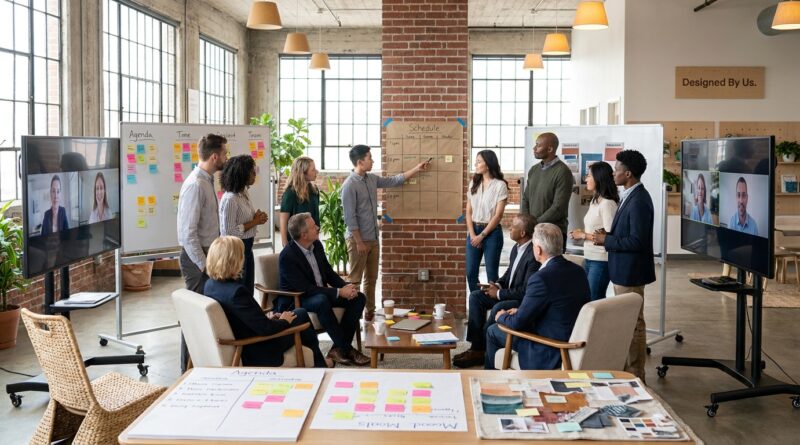
From Offsite To Role-Reversal Retreat: Why 2026’s Smartest Teams Now Let Employees Design The Agenda
Most corporate retreats still have the same problem. People travel, sit in a nicer chair than usual, and listen to the same voices they hear every week. If you have ever left an offsite thinking, “That could have been an email with snacks,” you are not alone. That frustration is getting sharper in hybrid teams, where some people already feel closer to the inner circle than others. A top-down retreat can make that gap worse. That is why one of the smartest post pandemic corporate retreat ideas is surprisingly simple. Let employees design the agenda. Not every minute, and not without guardrails. But enough to shift the retreat from a broadcast into a working session people actually believe in. The result is usually better discussion, more honest feedback, and clearer proof that the time and travel were worth it.
⚡ In a Hurry? Key Takeaways
- A role-reversal retreat works because employees help build the agenda, which makes the event feel useful instead of performative.
- Start small by giving mixed employee squads ownership over design zones such as session formats, decision rules, and remote inclusion.
- This approach is not just more engaging. It also gives you a repeatable playbook and clearer data on whether the retreat improved trust, belonging, and follow-through.
Why the old offsite format is wearing people out
For years, the standard company retreat followed a familiar script. Leaders set the goals. HR or an events team builds the schedule. Employees show up and do their best to look interested.
That model used to pass well enough. In 2026, it is starting to feel dated.
Post-pandemic work changed the social map of companies. Some people are in the office often. Some are remote. Some are new hires who have barely met colleagues in person. Some are managers who think communication is fine because no one says otherwise. Put all of them into a retreat designed from the top, and the quiet tension usually comes with them.
The problem is not just boredom. It is trust. If a company says it wants candor, inclusion, and real collaboration, but the agenda allows little room for employee input, people notice.
What a role-reversal retreat actually is
A role-reversal retreat does not mean executives disappear and employees run wild. It simply flips one key assumption. Instead of leaders deciding the full experience and everyone else reacting to it, employees help shape the structure, priorities, and rules of the gathering.
What employees can own
In a practical setup, leadership still sets the business context. For example, the company may need to improve cross-team handoffs, fix hybrid meeting habits, or decide how often people gather in person. But employee squads design how those conversations happen.
They can own things like:
- Session formats
- How feedback is collected
- How live and remote voices are included
- How decisions are documented
- What counts as a useful outcome by the end of the retreat
That shift sounds small. It is not. It changes the emotional temperature of the whole event.
Why this works better for hybrid teams
Hybrid work created a quiet class system in many companies. The insiders often have more hallway access, more accidental visibility, and more confidence speaking up. The outsiders, usually remote staff, newer hires, or people outside headquarters, can end up attending the same company but not quite the same culture.
An employee-designed agenda helps because the people who feel the friction most clearly are finally allowed to name it.
It surfaces real problems fast
Executives may think the issue is alignment. Employees may say the real issue is that key decisions happen after the meeting, in side chats. Leadership may want a strategy block. Employees may want a live exercise showing why remote participants get sidelined in under ten minutes.
That is exactly the point. The retreat becomes a place to expose the gap between official process and lived reality.
It turns skeptics into contributors
The most skeptical employees are often the most useful ones in this format. They know where previous retreats wasted time. They know which “interactive” sessions were theater. When you ask them to co-design instead of just attend, you move them from eye-rolling critics to practical builders.
How to pilot this without creating chaos
You do not need to hand over the whole retreat. In fact, you should not. The best pilots use clear boundaries.
Step 1: Set the non-negotiables
Leadership should define a few firm points before inviting employee input:
- The retreat’s business goals
- The budget and time limits
- Any legal, policy, or confidentiality rules
- The decisions that must be made by the end
Think of this as building the walls of the room. Employees can then arrange the furniture inside it.
Step 2: Create diverse design squads
Build small squads with a mix of roles, locations, seniority, and work styles. Do not stack them with the usual high-visibility people. Include remote staff, individual contributors, newer employees, and the people who often get invited late to planning discussions.
Each squad gets one design zone. For example:
- Session Flow Squad: How long sessions should run and how to keep them active
- Decision Rules Squad: How the group will make choices and record them
- Remote Inclusion Squad: How remote voices will be heard in real time
- Belonging Squad: How to make the gathering feel welcoming, not cliquish
Step 3: Ask for prototypes, not opinions
Do not ask, “What would make the retreat better?” That often gets you vague wish lists.
Ask for prototypes. A sample opening activity. A draft decision board. A live chat rule for remote attendees. A two-page guide for moderators. Concrete beats abstract every time.
Step 4: Test one or two changes before the full retreat
If possible, use a team meeting or quarterly check-in as a dress rehearsal. You will spot issues early, and employees will see their ideas taken seriously.
What good employee-designed agendas usually include
The best ones are not packed with games for the sake of games. They focus on removing dead space and making participation fair.
Shorter executive airtime
Employees often cut long leadership presentations faster than any consultant would. Not because they dislike leadership, but because they know the room tunes out after a point.
Clearer decision moments
Many retreats talk a lot and decide very little. Employee designers tend to push for visible decision points, owners, and deadlines. They want proof the retreat mattered.
Better live input from remote participants
This is one of the biggest wins. Employees who have been the tiny face on the screen know exactly what does not work. They often design smarter fixes, such as rotating in-room advocates, equal speaking rounds, shared digital boards, and moderator scripts that force inclusion instead of hoping for it.
Honest friction sessions
These are not complaint festivals. Done well, they are structured discussions on where work breaks down. Think cross-functional handoffs, meeting overload, unclear ownership, or office-first habits that hurt remote teammates.
That kind of session is often more useful than another polished keynote.
How this connects to retreat value and budget pressure
Companies are under more pressure now to prove every trip is worth it. That includes morale-focused events. Nobody wants to spend heavily on flights, venues, and time away from work only to produce a few nice photos and no lasting change.
A role-reversal retreat helps because it creates output you can reuse. You are not just hosting an event. You are collecting working rules, facilitation ideas, inclusion practices, and team agreements that can shape every future gathering.
That also pairs naturally with another growing trend. Some teams are rethinking the trip itself, not just the agenda. If your employees are already pushing for more thoughtful travel, it is worth seeing how planners are also adjusting the experience in From Offsite To Bleisure-Retreat: Why 2026’s Smartest Teams Now Let People Add Real Vacation To Company Trips. The common thread is simple. People want company gatherings to respect both their time and their reality.
How to measure whether it worked
If you want this idea to survive beyond one experiment, measure it against your last top-down offsite.
Look at engagement
Track basic signals. Who spoke. Who contributed in writing. How many sessions ran on time. How often remote participants were brought in without prompting.
Check belonging and trust
Use a short survey right after the retreat and again a few weeks later. Ask questions such as:
- Did you feel your perspective was represented in the agenda?
- Did the retreat make collaboration feel easier or clearer?
- Did the event surface real problems we usually avoid?
- Would you want this design approach used again?
Measure post-retreat output
This is where many offsites fail. Track what actually happened after people went home. Were decisions documented? Did owners follow through? Did any new meeting norms or hybrid practices stick?
If the answer is yes, the retreat was not just more pleasant. It was more useful.
Common mistakes to avoid
Do not fake participation
If leaders ask for employee design input and then quietly override everything, people will spot it instantly. That usually does more damage than never asking in the first place.
Do not make it a popularity contest
The loudest or funniest ideas are not always the best. Give squads clear criteria so they build for the retreat’s goals, not for applause.
Do not confuse freedom with zero structure
People need boundaries. Too much openness creates confusion and delays. Good role-reversal retreats are guided, not random.
Do not skip documentation
If great ideas come out of the retreat but live only in someone’s notebook, you lose half the value. Capture the formats, rules, and lessons in a shared playbook.
At a Glance: Comparison
| Feature/Aspect | Details | Verdict |
|---|---|---|
| Agenda ownership | Traditional offsites are mostly designed by leadership or HR. Role-reversal retreats give employee squads ownership of key design zones within clear limits. | Employee-designed wins for buy-in and honesty. |
| Hybrid inclusion | Top-down formats often treat remote access as a technical add-on. Employee-led design usually builds remote participation into the session rules from the start. | Role-reversal is better for mixed-location teams. |
| Post-retreat usefulness | Old-school retreats can feel inspiring in the moment but fuzzy afterward. Employee-designed retreats tend to produce clearer playbooks, owners, and follow-up actions. | Better return on time and budget. |
Conclusion
Right now, teams are stuck between old-school offsites that burn budget and “fun,” and new pressure to prove every in-person gathering actually moves work forward. A role-reversal retreat is a practical answer to that tension. It turns skeptical employees into co-designers, brings hidden hybrid friction into the open, and creates bottom-up playbooks you can use again instead of starting from scratch each time. The easiest way to test it is with your next quarterly meetup. Assign diverse employee squads a few clear design zones, such as how sessions run, how decisions are made, and how remote voices are included live. Then compare engagement, belonging, and post-retreat output against your last top-down offsite. You may find the smartest retreat idea is not a flashier venue or a bigger speaker. It is trusting your own people to help build the room they are being asked to sit in.