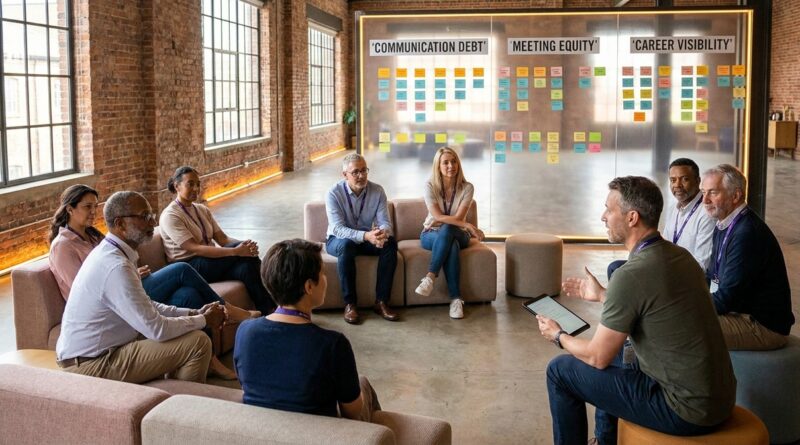
From Offsite To Trust-Reset Retreat: Why 2026’s Smartest Teams Now Use Offsites To Fix Hybrid Inequity, Not Just ‘Team Spirit’
Nothing kills the mood faster than flying everyone to a nice resort, handing out branded hoodies, and then pretending the real problem is “team bonding.” Employees are not confused. They can tell when a retreat is built to make leadership feel good, not to fix what daily work actually feels like. For many hybrid teams, that frustration has a name now. Proximity bias. The people who happen to be near the office, or near the boss, keep getting the side conversations, the quick clarifications, and the quiet career advantages. Everyone else notices. They just do not always say it out loud. That is why the smartest post pandemic corporate retreat ideas for hybrid trust rebuilding are changing fast. The goal is no longer forced fun. It is trust repair. A good retreat in 2026 gives people a safe way to talk about hybrid inequity, reset broken habits, and agree on new rules that still work after everyone goes home.
⚡ In a Hurry? Key Takeaways
- Smart teams now use retreats to fix hybrid trust gaps and proximity bias, not just boost morale for a weekend.
- Build the agenda around honest discussion, shared rules, and follow-up habits, not endless presentations and icebreakers.
- If people leave with clear working agreements and safer ways to speak up, the retreat has real value after the flight home.
Why the old offsite model is falling flat
The classic company retreat was built for a different era. Get everyone in one place. Share strategy. Have a dinner. Maybe do a ropes course. Then assume people feel connected again.
That formula feels thin now, especially in hybrid teams. The tension employees carry is not just social. It is structural. Who gets looped in early. Who gets face time with decision-makers. Who hears the hallway update that never makes it into Slack. Who feels safe disagreeing in a room full of people who spend more time together in person.
If your retreat ignores that, people notice. The event starts to feel like office PR. Nice photos. Fancy venue. Same old power dynamics.
What a trust-reset retreat actually does
A trust-reset retreat starts from a more honest question. Not “How do we raise morale?” but “What is making work feel unfair, unsafe, or uneven?”
That is a very different kind of gathering.
Instead of asking people to perform enthusiasm, it asks them to help redesign how the team works. The best sessions are practical. They dig into communication, decision-making, meeting behavior, visibility, feedback, and career access.
This is why many leaders are moving away from slide-heavy agendas. If your team is tired of ballroom presentations, it is worth looking at From Offsite To Creative-Residency Retreat: Why 2026’s Smartest Teams Now Make Art Instead Of Slide Decks. It captures a broader shift. People want experiences that create honesty and shared understanding, not more passive listening.
The real issue is hybrid inequity
Hybrid inequity sounds abstract until you list what it looks like in real life.
It shows up in visibility
Some employees get remembered because they are physically present. They are seen working late. They run into leaders. They get invited into spontaneous chats. Remote and part-time office workers often have to work twice as hard to create the same impression.
It shows up in information flow
Important context still travels through side conversations. Someone hears a concern after a meeting. Someone gets a quick office correction before a project goes off track. Someone else, working remotely, gets none of that.
It shows up in safety
When a few people have stronger in-room chemistry, others may hesitate to challenge decisions. They worry they are missing subtext. They worry they look negative. Over time, silence becomes a habit.
This is exactly what a retreat can address, if leadership is brave enough to let it.
What to include in a post-pandemic retreat for hybrid trust rebuilding
1. Name the problem plainly
Do not hide behind soft language. Say that hybrid work has created uneven access to information, influence, and opportunity. People relax when leadership stops pretending everything is fine.
You do not need a blame session. You do need honesty.
2. Use neutral facilitation
If the whole retreat is run by the same leaders employees are nervous about, many people will self-censor. A neutral facilitator can help create a safer room, set ground rules, and keep powerful voices from swallowing the conversation.
3. Gather input before the trip
Anonymous surveys work well here. Ask very specific questions.
- Where do you feel left out of decisions?
- What parts of hybrid work feel unfair?
- When do meetings favor people in the room?
- What makes it harder to speak up?
This gives you real themes to work on instead of guessing.
4. Design for small-group honesty
Most people will not share a sensitive concern in front of 80 coworkers. Break into smaller groups. Mix functions, seniority levels, and work locations. Give people structured prompts, not vague instructions to “connect.”
5. Turn complaints into working agreements
This is the step many retreats miss. If someone says, “Decisions get made after the meeting,” the group should build a rule in response. For example:
- Major decisions must be summarized in a shared channel within 24 hours.
- No project direction changes through private side chats alone.
- Meeting leaders must actively include remote voices first in key discussions.
That is when a retreat stops being emotional theater and starts becoming useful.
6. Make managers practice new behaviors live
Do not end with a PDF. Use role-play, mock meetings, and feedback rounds. Have managers practice running inclusive meetings, sharing context clearly, and responding well to dissent.
Awkward? Maybe. Worth it? Absolutely.
What leaders often get wrong
They confuse fun with trust
A fun dinner can help people warm up. It cannot fix a system people believe is unfair. Trust comes from consistency and fairness, not just good catering.
They over-program the event
If every minute is packed, people have no room to process or speak honestly. Leave white space. Some of the most important conversations happen in structured reflection, not in another keynote.
They skip the hard follow-up
The retreat ends. People go home. Nothing changes. That is the fastest way to make next year’s event feel cynical.
If you ask for honesty, you need to show what you heard, what you are changing, and what will take longer.
Simple retreat formats that work better in 2026
If you are hunting for post pandemic corporate retreat ideas for hybrid trust rebuilding, start with formats that create participation, not passive attendance.
Hybrid fairness labs
Teams map moments where work becomes unequal. Then they redesign those moments together. Think meetings, promotions, onboarding, project updates, and performance reviews.
Psychological safety sessions
Not fluffy. Practical. What makes people hold back. What signals make disagreement feel risky. What leaders do that shuts conversation down, even by accident.
Decision transparency workshops
Pick a few real examples of confusing decisions. Walk backward through how they were made. Then build a better process the team can use later.
Manager listening circles
Small groups. Clear rules. Managers listen first, ask clarifying questions second, and defend themselves never. That alone can change the tone of a retreat.
Co-creation blocks
Use working sessions to write actual team agreements. Do not wait until later. People support what they help build.
How to tell if the retreat worked
Do not judge success by applause, photos, or survey scores collected in the airport lounge.
Look 30, 60, and 90 days later.
- Are meetings more balanced between in-room and remote staff?
- Are decisions documented more clearly?
- Are managers changing how they communicate?
- Are quieter employees speaking up more often?
- Do people report less confusion about who gets access and why?
If the answers are yes, your retreat did something rare. It changed daily work, not just a weekend mood.
One smart way to frame the event
Sometimes the language matters as much as the format. “Offsite” sounds like a calendar item. “Trust reset” sounds like what it is. A serious pause to repair how the team functions.
That framing helps employees understand this is not another pep rally. It is a working session with a human center.
At a Glance: Comparison
| Feature/Aspect | Details | Verdict |
|---|---|---|
| Traditional offsite | Strategy decks, social events, broad morale messaging, little discussion of hybrid unfairness | Feels polished, but often changes very little |
| Trust-reset retreat | Honest discussion of proximity bias, structured listening, co-created team rules, manager practice | Best option for rebuilding trust and fairness |
| Follow-up after the event | Shared commitments, visible progress updates, accountability for leaders and managers | Essential, or the whole retreat risks feeling performative |
Conclusion
Employees are not asking for another forced-fun retreat. They are asking for fairness, clarity, and proof that hybrid work will not quietly split the company into insiders and outsiders. That is why the best retreats now feel less like a celebration and more like a reset. Right now, engagement is sliding and employees are increasingly vocal that traditional retreats feel out of touch and one-sided. Giving people a clear, brave space to unpack hybrid inequity, rebuild psychological safety and co-create new working agreements turns a mandatory trip into a landmark cultural moment that actually improves day-to-day collaboration when everyone goes home.