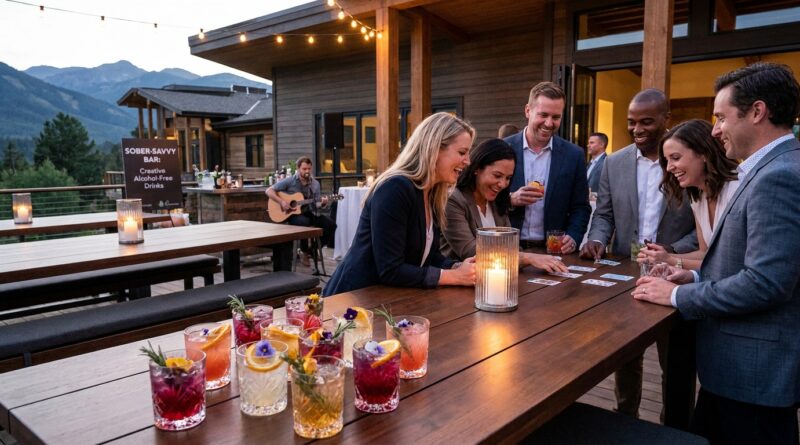
From Offsite To Sober‑Savvy Retreat: Why 2026’s Smartest Teams Now Trade Open Bars For Ritual Mocktail Clubs
You can feel the waste in the room. The company is paying resort prices for an open bar, half the team is nursing one drink for two hours, and the people who do not drink are quietly checking the time. Then leadership wonders why the big bonding night feels forced. That frustration is real, especially now that more younger employees are drinking less, asking for healthier options, or skipping alcohol altogether. A sober curious corporate retreat is not about making things dull or preachy. It is about designing evenings people actually want to join. The smartest teams in 2026 are swapping the old “free drinks equals fun” formula for ritual mocktail clubs, guided conversation, music, small sensory moments, and low-pressure social energy. The result is often better than the old model. People stay present. Introverts are not sidelined. The next morning starts sharper. And the event finally feels like culture, not just catering.
⚡ In a Hurry? Key Takeaways
- A sober curious corporate retreat can feel more social and memorable than a standard open-bar offsite when the evening is built around rituals, not just drinks.
- Start with one mocktail-led evening: a welcome drink, a simple group activity, conversation prompts, and a short wind-down moment.
- This format cuts alcohol spend and liability while making the event more inclusive for non-drinkers, anxious attendees, and quieter team members.
Why the old open-bar playbook is starting to fail
For years, retreat planning ran on autopilot. Book the hotel. Add the buffet. Open the bar. Put on a playlist. Hope chemistry happens.
That worked better when team culture was built around late nights and expense accounts. It works a lot worse now.
Post-pandemic teams are different. People are more health-aware. Some are sober curious. Some are managing anxiety, sleep, medication, or burnout. Others simply do not enjoy centering every social moment on alcohol. Yet a lot of retreat schedules still act like it is 2014.
That mismatch creates a strange vibe. The company spends big money on alcohol, but the energy is flat because the format no longer fits the people in the room.
What a “ritual mocktail club” actually means
Do not picture a sad fruit juice station in the corner. That is the old mistake.
A ritual mocktail club is a hosted social experience. The drink matters, but it is not the whole event. Think of it more like a coffee ceremony, tasting room, or dinner party with structure.
The key parts
A good version usually includes:
- A signature zero-proof welcome drink on arrival
- A short story or theme behind each drink
- Simple participation, like choosing herbs, garnishes, or flavor profiles
- Table prompts or guided conversations
- A light sensory element, such as candles, live acoustic music, or tea service
- A natural ending, not a blurry one
This gives people something to do, not just something to consume.
Why younger employees respond so well to it
Gen Z and many millennials are not rejecting fun. They are rejecting stale formulas.
They tend to value experiences that feel intentional, social, and healthy enough that tomorrow is not ruined. They also tend to notice when an event says “inclusion” during the keynote but quietly makes alcohol the main social tool after dinner.
A sober curious corporate retreat sends a clearer message. It says: we want everybody here, not just the loudest drinkers.
It helps the people who usually disappear
At a typical open bar, three groups often fade into the background:
- People who do not drink
- People who drink lightly and stop early
- People who find noisy, unstructured mingling draining
When the evening has a bit of shape, those people have a way in. That changes who speaks, who connects, and who leaves feeling included.
The business case is stronger than it looks
This is not just a wellness trend. It is also a practical operations decision.
1. You can cut waste
Open bars are expensive. Premium liquor packages, extra staffing, glassware, late-night service, and transport all add up fast. If your team is only lightly drinking, that budget is not buying much value.
Many retreat planners now move part of that spend into better food, a custom zero-proof menu, lounge-style seating, facilitation, or a next-morning wellness activity. People notice those upgrades more than unlimited vodka sodas.
2. You reduce risk
Leadership teams are not imagining the liability issue. It is real. Alcohol raises the chance of injuries, harassment claims, oversharing, bad judgment, and ugly next-day fallout. Even one incident can overshadow the whole retreat.
A sober-savvy format lowers the temperature without killing the mood.
3. You get better next-day participation
No planner wants to spend heavily on a strategy session that starts with half the room tired, foggy, and hiding behind coffee. If the evening is lively but low-proof, the morning gets better. Attendance improves. Attention improves. People are less likely to regret the night before.
How to redesign one evening without making it weird
This is where some teams stumble. They remove the bar but forget to replace the social engine.
That is the whole game. If you take away the old default, you need a new structure that still feels relaxed.
Use this simple model
1. Start with an arrival ritual.
Have staff greet each person with a signature mocktail. Give it a name that fits the retreat theme. Keep it pretty, not preachy.
2. Add a tiny moment of participation.
Let guests choose a garnish, botanical, tea base, or aromatic spray. People like customizing things. It breaks the ice fast.
3. Give the room a social prompt.
Place conversation cards on tables. Keep them light but meaningful. Try prompts like “What is one thing your role taught you this year?” or “What habit helps you recover after a hard week?”
4. Build in one shared experience.
This could be a 15-minute guided tasting, a group toast, a local herbalist demo, or a chef-led pairing. It gives the night shape.
5. End with a soft landing.
Offer herbal tea, a dessert bite, and an easy wind-down. People leave feeling looked after, not cut off.
What to serve so people do not miss the alcohol
The secret is depth. Adults do not want a glass of sugar with a mint leaf floating in it.
Better mocktail programs use bitterness, spice, smoke, citrus, tea, botanicals, and texture. That gives the drink the same “special occasion” feel people expect from a cocktail.
Mocktail ideas that work well at retreats
- Grapefruit rosemary spritz with tonic and sea salt
- Blackberry basil cooler with lime and sparkling water
- Smoked lapsang tea highball with orange peel
- Ginger yuzu fizz with mint
- Cucumber elderflower cooler with cracked pepper
If the budget allows, bring in a real zero-proof bartender. Presentation matters. People are much more open to this when the drink in their hand feels like an experience, not a compromise.
How to sell the idea internally
Some executives will worry that removing the open bar makes the event feel cheap or overly controlled.
Do not frame it as taking something away. Frame it as upgrading the experience.
Try this pitch
“We are shifting part of the beverage budget into a hosted evening experience that is more inclusive, lower risk, and more memorable. Guests will still have excellent drinks, but the focus is connection and energy, not overconsumption.”
That language tends to land better than “we are cutting alcohol.”
Mistakes to avoid
Not every alcohol-light retreat succeeds. The misses are usually predictable.
Do not make it moral
This is not about judging people who drink. A sober curious corporate retreat works best when it feels inviting, stylish, and optional, not righteous.
Do not leave people standing around
If you remove the bar but offer no structure, people will feel the gap immediately. Give the room rhythm.
Do not hide the non-alcoholic options
If the zero-proof drinks look like an afterthought, the whole concept falls apart. Make them the stars.
Do not force vulnerability
Guided conversation is good. Mandatory emotional confession is not. Keep prompts thoughtful but light enough for work.
A sample evening agenda that actually works
Here is a practical template for a 90-minute retreat social block:
6:30 PM. Arrival and signature mocktail
6:40 PM. Short welcome from host or team lead
6:45 PM. Choose-your-flavor mocktail station opens
7:00 PM. Passed appetizers and table prompts begin
7:20 PM. 10-minute guided tasting or local ingredient story
7:35 PM. Casual mingling with acoustic music or playlist
8:00 PM. Optional tea and dessert transition
8:15 PM. People break naturally into smaller conversations, board games, fireside chat, or early night
Notice what is missing. No pressure to “rage.” No dead air. No awkward scramble to create fun from scratch.
When it makes sense to keep some alcohol
This does not have to be all or nothing.
Many teams do best with a mixed model. For example, one wine table at dinner, plus a strong mocktail program and a non-alcohol-centered evening design. That often satisfies everyone without making alcohol the main event.
The point is not prohibition. The point is proportion.
At a Glance: Comparison
| Feature/Aspect | Details | Verdict |
|---|---|---|
| Open bar model | High cost, uneven participation, more liability, often weak next-morning energy | Familiar, but increasingly poor fit for many 2026 teams |
| Ritual mocktail club | Hosted zero-proof drinks, social prompts, sensory touches, better inclusion | Best choice if you want memorable connection without the usual downsides |
| Hybrid approach | Limited alcohol plus premium non-alcoholic options and a structured evening plan | A smart transition option for companies not ready to go fully sober-savvy |
Conclusion
Retreat planners are under real pressure right now. Alcohol spend is high, engagement can be hit or miss, and leadership is understandably nervous about risk at a time when employees are drinking less but stress and burnout are still running high. That is why the sober-savvy shift matters. A sober curious corporate retreat can cut waste, lower liability, and create a more welcoming social atmosphere at the same time. Just as important, it gives quieter people and non-drinkers a real seat at the table instead of asking them to adapt to a night built for someone else. The best part is that this is not about stripping away fun. It is about designing it on purpose. With ritual mocktails, guided conversation, and light wellness moments, the most awkward part of the offsite can become the part people remember most fondly.