From Offsite To Flex‑Location Retreat: Why 2026’s Smartest Teams Now Let People Join From Any City, Not Just The Venue
You can feel the trap coming. Leadership wants an in-person retreat because “people need face time,” but your team lives in six cities, two countries, and at least three time zones. A few people can travel. A few really cannot. Parents have school pickup. Caregivers have limits. One key manager has a visa issue. And everyone who joins by laptop knows what usually happens next. They become tiny boxes on a wall, ignored after the first hello. That is not a retreat. That is a very expensive reminder of who had the easiest trip. Smart teams in 2026 are moving to a better model: the flex-location retreat. Instead of forcing everyone into one venue, you design one shared event that happens at the same time across several cities, homes, and small local hubs. It keeps the energy of a real retreat, without pretending every good employee can just hop on a plane.
⚡ In a Hurry? Key Takeaways
- A flex-location retreat is one shared retreat experience designed for multiple cities and remote participants, not one room with remote leftovers.
- Start by planning for equal participation first, then choose one main venue, a few local hubs, and clear sessions that work across time zones.
- This approach cuts travel costs, includes parents and caregivers, and lowers the risk of excluding great people who cannot travel.
What a flex-location retreat actually is
If you are searching for hybrid corporate retreat ideas for distributed teams, this is the one worth paying attention to.
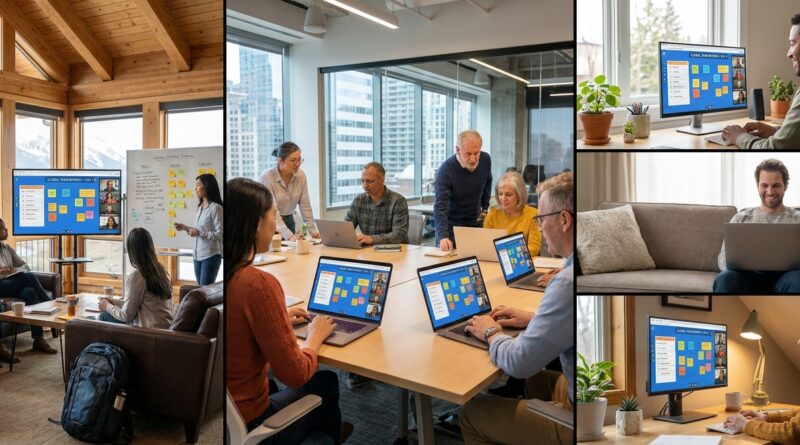
A flex-location retreat is not “some people are in the room and others dial in.” It is a retreat built from the start for mixed attendance. One group may gather at a main venue. Smaller groups may meet in local coworking spaces or hotels in other cities. Some people may join from home for part of the day. The key is that every person joins the same agenda, same decisions, and same shared moments.
Think of it like a live TV broadcast crossed with a workshop. There is one event clock. One set of goals. One social plan. But attendance happens in more than one place.
Why the old offsite model is breaking down
The classic offsite assumed a simpler world. Most people lived near one office, or at least in the same region. Travel budgets were easier to approve. Teams were less spread out. That world is gone for many companies.
Now you may have top performers who were hired remotely on purpose. You may also have workers who are happy to travel once a year, but not three flights and two nights away from family. If your retreat only works for frequent travelers, it is not really a culture event. It is a filter.
That is why so many leaders are rethinking what gatherings are for. In fact, if your retreat is also meant to fix collaboration habits, it is worth reading From Offsite To Alignment Retreat: Why 2026’s Smartest Teams Now Use Gatherings To Fix Their Hybrid Work Rules In 48 Hours. It gets at the bigger shift. Teams are no longer gathering just to be seen. They are gathering to solve how they work.
The big idea: same moment, different places
This is the part many companies miss. The magic of a retreat is not the plane ticket. It is the shared moment.
People remember the tough conversation that finally got resolved. The customer story that changed priorities. The silly team challenge that made two departments stop acting like strangers. None of that requires everybody to sleep in the same hotel.
What does require care is the event design.
Good flex-location retreats have three layers
Layer 1: Shared live moments. These are your all-hands sessions, strategy updates, Q&As, team wins, and company-wide activities. Everyone attends at the same time.
Layer 2: Local connection. People in the same city meet in person if possible. They do lunch together, workshop together, or join an activity together.
Layer 3: Small-group mixing. Cross-location breakouts pair people who do not normally work together. This is where trust starts to grow.
How to plan one without creating a logistical headache
The easiest mistake is to begin with the venue. Start with the people instead.
1. Sort your attendees by constraints, not job titles
Make a simple list:
- Can travel easily
- Can travel locally but not fly
- Cannot travel this time
- In time zones that need special scheduling
This tells you whether you need one main venue and two small hubs, or mostly home-based participation with one anchor city.
2. Pick a “golden overlap” time block
If your team spans time zones, do not try to make all eight hours work for everyone. That is misery.
Instead, find a four- to five-hour overlap where everyone can be live. Put your most important sessions there. Save optional social events, local meals, or recordings for the edges.
3. Design for equal participation
This matters more than fancy production.
If the in-room people can interrupt, joke, and brainstorm while remote folks wait to be called on, you have already failed. Use facilitators. Use digital whiteboards. Use moderated Q&A. Use breakout groups with a clear task and a visible output.
The rule should be simple. Nobody gets a better seat at the table just because they are physically closer to the projector.
4. Give each location a host
Every hub needs one person who handles timing, tech checks, room energy, and handoffs. This can be an operations lead, office manager, team lead, or external producer.
Without a local host, small hubs drift. People arrive late. Audio goes bad. Discussions run long. The main event loses rhythm.
5. Keep the agenda lighter than a normal conference
People are balancing travel, screen time, and group sessions. If you overpack the day, attention drops fast.
Choose fewer sessions. Make them matter more.
Hybrid corporate retreat ideas for distributed teams that actually work
Here are formats that tend to go over well in a flex-location setup.
City hub lunches with one live kickoff
Start with a company-wide live session. Then break into city-based lunches with guided discussion prompts. This is simple, affordable, and far more human than a long Zoom day.
Shared workshops with local reflection time
Run a live workshop for everyone. Then give each location 45 minutes to discuss what it means for their team. Bring everyone back together to compare notes.
Cross-location speed meetings
Pair people from different cities for short video chats. Give each round a prompt, like “What is one work habit we should stop?” or “What do you wish other teams knew about your job?”
Parallel team challenges
Each hub tackles the same creative challenge, then presents results live. This adds energy without forcing everyone into one awkward digital game.
One big social moment
Do not skip this. A toast, a mailed snack box, a live quiz, a shared playlist, or a surprise guest can help make the event feel like one retreat instead of three separate meetings.
Tech setup that helps, without turning your retreat into a TV studio
You do not need a giant production budget. You do need decent basics.
What is worth spending on
- Reliable microphones, because bad audio ruins everything
- One strong internet connection per hub, plus a backup hotspot
- A dedicated screen at each location so remote participants are visible
- A shared digital workspace for notes, polls, and breakout outputs
What is usually not worth overspending on
- Fancy stage lighting
- Complex camera switching for a small team event
- Too many apps that confuse attendees
If people can hear, see, respond, and contribute, you are most of the way there.
Common mistakes that make remote attendees feel second-class
Putting all the energy in the main room
If every joke, side chat, and decision happens in one physical venue, remote attendees will check out. They are not wrong to do it.
Using one static conference room camera all day
This is the classic bad hybrid move. People at home stare at a distant room, cannot hear who is speaking, and feel invisible.
Forcing everyone into one schedule without breaks
Screen fatigue is real. Travel fatigue is real too. Build pauses into the day.
Treating remote attendance like a personal choice instead of a business reality
Sometimes a person cannot travel because of cost, health, caregiving, paperwork, or simple life timing. Do not quietly punish that. A retreat should build trust, not test loyalty.
What leaders get wrong about “being together”
Many leaders are not really asking for togetherness. They are asking for reassurance. They want to feel the team is still connected.
That is understandable. But forcing everyone into a single place can backfire if it creates resentment or excludes key people.
A flex-location retreat sends a better message. It says, “We care enough to gather, and we care enough to make gathering realistic.” That is much stronger than a speech about flexibility followed by a mandatory flight.
How to know if this model is right for your team
A flex-location retreat makes sense if most of these are true:
- Your team is spread across multiple cities or countries
- Travel cost is under scrutiny
- Some valuable employees cannot travel this quarter
- You want one shared event, not separate local meetups
- You care about fairness in participation
If nearly everyone already lives within easy travel distance, a simple in-person retreat may still be best. The point is not to avoid gathering. The point is to gather in a way that matches reality.
At a Glance: Comparison
| Feature/Aspect | Details | Verdict |
|---|---|---|
| Participation quality | Flex-location retreats are designed so main venue attendees, local hubs, and home participants all have structured ways to speak, decide, and connect. | Much better than old “conference room Zoom” hybrid setups. |
| Cost and travel strain | You reduce flights, hotel nights, and last-minute travel problems while still keeping a shared live event. | Strong choice for budget-conscious distributed teams. |
| Culture and trust building | Done well, the model creates one meaningful shared moment while respecting family, health, and location limits. | Best fit for companies that want flexibility to feel real, not cosmetic. |
Conclusion
Hybrid work has stabilized. Retreat planning often has not. That is why so many company gatherings still leave out parents, caregivers, distributed hires, and anyone who cannot say yes to a flight on command. A flex-location retreat is a more honest answer. It treats geography as a design constraint, not a problem to wish away. You cut travel costs and risk. You protect people’s health and family commitments. And you still create one powerful same-time experience that can rebuild trust and remind people they are part of something shared. If you are dealing with return-to-office fatigue and culture drift, this is one of the clearest ways to prove your company really believes in flexibility, while keeping the best part of a retreat intact. People still get to come together. They just do it in a way that fits real life.