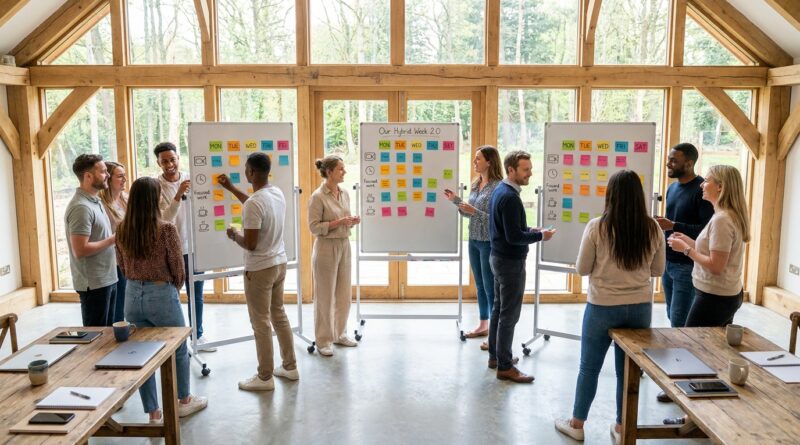
From Offsite To Alignment Retreat: Why 2026’s Smartest Teams Now Use Gatherings To Fix Their Hybrid Work Rules In 48 Hours
If your team is commuting into the office just to sit on back-to-back Zoom calls, people are right to be annoyed. Hybrid work was supposed to give everyone more flexibility. Instead, many companies ended up with a strange middle ground. One manager wants three office days. Another quietly allows one. One team treats Wednesday like sacred collaboration time. Another uses it as a headphone day where nobody talks. Staff can feel the unfairness, even when leaders cannot. That is where a well-run Alignment Retreat comes in. Not the old offsite with trust falls and generic speeches. A practical two-day working session. The goal is simple. Fix the rules of hybrid work while everyone is in the same room, with enough structure to make real decisions. For teams searching for smart hybrid work corporate retreat ideas, this is quickly becoming the gathering format that actually solves something.
⚡ In a Hurry? Key Takeaways
- An Alignment Retreat is a focused 48-hour meeting designed to set clear hybrid work rules, not just boost morale.
- Use the retreat to decide practical basics like office days, meeting norms, response times, and what truly requires in-person time.
- This works best when staff can speak safely, managers listen without defending old habits, and the final rules are written down for everyone.
Why the old offsite is not enough anymore
For years, corporate gatherings were built around energy. Big welcome session. A keynote. A dinner. Maybe a workshop about culture. That can still have value, but it does not fix the daily friction people feel in hybrid work.
The problem is not that teams forgot how to bond. The problem is that nobody has fully agreed on how work is supposed to work now.
When should people come in? What work is better done together? Which meetings should stay remote? Is it okay to protect a focus day at home? Who gets flexibility, and why? If those questions are answered differently by every manager, people stop trusting the system.
That is why the smartest gatherings in 2026 are more specific. They are built to settle operating rules, not just improve vibes.
What an Alignment Retreat actually is
Think of it as a company reset for the messy parts of hybrid work. A good Alignment Retreat is not a holiday, and it is not punishment either. It is a structured session where a team talks honestly about what is working, what is wasting time, and what rules need to change.
The output should be concrete. Not broad promises. Real agreements.
Typical decisions made in 48 hours
Most teams can make surprising progress in two days if they come in prepared. Common outcomes include:
- Clear reasons for in-office days
- Shared expectations for remote availability
- Rules for meeting formats and camera use
- A fair approach to focus time
- Team-specific norms that still fit company policy
- A written plan for testing and reviewing the new rules
This is why the format is showing up in searches for hybrid work corporate retreat ideas. It gives leaders something many offsites never do. A useful result on Monday morning.
Why people are burned out by fuzzy hybrid rules
Most burnout stories are not caused by one dramatic policy. They come from a hundred small frustrations.
You commute in because you think the team will be collaborating, then spend all day wearing a headset at a shared table. You stay home to get deep work done, then learn an important decision happened informally in the office. You ask what the rule is, and the answer depends on who you ask.
That kind of uncertainty wears people down. It also creates quiet resentment. Staff start to feel that flexibility is political, not fair.
Leaders often miss this because the surface looks fine. Attendance is up. Meetings happen. Deadlines are mostly met. But underneath, people are making private trade-offs that cost energy and trust.
Why 48 hours is often enough
Two days sounds short for such a big issue, but that time limit is actually useful. It forces choices.
Most teams already know where the pain is. They do not need six months of steering committees to confirm that nobody enjoys commuting for low-value meetings. They need a setting where the right people can say the quiet part out loud and agree on a better way.
What makes the time work
A strong retreat usually has four ingredients:
- Good prep before anyone arrives
- A neutral facilitator or trusted moderator
- Ground rules that make it safe to speak honestly
- Decision-making power in the room
If the retreat is only a listening exercise and leadership reserves every real decision for later, staff will notice immediately. The event then becomes just another expensive performance.
What to cover in an Alignment Retreat
If you are planning one, keep the agenda practical. The best sessions focus on work design, not abstract culture slogans.
1. Why do we come together in person?
This is the first question because it changes everything else. If the answer is “because leadership prefers it,” you will get compliance at best. If the answer is tied to real work, people are far more likely to accept it.
Examples of useful in-person reasons include onboarding, planning, brainstorming, sensitive conversations, customer workshops, and team relationship building. Quiet individual admin work usually does not make that list.
2. Which meetings should be remote by default?
Many companies still treat office attendance and meeting quality as the same thing. They are not. Some meetings are simply better online. Quick status checks. Cross-office updates. Sessions with participants in multiple cities anyway.
If half the room is on laptops talking to the other half on laptops, ask the obvious question. Why is everyone commuting for this?
3. What counts as fair flexibility?
This is where tension often lives. Not every role has the same level of freedom, but teams still need a shared sense of fairness. That means explaining differences clearly.
People can handle “these customer-facing roles need more in-person coverage” much better than “somehow those people always get exceptions.”
4. How do we protect focus time?
Hybrid work often fails when office days become noisy meeting marathons and home days become catch-up days filled with pings. A retreat should define when people can expect uninterrupted work time and how that time is protected.
5. How will we review the new rules?
No hybrid policy gets everything right on the first try. Good teams treat the retreat outcome as version one. They set a review date, collect feedback, and adjust.
What employees actually want from these gatherings
Usually, it is not luxury. It is honesty.
People want to know why they are being asked to travel, show up, or rearrange family routines. They want consistency between teams. They want fewer symbolic rituals and more useful agreements.
In some cases, they also want the gathering to feel worthwhile beyond the company itself. If your team is tired of the standard resort formula, it is worth looking at From Offsite To Give‑Back Retreat: Why 2026’s Smartest Teams Now Build Something For The Community, Not Just Themselves. That idea works especially well after the alignment work is done, when a team wants to reconnect around shared purpose instead of just policy.
How managers can make the retreat feel safe
This part matters as much as the agenda. If staff think they will be punished for criticizing hybrid rules, they will say very little. Then the retreat becomes a polished version of the same problem.
Do this
- Share anonymous survey findings before the event
- State clearly which decisions can be made in the room
- Separate idea generation from leadership response
- Have managers listen first, talk second
- Write decisions down in plain language before people leave
Avoid this
- Opening with a defensive speech about why current policies are already fair
- Using breakout groups with no path to action
- Letting the loudest department define the rules for everyone
- Turning the retreat into a branding exercise
Good hybrid work corporate retreat ideas start with real problems
A lot of retreat planning still starts with activities. That is backwards.
Start with the actual friction. Maybe people are confused about office attendance. Maybe distributed staff feel invisible. Maybe managers are creating different rules without meaning to. Once you know the problem, the format becomes clearer.
For example, a strong hybrid alignment retreat might include:
- A pre-retreat survey on commute pain, meeting quality, and flexibility gaps
- A visual map of how work actually happens today
- Small-group sessions by function, then cross-team comparison
- A debate on which tasks require physical presence
- A final session to draft a simple hybrid team charter
That is not flashy. It is useful. And right now, useful beats flashy.
What the final output should look like
By the end of the retreat, every employee should be able to answer a few basic questions without guessing.
- How many in-office days are expected, and why?
- What happens on those days?
- Which meetings stay remote?
- How are exceptions handled?
- When can people protect focus time?
- When will the team review whether the rules are working?
If those answers are still vague, the retreat is not finished. A nice dinner does not count as closure.
At a Glance: Comparison
| Feature/Aspect | Details | Verdict |
|---|---|---|
| Traditional offsite | Often focused on motivation, bonding, and executive messaging, with limited policy follow-through. | Good for morale, weak for fixing hybrid confusion. |
| Alignment Retreat | A structured 48-hour session built to set team norms for office time, remote work, meetings, and fairness. | Best choice when the real problem is unclear hybrid rules. |
| Success measure | Not applause or attendance, but whether staff leave with written, shared expectations they can actually use. | If the rules are clearer on Monday, the retreat worked. |
Conclusion
Return-to-office mandates and half-baked hybrid policies are quietly burning people out while failing to deliver better collaboration. That is the part many companies still do not want to admit. Teams do not need another motivational keynote right now. They need a safe, structured space to fix the messy middle of how, when and why they come together. A focused Alignment Retreat gives managers a concrete way to turn post-pandemic friction into shared norms, clearer expectations and fewer pointless commutes, so the time and money spent gathering people actually moves the culture forward instead of deepening frustration.