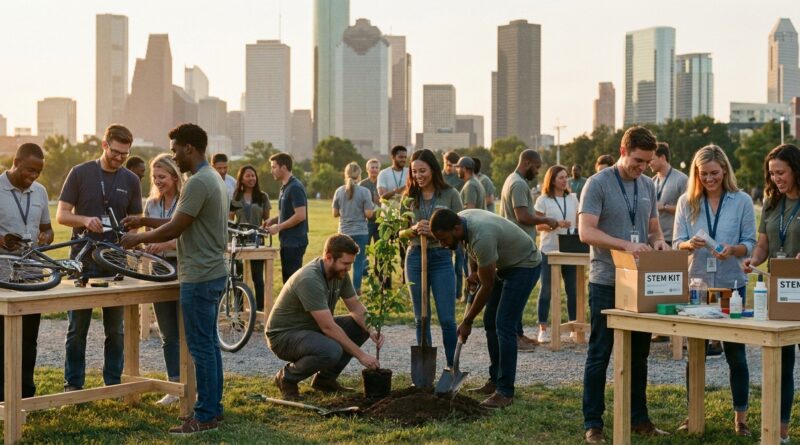
From Offsite To Give‑Back Retreat: Why 2026’s Smartest Teams Now Build Something For The Community, Not Just Themselves
Your team is not wrong to roll their eyes at another resort offsite with branded notebooks, forced fun and a slide deck about “shared purpose.” People are tired. They are watching travel budgets, climate impact, family time and their own energy much more closely than they did a few years ago. So when a company asks them to spend two or three days away, they want that time to mean something real. That is why the smartest planners in 2026 are rethinking the whole model. Instead of building a retreat around themselves, they are building part of it around the community they visit. A corporate retreat with community give back can still include strategy, team bonding and good food. The difference is simple. The team leaves behind something useful, visible and human. That shift turns an offsite from a nice expense into a story people actually feel proud to tell.
⚡ In a Hurry? Key Takeaways
- A corporate retreat with community give back feels more meaningful to employees than the usual resort-only agenda.
- Start with one focused local project, like a build day, skills lab or neighborhood partnership, not a vague “volunteer hour.”
- The best results happen when the give-back is useful to the host community, optional in spirit, and planned with local groups instead of dropped in at the last minute.
Why the old offsite formula is wearing out
There was a time when getting everyone out of the office, or off Zoom, and into a nice hotel was enough. It felt like a reward. It felt fresh.
Now, not so much.
Employees are asking harder questions. Why this trip? Why this location? Why am I away from my kids or my routine for something that could have been an email and a dinner? Those are fair questions.
What many teams want now is a stronger reason to gather. Not just connection for connection’s sake, but connection with a point. A retreat that includes a local give-back project answers that need in a very practical way.
It says, “We are here to work on our team, yes. But we are also here to leave this place a little better than we found it.”
What a corporate retreat with community give back actually looks like
This does not mean making your engineers paint a fence for a photo op. It does not mean one awkward hour stuffing swag bags in matching T-shirts.
Done well, it is much more thoughtful.
Common formats that work
A give-back retreat usually includes one of these:
- A focused build project, such as assembling bikes, literacy kits, school furniture or care packages tied to a local need
- A skills-based impact lab, where the team helps a nonprofit with design, operations, fundraising ideas, tech setup or marketing
- A neighborhood or environmental restoration effort, planned with a trusted local partner
- A hybrid model, with half the team doing hands-on work and half doing professional support work
The key is that the activity has to be real, useful and welcome. If the community partner would not choose it without your team there, it is probably the wrong project.
Why this model is landing better in 2026
Three things changed.
1. Employees want proof, not slogans
Most teams have heard enough speeches about purpose. They do not need another keynote about values. They want to see those values in action.
A give-back retreat makes purpose visible. It takes the company’s nice words off the website and puts them into a day people can touch.
2. Travel has to earn its keep
Every offsite now has a quiet math problem attached to it. Cost, carbon, time away, stress, logistics. Leaders know this. Employees know it too.
When part of the retreat produces a clear local benefit, the trip becomes easier to defend internally and easier for employees to feel good about.
3. People remember shared service differently than shared entertainment
Happy hours are fine. Nice dinners are nice. But teams often remember doing something useful together far longer than they remember the dessert station.
That is because service creates a different kind of bond. It pulls people out of status mode. It gets managers, new hires and senior leaders working side by side in a more human way.
This is not charity theater. That part matters.
Let’s be honest. Some corporate social impact efforts feel staged. People can spot that instantly.
If you want a corporate retreat with community give back to work, avoid the common mistakes:
Do not center your team over the community
The retreat is for your people. The project is for the partner and the place. Those are connected, but not identical.
Do not invent a need
Ask local organizations what would help. Then do that. Simple.
Do not force emotional performance
Not everyone wants to cry in a circle after planting trees. Let people contribute in their own way.
Do not treat it like cheap labor
Sometimes the best thing a company can do is fund expert local work, then add a smaller hands-on piece for the team. Not every problem needs 80 visitors with clipboards.
How to plan one without making it messy or awkward
This is where a lot of good intentions go sideways. The secret is focus.
Start with one sharp question
Ask, what kind of impact fits this team and this location?
If your company works in design, product, logistics, hospitality, education or tech, you may already have strengths that can be useful. Use them. If not, choose a hands-on project with clear outputs.
Pick a local partner early
Do not add the give-back piece two weeks before the event. Work with a local nonprofit, school, civic group or community organizer early enough to shape something that truly helps.
Define success in plain English
By the end of the retreat, what will exist that did not exist before?
Examples:
- 300 learning kits assembled and delivered
- Three small nonprofits leave with a working digital outreach plan
- A community garden gets built and funded for next-season upkeep
- Twenty job seekers receive coaching, resume help and interview support
Keep the activity finite
One of the biggest planning mistakes is making the service piece too broad. The best projects fit into a clear window, often two to four hours, and produce a concrete result.
Build reflection into the agenda, but keep it light
Give people space to talk about what they noticed and what mattered. Just do not overproduce it. A smart facilitator and 20 honest minutes can do more than a full workshop packet.
This idea connects closely with From Offsite To Regenerative-Retreat: Why 2026’s Smartest Teams Now Trade Cookie-Cutter Resorts For Place-Based Impact, which makes the bigger case for choosing retreats that contribute to the places hosting them instead of just using them as a backdrop.
What companies are getting out of it
Yes, this is about doing some good. It is also about making the retreat itself better.
Higher engagement
People show up differently when part of the agenda feels meaningful. Attendance energy improves. Conversation improves. Even the strategy sessions often improve, because people stop feeling like the whole trip is a performance.
Better retention signals
Employees notice where a company puts its money and time. A retreat built around community value sends a stronger signal than another standard luxury package.
Stronger employer brand
When done honestly, these retreats create the kind of story recruiting teams wish they had more often. Not “we had a beautiful venue,” but “our team helped build something useful while we were there.”
More grounded leadership
Leaders get a clearer sense of how their decisions are being judged. People are not just asking, “Did we have a good time?” They are asking, “Did this reflect who we say we are?” That is healthy.
What employees actually want from these retreats
Most employees are not asking for sainthood. They are asking for coherence.
If the company talks about care, impact, belonging and responsibility, then the retreat should not feel wasteful or detached from real life.
They want a trip that respects their time. They want moments that feel human. They want less fake magic and more honest usefulness.
That does not mean every minute has to be serious. You can still have dinner by the water. You can still have music, local food and time to relax. In fact, you should. The give-back piece works best when it is part of a balanced agenda, not a guilt exercise.
A simple retreat agenda that gets the mix right
Day 1
Arrivals, welcome session, state-of-the-team update, small-group discussions, dinner with local storytelling or cultural programming.
Day 2
Morning strategy work, lunch, afternoon community project or impact lab, short reflection, evening social time.
Day 3
Team planning, commitments for the quarter, optional follow-up support for the local partner, departure.
That structure keeps the business goals intact while making the retreat feel bigger than itself.
How to tell if your give-back idea is good or just trendy
Run it through this quick test:
- Would the local partner describe this as genuinely helpful?
- Can employees explain the purpose in one sentence?
- Will there be a clear result at the end?
- Does it fit your company’s values without feeling forced?
- Would you still do it if nobody posted about it online?
If the answer is yes across the board, you are on the right track.
At a Glance: Comparison
| Feature/Aspect | Details | Verdict |
|---|---|---|
| Traditional offsite | Heavy on meetings, social events and venue polish, but often light on lasting meaning | Fine for routine gatherings, weaker for values-driven teams |
| Corporate retreat with community give back | Blends business goals with a focused local project or impact session that leaves something useful behind | Best choice for engagement, morale and stronger purpose |
| Poorly planned volunteer add-on | Feels rushed, performative or disconnected from local needs | Avoid it. It can do more harm than good |
Conclusion
The retreat is not dead. It just needs a better reason to exist. A corporate retreat with community give back gives teams that reason. It respects people’s time, lines up better with real values and creates a more memorable kind of connection than the usual resort script. This helps our community today because post-pandemic employees are questioning every trip, every offsite and every hour away from home, and retreats that include a focused give-back build or local impact lab are outperforming standard agendas on engagement, retention and employer brand while staying aligned with the growing expectation that corporate gatherings must benefit more than just the people in the room.