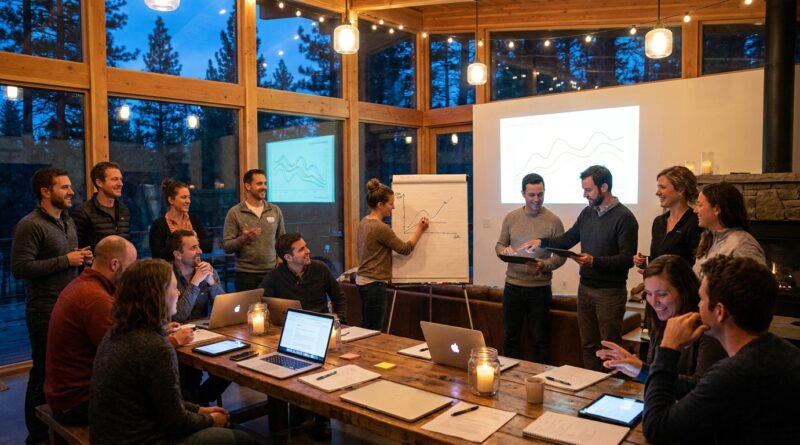
From Offsite To Data-Story Retreat: Why 2026’s Smartest Teams Now Turn Company Gatherings Into Live Insight Labs
You can feel the tension before the retreat even starts. Finance is asking why this trip costs so much. The CEO wants proof it will move the business. The team wants something better than trust falls, keynote slides, and a survey that says everyone had a “great time.” That is the real problem with many post pandemic corporate retreat trends. They talk a lot about connection, but not enough about what changed after everyone flew home. In 2026, the smartest teams are fixing that by turning the gathering into a data-story retreat. Instead of treating metrics as a dry dashboard exercise and the retreat as a culture exercise, they mix the two. People look at the numbers together, explain what those numbers mean in real life, challenge bad assumptions, and leave with a few clear measures that actually shape weekly work. The retreat stops being a reward trip and starts acting like a live insight lab.
⚡ In a Hurry? Key Takeaways
- A data-story retreat turns an offsite into a working session where teams agree on a small set of useful metrics and connect them to real decisions.
- Start with three to five business questions, not 40 KPIs. Then build sessions where people test what the numbers mean in practice.
- This approach gives leaders board-ready evidence without making staff feel watched, because the team helps shape the measures and follow-up rituals.
Why the old retreat model is starting to look expensive
For years, offsites were sold on good intentions. Better culture. Better connection. Better morale.
Those things still matter. But they are not enough on their own anymore.
Travel budgets are tighter. Remote and hybrid work changed expectations. Every in-person day now has to earn its place. That is why one of the biggest post pandemic corporate retreat trends is the move toward a data driven offsite. Leaders want to answer a simple question. What did this gathering actually change?
If the only evidence is a smiling group photo and a pulse score from Monday morning, that is a weak answer.
What a data-story retreat actually is
A data-story retreat is not a conference with more charts. It is also not a strategy meeting dressed up as a getaway.
It is a retreat designed around one core idea. Numbers make more sense when the people behind them are in the room together.
Here is how it works. Before the event, leaders pick a short list of business questions that matter now. On site, teams review the numbers tied to those questions, add frontline context, spot where dashboards are misleading, and agree on how to use a few shared metrics after the retreat.
The “story” part matters just as much as the data part. A metric alone can tell you that customer onboarding slowed down. The story tells you why. Maybe handoffs are messy. Maybe managers are approving too many exceptions. Maybe the metric is measuring the wrong thing in the first place.
When both pieces come together, people stop treating data like a report card and start treating it like a tool.
Why this works better than another slide-heavy offsite
It creates shared understanding
Most dashboards are read alone. That is the problem. People stare at the same chart and walk away with different meanings.
At a retreat, you can fix that in real time. Sales explains what happened in the field. Operations explains the bottleneck. HR explains what talent data is showing. Finance pressure-tests the assumptions. Suddenly the numbers have context.
It makes behavior change more likely
A retreat should not just produce agreement in the room. It should produce new habits back at work.
When teams co-create the metrics, they are more likely to use them. They feel ownership. They know what the measure is for. They know what good looks like. That is a very different feeling from having a dashboard handed down from the top.
It gives leadership something stronger than “the energy was great”
Executives need hard outcomes. A data-story retreat can produce them.
Not miracles. Not fake certainty. Just a better chain of evidence. Here were the questions we tackled. Here are the metrics we chose. Here are the decisions and rituals we changed. Here is what improved over the next 30, 60, and 90 days.
How to design a data driven offsite without making it feel clinical
This is where many teams get nervous. They hear “data-driven” and imagine a joyless event full of spreadsheets.
That is not the goal.
The goal is to make the retreat feel useful. Human. Honest. Focused.
1. Start with business questions, not dashboards
Do not begin with every metric the company tracks. Begin with three to five questions you need the retreat to answer.
For example:
- Why are our best new hires taking longer to ramp?
- Which cross-functional delays are hurting customer retention?
- What signs tell us a project is drifting before it becomes a fire?
Those questions are much easier for people to engage with than “let’s review performance metrics.”
2. Bring only the numbers that can lead to action
If a metric will not change a decision, it probably does not belong in the room.
That means cutting ruthlessly. Most teams need fewer metrics, not more. Three to seven is usually enough for a retreat. Think of them as the handful that can connect team behavior to business results.
3. Pair each metric with lived experience
For every chart, ask two things. What is this telling us? What is it missing?
This is where the retreat format becomes powerful. People can explain edge cases, surface hidden friction, and call out where a clean-looking dashboard is hiding a messy process.
4. Build exercises, not just presentations
Have teams work through real scenarios. Give them a metric and a decision. Then ask what they would do with it.
If the metric does not help them decide, it is weak. If people cannot explain it simply, it is probably too complicated. If it triggers argument about definitions, that is useful too. Better to uncover that now than six weeks later.
5. End with operating rituals
This is the part too many retreats skip.
Do not leave with inspirational language. Leave with a cadence. Who reviews the metrics weekly? Which meeting changes? What gets escalated? What gets retired? What is the first experiment we will run when we get back?
If you want a retreat that feels more hands-on and test-based, From Offsite To Experiment-Lab Retreat: Why 2026’s Smartest Teams Now Prototype Their Future Of Work In 3 Days is a useful companion idea. The overlap is clear. Both formats treat the gathering as a place to test the future, not just talk about it.
What a sample agenda can look like
Day 1: Get honest about the current picture
Review the few business questions that matter most. Show the baseline data. Let teams react. Where does the data confirm reality, and where does it clash with what people are living day to day?
Day 2: Turn numbers into shared stories
Break into mixed groups. Have each group map one metric to real workflows, blockers, and customer or employee outcomes. Ask them to identify what should be measured, what should be ignored, and what decisions the metric should inform.
Day 3: Lock in the post-retreat system
Finalize the metric set. Write plain-English definitions. Agree on review rhythms, owners, thresholds, and first experiments. End with a 30-60-90 day follow-up plan.
The common mistakes that sink these retreats
Too many metrics
When everything matters, nothing sticks. Keep the list short.
Metrics with no owner
If nobody is clearly responsible for watching and acting on a measure, it will fade fast.
Turning data into surveillance
This is a big one. If staff think the retreat is a fancy way to monitor them, trust will disappear. Frame metrics around better decisions and fewer bottlenecks, not blame.
No follow-up rhythm
The retreat is not the finish line. It is the reset point. Without weekly and monthly habits, the work dies in the notes app.
How to show ROI without forcing fake precision
You do not need to pretend a retreat caused every improvement by itself. Smart leaders know better.
What you can do is build a reasonable evidence trail:
- Document the baseline before the event.
- Record the specific decisions and process changes made on site.
- Track the agreed metrics for 30, 60, and 90 days.
- Note what improved, what did not, and what needs another test.
That gives your CEO a clear narrative. It gives your CFO numbers with context. And it gives your team proof that the retreat was not just a temporary mood boost.
Who should use this model first
This works especially well for teams that already have lots of reporting but poor alignment. If your company has dashboards everywhere and still cannot agree on what is happening, this format is for you.
It is also useful after mergers, during reorgs, or when hybrid work has created too much distance between what leaders think is happening and what teams are actually dealing with.
At a Glance: Comparison
| Feature/Aspect | Details | Verdict |
|---|---|---|
| Traditional offsite | Strong on bonding and inspiration, weak on proof of business impact unless follow-up is unusually tight. | Good for morale, not enough on its own for 2026 accountability. |
| Data-story retreat | Uses live discussion, shared interpretation, and a small metric set to connect human insight with measurable outcomes. | Best choice when leaders need board-ready evidence and teams need alignment that lasts. |
| Dashboard-only review | Efficient for reporting, but often misses nuance, ownership, and behavior change across functions. | Useful for monitoring, poor for building shared meaning or commitment. |
Conclusion
Leaders are under pressure in 2026 to justify every flight and every offsite day with hard outcomes, not vibes. At the same time, teams are drowning in dashboards that never become shared understanding or behavior change. A data-story retreat solves both problems at once. You turn an expensive gathering into the one place where numbers, narratives, and lived experience finally meet. The team co-creates a small set of metrics that actually matter, tests them in real conversations and exercises on site, then locks in rituals for how those metrics will shape decisions back at work. That is the practical win here. You move beyond vague talk about being “outcome-focused” and design a retreat that produces board-ready evidence, deeper alignment, and a team that feels like it owns the numbers instead of being policed by them.