From Offsite To Flexible-Route Retreat: Why 2026’s Smartest Teams Now Let People Choose Their Own Travel Adventure
Everybody says they want a team retreat that brings people together. Then the calendar invite lands with a Sunday flight, a tight layover, and a 7 a.m. kickoff on Monday. That is where goodwill starts to leak out. People may still show up smiling, but many arrive tired, annoyed, and already running on fumes. For teams still adjusting to hybrid work, caregiving schedules, and different time zones, the old one-size-fits-all trip plan feels especially out of touch. That is why post pandemic corporate retreat travel flexibility is becoming such a big deal in 2026. Smart teams are not just redesigning the event. They are redesigning the journey. Instead of forcing everyone into the same travel mold, they give people a few approved ways to get there. The result is simple. Better energy, fewer travel headaches, and a retreat that starts feeling useful before the first session even begins.
⚡ In a Hurry? Key Takeaways
- Flexible-route retreats work because they let employees choose from approved travel options instead of forcing one rigid itinerary on everyone.
- Start with simple choices like early arrival, hub meetups, or train-versus-flight options within a clear budget range.
- This approach can improve morale and control costs at the same time, especially for hybrid teams spread across regions.
The old retreat model is wearing people out
For years, company offsites followed a familiar script. Pick a destination. Book everyone on roughly the same schedule. Get them into the hotel. Start programming fast.
On paper, it looks efficient. In real life, it often feels punishing.
Red-eye flights. Sunday travel that eats into family time. Employees crossing multiple time zones only to jump straight into icebreakers and strategy sessions. It is not hard to see why some retreats leave people more depleted than connected.
Leadership usually means well. They want a shared moment. They want culture. They want people in the same room again. But if the trip itself drains the team, the retreat begins with a hidden deficit.
What a flexible-route retreat actually means
This is not travel chaos. It is not a free-for-all where everyone books whatever they want and sends Finance into a panic.
A flexible-route retreat means the company sets clear guardrails, then gives people a few approved ways to arrive based on where they live, how they work, and what they need.
Common options include:
Early arrival for long-haul travelers so they can rest before the event starts.
Regional hub travel, where smaller groups meet in a city and continue together.
Train, car, or nonstop flight options where practical.
Extra night approval for employees crossing major time zones.
Staggered arrival windows instead of one mass check-in.
The key idea is choice within structure. Employees are not left guessing. They are given smart options that fit both their lives and the company budget.
Why this matters more after the pandemic
Work changed. People changed. Expectations changed too.
Many teams are now scattered across cities, states, or countries. Some employees are caregivers. Some have health concerns. Some can travel easily. Others can, but only if the trip does not bulldoze the rest of their week.
That is why post pandemic corporate retreat travel flexibility is more than a perk. It is a signal. It tells employees, “We see the whole person, not just the badge.”
That message lands hard, especially after years of stress and blurred work-life lines. If your retreat is supposed to rebuild trust and connection, travel planning is one of the first places to prove it.
Flexible travel can save money too
This surprises people. More choice sounds more expensive. Often, it is the opposite.
When everyone flies at the same time on the same routes, prices spike. When teams use staggered departures, regional hubs, and a mix of transport options, planners can spread costs out more intelligently.
Here is where savings often show up:
Fewer last-minute bookings because employees select routes earlier.
Better use of regional airports instead of forcing major-airport connections.
Lower burnout costs from employees arriving functional, not fried.
Smarter hotel use when arrival schedules are planned instead of rushed.
It is worth remembering that T&E spend is not just airfare and hotel. It is also lost productivity, low engagement, and the awkward first day where half the room looks jet-lagged.
Travel days should not be dead days
One of the smartest shifts happening now is treating travel as part of the retreat, not just the annoying thing before it.
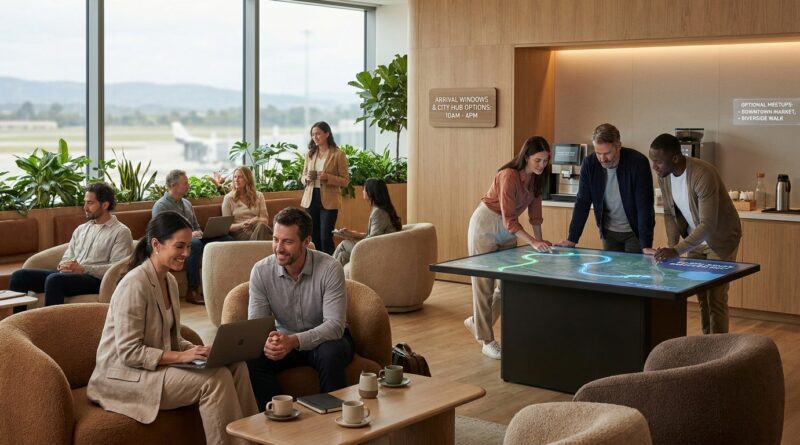
If a few employees connect at a hub airport lounge, share a train ride, or arrive a day early for a low-pressure dinner, those are real cultural moments. Not forced ones. Real ones.
That matters because people often bond more naturally in transit than in a conference room.
You do not need to turn every airport gate into a team-building exercise. Please do not. But you can design light-touch moments that make the journey feel intentional.
Examples that work:
Optional regional meetups before the final leg of travel.
Arrival-day walking dinners instead of formal sessions.
Small city guides for early arrivals so they can explore in pairs or trios.
Slack or WhatsApp threads grouped by route, so travelers can coordinate casually.
How to build a flexible-route retreat without creating a mess
This is where many companies hesitate. They like the idea, but worry it will become a planning nightmare.
It does not have to.
1. Set your non-negotiables
Be clear about the retreat start time, approved arrival window, nightly hotel limits, and total travel budget bands.
2. Group employees by geography
Look for natural clusters. East Coast. West Coast. Central Europe. Southeast Asia. Those clusters often reveal the best hub cities or route patterns.
3. Offer two to four travel paths
Too many choices confuse people. Too few defeat the point. Keep it manageable.
4. Create a simple approval process
If someone needs an exception due to disability, caregiving, or an extreme route, make that process private and easy.
5. Protect recovery time
If someone crosses multiple time zones, do not make them land at midnight and brainstorm at breakfast. That is not efficiency. That is bad planning.
Culture is built before the first keynote
This is the part some executives miss. A retreat does not start when the MC walks onstage. It starts when employees see how the company expects them to get there.
If the plan says, “We value togetherness, but not enough to protect your energy,” people notice.
If the plan says, “We want you there, and we want you there in one piece,” people notice that too.
That is why flexible-route planning fits so well with the broader move toward more humane gatherings. If you are also rethinking the purpose of the event itself, this piece pairs naturally with From Offsite To Burnout-Recovery Retreat: Why 2026’s Smartest Teams Now Design Gatherings As Live Nervous-System Reset. The two ideas go together. A calmer event is good. A calmer path into that event is even better.
What employees usually want most
Not luxury. Not endless options. Not some grand adventure travel package.
Most people want three simple things. Predictability. Dignity. A little control.
They want to know they will not be punished for asking for the sane flight. They want the company to understand that a parent in Denver and a designer in London may need different travel plans. They want to arrive ready to participate, not just recover.
When you meet those needs, people feel respected. That feeling carries into the retreat itself.
Mistakes to avoid
Calling it flexible, then making exceptions painful
If employees have to beg for every practical accommodation, the policy is flexible in name only.
Giving unlimited choice with no guardrails
That usually creates cost creep and planning confusion. Boundaries matter.
Ignoring the first and last day
The retreat may be excellent, but if departure day is a brutal 5 a.m. airport run after a late closing dinner, that is what people remember.
Designing for headquarters staff only
Remote employees can spot this instantly. A people-first retreat has to work for the people farthest away too.
At a Glance: Comparison
| Feature/Aspect | Details | Verdict |
|---|---|---|
| Traditional group travel plan | Same arrival window, similar routes, limited accommodation for time zones or personal constraints | Easy to manage, but often rough on energy and morale |
| Flexible-route retreat | Approved travel choices, hub routing, staggered arrivals, recovery time for long-distance travelers | Best balance of cost control, employee respect, and event readiness |
| Unstructured travel freedom | Everyone books their own ideal trip with minimal oversight | Good for autonomy, but risky for budgets and logistics |
Conclusion
The smartest retreat planners in 2026 are finally admitting something obvious. If the trip there feels miserable, the retreat starts in a hole. Right now, travel costs are under scrutiny and hybrid teams are scattered across time zones, yet in-person retreats are back on every executive roadmap. Flexible-route retreats solve three problems at once. They respect individual energy and life constraints. They help keep T&E spend under control by staggering flows and using hubs. And they turn travel days into small, useful moments of connection instead of dead time. Giving your team some choice in how they arrive is not a huge operational revolution. It is a small structural tweak with real cultural upside. More importantly, it shows your people that you actually learned something from the last few years, and you are not blindly snapping back to the old way of doing things.