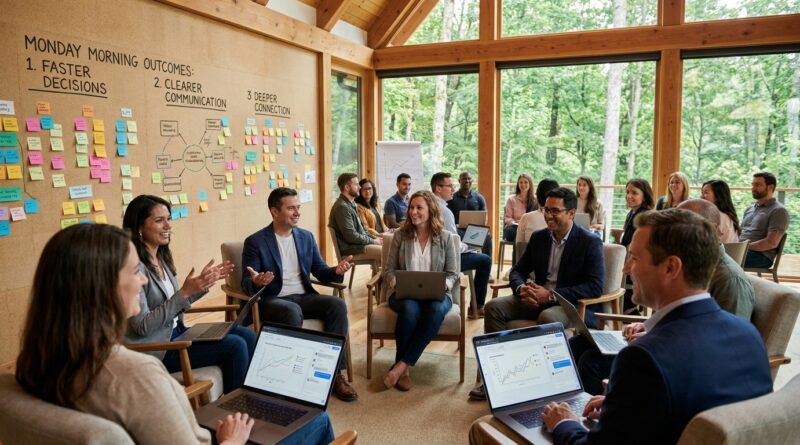
From Offsite To Outcome-Retreat: Why 2026’s Smartest Teams Now Design Gatherings Backwards From Monday Morning
You can feel the frustration in a lot of leadership teams right now. They spend months planning a beautiful retreat, fly everyone somewhere impressive, book the wellness session, the chef dinner, the fireside chat, and maybe even an AI-powered workshop. People leave energized. Then Monday hits. By Wednesday, the same old mess is back. Meetings drift. Decisions stall. Slack starts buzzing like a smoke alarm. The retreat was memorable, but the work did not change. That is why one of the biggest post pandemic corporate retreat trends 2026 is this simple shift: smart teams are planning gatherings backwards from Monday morning. Instead of asking, “What should happen at the retreat?” they start with, “What exactly should be different next week?” That one question changes the agenda, the guest list, the activities, and most importantly, the odds that the retreat actually earns its keep.
⚡ In a Hurry? Key Takeaways
- Smart teams now design retreats from the desired Monday-after behavior, not from the venue or activity list.
- Pick 2 or 3 work habits to change, then build every session around those habits and how you will measure them.
- A retreat feels good. An outcome-retreat proves value by showing better meetings, faster decisions, and clearer ownership within days.
The big shift from offsite to outcome-retreat
For years, the standard offsite worked like this. First, choose the destination. Then add some inspiration, some team bonding, a strategy block, maybe a wellness moment, and hope the magic lasts.
Hope is not a plan.
That old model struggles because it treats the retreat like a break from work. The best teams in 2026 treat it like a temporary operating room for fixing work. Different mindset. Different results.
An outcome-retreat starts at the other end. Leaders picture the first Monday, Tuesday, and Wednesday back at work. They define what should be noticeably better. Then they design the retreat to produce that result.
Maybe the goal is fewer status meetings. Maybe it is quicker product decisions. Maybe it is cleaner handoffs between sales and delivery. Maybe it is reducing Slack fatigue by agreeing on when chat is for discussion, when it is for updates, and when it should not be used at all.
The retreat becomes less about creating a vibe and more about creating a visible change.
Why this matters more in 2026
The money is tighter. Patience is shorter. Leaders are still interested in experiences, wellness, and better team connection, but they also need to show results.
That is the heart of the current post pandemic corporate retreat trends 2026 story. Companies are not done with retreats. They are just done with expensive retreats that cannot explain what changed afterward.
That means internal planners are under pressure too. They are being asked to deliver the human side and the business side at once. Morale and measurable improvement. Connection and ROI.
A backward-designed retreat helps because it gives planners a simple filter. If a session will not change a real work habit next week, it probably does not belong on the agenda.
Start with Monday morning, not the mountain view
Ask three plain-English questions
Before anyone talks about destinations or speakers, ask:
- What are people doing now that is slowing us down?
- What should they do instead next week?
- How will we know the change actually happened?
Those questions sound basic, but they force clarity fast.
For example, a leadership team might say their issue is “poor collaboration.” That is too fuzzy. Dig one layer deeper. Maybe the real problem is that decisions get reopened in Slack after meetings end. Now you have something you can work with.
The new Monday-morning outcome could be this: once a decision is made in the meeting, it gets logged in one place, assigned to one owner, and not reopened unless new evidence appears.
That is a behavior. Behaviors can be practiced. Behaviors can be measured.
The 5-part framework for an outcome-retreat
1. Choose one business problem, not seven
This is where many retreats go off the rails. Teams try to fix strategy, culture, communication, trust, burnout, innovation, and planning all in two days.
Pick one major business problem and at most two supporting habits.
Good examples:
- Too many meetings with too few decisions
- Projects stall during handoff between departments
- Hybrid teams miss context and duplicate work
- Managers create Slack overload by treating every message like a fire drill
If the retreat solves even one of those cleanly, people will feel the difference next week.
2. Define the visible Monday behaviors
Now get specific. What will people actually do differently?
For example:
- Every meeting ends with owner, deadline, and decision log
- Teams use one shared template for project handoffs
- Slack channels are grouped by purpose: urgent, updates, discussion
- Managers move non-urgent questions into async updates instead of interrupting people all day
If you cannot picture the behavior, the retreat goal is still too vague.
3. Design sessions as rehearsals, not talks
This is the part many teams miss. If you want people to work differently next week, they need to practice during the retreat.
So replace some presentations with live working sessions.
Do a real decision meeting and fix the format in the room. Run an actual cross-functional handoff and spot where confusion starts. Review a Slack mess from last month and rewrite the rules together.
This is one reason articles like From Offsite To Experiment-Lab Retreat: Why 2026’s Smartest Teams Now Prototype Their Future Of Work In 3 Days connect with so many leaders. Teams no longer want abstract inspiration. They want a safe place to test how work should actually run.
4. Build the follow-through before the retreat starts
Do not wait until the closing circle to talk about next steps. By then, people are half-packed and mentally at the airport.
Before the retreat begins, decide:
- Who owns each new habit
- What tools or templates will support it
- When the first check-in happens
- What metric will be reviewed after 7, 30, and 90 days
This is where ROI stops being hand-wavy. You are not trying to measure “team energy.” You are measuring things like cycle time, decision speed, meeting count, project drift, or response overload.
5. Keep the wellness part, but tie it to performance
Wellness is not fluff. Burned-out teams do sloppy work and make bad decisions. But it helps to connect the dots.
If you include walking sessions, recovery blocks, no-device hours, or coaching, explain why. The point is not just to be kind. The point is to help people think clearly, listen better, and avoid dropping back into frantic habits.
That is another major piece of post pandemic corporate retreat trends 2026. Wellness stays. It just needs a job to do.
What this looks like in the real agenda
A normal retreat agenda often asks, “What would be enjoyable and engaging?” An outcome-retreat asks, “What would make next Thursday better?”
Here is a simple example.
Old-style offsite
- Opening inspiration keynote
- Department updates
- Team-building activity
- Strategy brainstorm
- Dinner and networking
Backward-designed outcome-retreat
- Define the one workflow causing the most friction
- Map exactly where delays and confusion happen
- Test a new meeting or handoff format live
- Agree on team rules, owners, and templates
- Set the 7-day and 30-day scorecard
- Use wellness and social time to support trust and honest feedback
Notice the difference. The second agenda still has room for experience and connection. It just puts them in service of a result.
How to measure whether the retreat worked
You do not need a complicated dashboard. You need a few useful signals.
Good post-retreat metrics
- Number of recurring meetings removed or shortened
- Average time to make a cross-functional decision
- Project handoff errors or rework
- Slack volume in non-urgent channels
- Time from discussion to assigned owner
- Percent of projects using the new template or process
Also ask people one very practical question after a week: “What is easier now than it was before the retreat?”
If nobody can answer, the retreat may have been enjoyable but not useful.
Common mistakes that quietly ruin retreats
Too many goals
When everything is important, nothing gets fixed. Keep the scope tight.
No rehearsal time
If people only talk about better habits, they usually return to old ones. Practice matters.
Confusing agreement with adoption
A room full of nodding heads is not proof. What matters is what happens back at the keyboard.
Letting senior leaders stay vague
If leadership says “we want more ownership,” ask what that means in a Tuesday meeting. Push for examples.
Making follow-up somebody else’s problem
If no owner is named for the new behaviors, the retreat fades into memory fast.
Why internal planners like this model
Planners are often stuck in the middle. Executives want measurable impact. Employees want something that does not feel like corporate homework in a nice hotel.
The outcome-retreat model helps with both.
It gives planners a clean way to defend the budget. It also protects them from the all-too-common request to “make it inspiring” without any agreement on what success means.
When the retreat is built backwards from Monday morning, every choice gets easier. Venue. Session format. Facilitators. Tech. Wellness blocks. Even dinner conversation prompts.
You can simply ask, “Will this help people work differently next week?” If yes, keep it. If not, trim it.
At a Glance: Comparison
| Feature/Aspect | Details | Verdict |
|---|---|---|
| Planning starting point | Traditional offsites start with destination, speakers, and activities. Outcome-retreats start with the exact behavior or workflow that must improve after the trip. | Backward design wins for clarity and ROI. |
| Session format | Old agendas lean on presentations and inspiration. Outcome-retreats use live practice, working sessions, and decision rehearsals. | Practice beats passive listening. |
| Success measurement | Traditional success is often based on energy and feedback scores. Outcome-retreats track changes in meetings, handoffs, decision speed, and team habits within days or weeks. | Measured behavior change is the stronger proof. |
Conclusion
The smartest retreat trend of 2026 is not bigger experiences or shinier tech. It is discipline. Teams are finally asking the right question first. Not “What will wow people for three days?” but “What will make work better by next Wednesday?” That shift matters because companies still want connection, wellness, and memorable shared experiences, but leaders also need hard proof in a tighter economy. A backward-designed outcome retreat turns post-pandemic ideas like hybrid collaboration, immersive formats, and wellness into visible behavior changes and business metrics leaders can point to in Q4 reviews. It also gives busy internal planners a repeatable way to turn another offsite into a culture intervention that shows up in meetings, decisions, and shipped work almost immediately. If the retreat changes Monday morning, it was worth it. If not, it was just a trip.