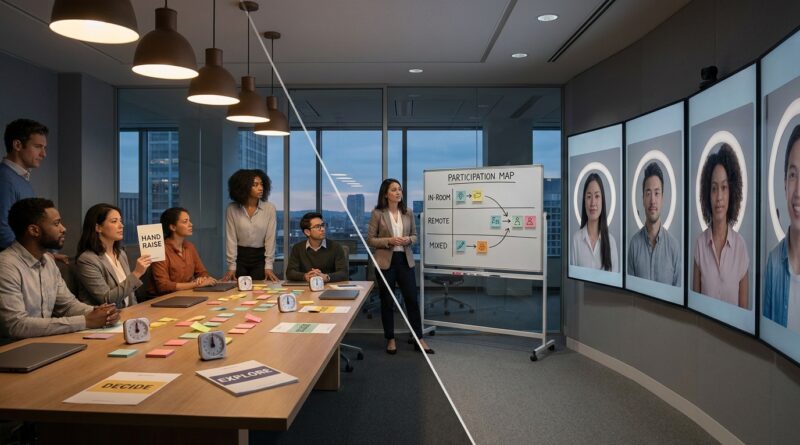
From Offsite To Participation-Retreat: Why 2026’s Smartest Teams Now Design Gatherings Around Who Gets A Real Voice
Everyone knows the feeling. The company retreat is meant to bring people together, but the hybrid setup quietly tells a different story. The people in the room make eye contact, jump in fast and shape the conversation. The remote people wait for a gap that never comes, stare at a giant screen and end the day wondering why they were invited at all. That is why so many so-called post pandemic hybrid corporate retreat ideas still fall flat. They fix the travel, the venue and the swag bag, but not the actual power dynamics. The smartest teams in 2026 are changing that. They are moving from the old offsite model to a participation-retreat model, where the main design question is simple. Who gets a real voice here? Once that becomes the center of the plan, the retreat stops feeling performative and starts producing better decisions, stronger trust and fewer bruised feelings after everyone logs off.
⚡ In a Hurry? Key Takeaways
- A participation-led retreat works better than a traditional offsite because it is built to balance who speaks, who influences decisions and who leaves with ownership.
- Start by redesigning agendas around turn-taking, small-group input, shared digital boards and clear decision rules instead of open-floor discussions.
- You do not need a bigger budget to make this fairer. Most teams can keep the same venue and format, then change the meeting structure to get better results.
The old offsite problem did not go away
Many leaders thought hybrid retreats would get easier with time. In some ways they did. The tech is better. People are more used to remote work. Travel is less chaotic than it was in the first rebound years.
But the core issue stuck around. Hybrid gatherings still tend to reward the people who are physically present, naturally confident or already close to leadership. If you have ever watched a big decision get shaped by whoever grabbed the mic first, you have seen the problem.
That is why the shift matters. A retreat should not just gather people. It should distribute voice on purpose.
What a participation-retreat actually means
A participation-retreat is not a fancy new label for an offsite. It is a planning model. The goal is to make sure the right people can contribute in a real way, not just appear on the attendee list.
It starts with one simple question
Before you plan a single session, ask this. At this retreat, where will people actually shape outcomes?
If the answer is “during Q&A” or “during open discussion,” that is usually a warning sign. Open discussion sounds democratic, but it often turns into a contest won by the fastest talkers.
It values structure over spontaneity
This is the part some teams resist. They worry structure will make the retreat feel stiff. In practice, it does the opposite. Good structure lowers social friction. People know when they can speak, how ideas will be captured and what happens next.
That makes quieter people more likely to join in. It also keeps senior voices from swallowing the room without meaning to.
Why this shift is showing up in 2026
Leaders are under pressure now. If you are asking people to travel, pause client work or spend six hours in a hybrid retreat, you need to show it was worth it.
A nice dinner and a motivational keynote are not enough anymore. Teams want visible value. That means clearer decisions, broader buy-in and less frustration after the event.
This is also why participation-led design fits neatly beside other smarter gathering trends. For example, some companies are also using retreats to build one concrete skill instead of trying to do everything at once. That approach is explored well in From Offsite To Skill-Sprint Retreat: Why 2026’s Smartest Teams Now Use Gatherings To Build One Game-Changing Capability. The common thread is focus. Smart teams are done with vague agendas.
What goes wrong in a typical hybrid retreat
If you want better post pandemic hybrid corporate retreat ideas, it helps to name the usual traps first.
The Zoom-on-a-TV problem
Remote attendees become spectators. They can hear most things, but they cannot break in naturally. Side conversations in the room outrun them every time.
The loudest-voice effect
In-person participants often dominate not because they are smarter, but because the room itself favors them. They can read body language, catch pauses and build momentum faster.
The fake feedback loop
Teams often ask for input after decisions are already half-made. That creates resentment. People are not fooled by a sticky-note exercise that changes nothing.
The unclear endpoint
Some retreats create lots of discussion and very little commitment. People leave inspired, then spend the next two weeks trying to figure out what was actually decided.
How to design a retreat around real voice
You do not need to reinvent your whole event. You need to redesign how time, speaking and decisions work.
1. Decide which moments require equal participation
Not every session needs the same format. A keynote update can be one-to-many. A strategy choice cannot.
Mark the agenda in advance. Which sessions are for alignment? Which are for idea generation? Which are for decisions? Which require input from remote and in-person people in equal measure?
That one step alone helps you stop treating every block of time the same.
2. Replace open-floor discussion with rounds
If a topic matters, do not toss it to the room and hope for fairness. Use timed rounds. Ask each person or table to respond in turn. Keep answers short. Capture them visibly.
This sounds basic because it is. It also works.
3. Use digital-first collaboration, even for people in the room
This is one of the biggest fixes. If remote staff are typing into a shared board while in-person staff are talking over one another at a flip chart, the process is already uneven.
Use one shared tool for everyone. Everyone posts ideas in the same place. Everyone votes in the same place. Everyone sees the same information at the same time.
The room should not get a shortcut that the remote people do not have.
4. Give facilitators a participation job, not just a timekeeping job
A facilitator should do more than move slides along. They should watch for imbalance.
That means noticing who has not spoken, when the room is drifting into side chatter and when one person is steering the outcome too heavily. Good facilitation is not about being polished. It is about protecting fair contribution.
5. Separate idea generation from evaluation
When people pitch and judge ideas in the same breath, status tends to win. Senior people speak, others nod and the room moves on.
Instead, collect ideas first. Then review them. Then score them against clear criteria. This gives newer, quieter and remote team members a better shot at being heard on merit.
6. Make decisions visible before the retreat ends
Every important session should end with a clear summary. What did we decide? What is still open? Who owns the next step? When will we review it?
If people leave unsure, the retreat will feel softer and less useful than it was.
Formats that work better for hybrid teams
If your current retreat model feels stale, here are a few practical formats that tend to create better participation.
Silent start sessions
Begin with five to ten minutes of quiet writing in a shared document or board. This gives everyone time to think before the strongest voices set the tone.
Paired breakout rotations
Mix remote and in-person attendees into pairs or trios, then rotate them through one focused question at a time. Smaller groups make it easier for everyone to contribute.
Vote-before-discuss sequences
Have participants rank ideas privately before discussion starts. This prevents the room from simply following the first persuasive speaker.
Decision clinics
Instead of broad strategy talk, bring one real decision into the room, give people the same background and work toward a concrete answer. Teams often leave these sessions feeling the retreat was finally worth the calendar disruption.
How to measure whether the retreat was worth it
This is where participation-led design gets especially useful. It gives leaders something more solid than “people seemed engaged.”
Track contribution balance
Look at who spoke, who submitted ideas and who influenced final choices. Was participation spread across functions, levels and locations?
Track decision clarity
Count how many meaningful decisions were made and documented. Not discussed. Made.
Track execution speed
After the retreat, see how quickly owners move on agreed actions. Teams tend to act faster when the process felt fair and clear.
Track sentiment by work mode
Ask remote, hybrid and in-person attendees separately whether they felt heard. If one group scores much lower, you have a design problem, not a culture mystery.
What leaders often get wrong
The biggest mistake is thinking fairness means giving everyone the same amount of airtime. That is not quite it.
The real goal is meaningful influence. Sometimes that means equal speaking turns. Sometimes it means written input before the meeting. Sometimes it means anonymous voting to reduce hierarchy effects.
Another mistake is trying to solve this with tech alone. Better microphones help. Better cameras help. But if the meeting design still favors the room, the tech just gives you a clearer recording of an unfair process.
How event planners can improve this without blowing up the budget
This is good news for the Corporate Event world. You do not need a brand-new venue, an expensive production company or a larger travel budget.
You can keep the same destination. Keep the same catering. Keep the same broad theme, if people love it.
The upgrade happens in the structure. Better facilitation. Better agenda design. Better rules for participation. Better capture of decisions. That is what turns a retreat from a nice gesture into a working tool.
At a Glance: Comparison
| Feature/Aspect | Details | Verdict |
|---|---|---|
| Traditional offsite discussion | Open-floor conversation, in-room energy drives outcomes, remote attendees often react late or not at all. | Good for bonding, weak for fair decision-making. |
| Participation-led retreat | Uses structured rounds, digital-first tools, clear facilitation and visible decision rules for all attendees. | Best choice for balanced input and stronger follow-through. |
| Cost and planning impact | Usually keeps the same venue and budget, but asks planners to redesign the flow of sessions and accountability. | High return without requiring a full event reset. |
Conclusion
The smartest shift in post pandemic hybrid corporate retreat ideas is not more entertainment or better branding. It is making participation the main design job. Right now leaders need to prove that pulling people away from work, flying them in or asking them to spend full days in hybrid sessions is worth the time, cost and attention. A participation-led retreat gives you something real to point to. More balanced input. Faster execution after the event because people actually feel heard. Less resentment from remote and hybrid staff who are tired of being turned into faces on a screen. For event planners and company leaders alike, this is a practical upgrade, not a total rebuild. Keep your venues, budgets and themes if they work. Just rewire how voice, time and decisions are handled so the retreat feels fair, focused and culturally meaningful instead of like another offsite with nicer tote bags.