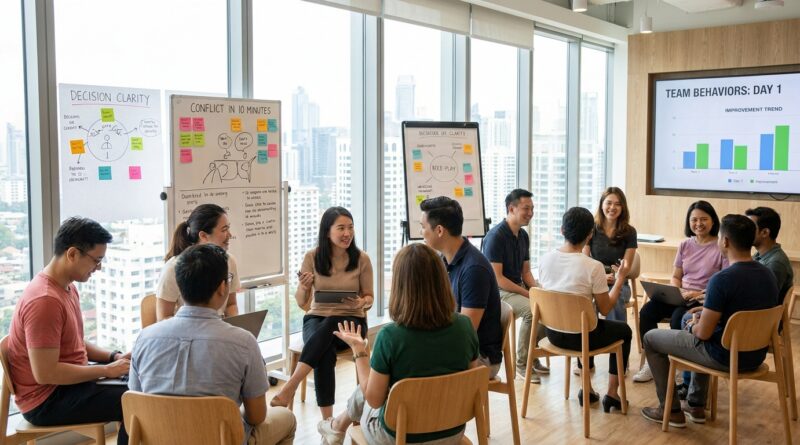
From Offsite To Skill-Sprint Retreat: Why 2026’s Smartest Teams Now Use Gatherings To Build One Game-Changing Capability
Plenty of teams are tired of the same old offsite script. You fly in, sit through a few slides, do an awkward icebreaker, eat a nice dinner, then head home wondering what exactly changed. Leaders feel that pressure too. Every retreat dollar now gets questioned, and employees are less willing to give up time away from home for something that feels vague. That is why the post pandemic corporate retreat skill based offsite is catching on in 2026. The smartest teams are no longer planning gatherings around “connection” alone. They are planning them around one useful skill the team needs right now, whether that is better client storytelling, faster decision-making, AI workflow use, cross-functional planning, or sharper feedback habits. The goal is simple. On Monday, people should be able to do something better, not just remember the hotel bar.
⚡ In a Hurry? Key Takeaways
- A Skill-Sprint retreat focuses the whole gathering on building one strategic capability, not just team bonding.
- Pick one skill tied to a real business problem, then design every session around practice, feedback, and a Monday-ready output.
- This model is easier to justify, easier to measure, and more respectful of people’s time, travel, and energy.
Why the old offsite is wearing thin
Most people are not against meeting in person. They are against wasting a trip.
That is the real shift. A retreat used to get a free pass if people had fun and came back feeling “aligned.” Now that is not enough. Teams are managing tighter budgets, leaner calendars, and a lot more burnout. So the question has changed from “Did people like it?” to “Was it worth it?”
That is where the Skill-Sprint retreat comes in. It treats in-person time like premium real estate. You do not fill it with generic presentations. You use it to build one capability that is hard to teach over Slack or a scattered set of video calls.
What a Skill-Sprint retreat actually is
Think of it as a short, focused training camp for one important team skill.
Not ten skills. One.
That discipline is what makes it work. When a retreat tries to fix culture, boost morale, train managers, align strategy, and brainstorm product ideas all at once, everyone leaves with a notebook full of half-starts. A Skill-Sprint keeps the promise smaller and much more useful.
Examples of good retreat skills
The best capability target is specific, urgent, and connected to work people already need to do. For example:
- Running better client discovery calls
- Using AI tools safely in everyday workflows
- Giving faster, clearer peer feedback
- Making cross-team decisions without endless meetings
- Turning strategy into a 90-day execution plan
- Presenting ideas with more clarity and confidence
If the skill matters on Monday, people pay attention. If it feels abstract, they drift.
Why this model works better in 2026
People have gotten choosier, and honestly, that is healthy.
Employees now weigh travel against family time, project deadlines, and personal energy. Leaders are doing the same with money. So a retreat has to clear a higher bar. It needs a visible return.
A skill-based offsite clears that bar because it gives everyone a clear answer to the question, “What are we going there to do?”
It is easier to sell internally
“We want the team to bond” sounds nice, but it is hard to defend when budgets are tight.
“We want the customer success team to improve renewal conversations by practicing a shared framework in person” is much easier to approve. It is concrete. It sounds serious because it is serious.
It feels fairer to employees
People do not want to burn two or three days traveling just to take part in a retreat that could have been an email plus dinner. But many will gladly make the trip if they know they are getting better at something that helps their job and career.
It creates proof, not just good vibes
You can measure a skill sprint. You can compare before and after. You can track adoption. You can ask whether the team is using the new method 30 days later. That is much stronger than saying, “People seemed energized.”
How to design a post pandemic corporate retreat skill based offsite
This is where many teams either get it right or turn it back into a dressed-up offsite.
1. Start with one business problem
Do not begin with activities. Begin with friction.
Ask: what is slowing this team down right now?
Maybe sales and product cannot agree on priorities. Maybe new managers avoid hard conversations. Maybe the team has AI tools available but no shared process for using them well. That friction point should guide the whole retreat.
2. Translate the problem into one capability
Now turn that problem into a skill statement.
For example:
- From “Our meetings are messy” to “We need to make decisions faster with a common decision method”
- From “Our pitch is inconsistent” to “We need to tell a sharper, repeatable customer story”
- From “Managers are overwhelmed” to “We need to delegate more clearly and coach better”
If you cannot describe the capability in one sentence, it is still too fuzzy.
3. Build the agenda around practice, not passive listening
This is the big one.
A skill is not built by sitting in rows and watching slides. It is built by trying, adjusting, trying again, and getting useful feedback. So the retreat agenda should have less talking at people and more working with people.
Good formats include:
- Live simulations
- Peer coaching rounds
- Role-play with real scenarios
- Small-group problem labs
- Guided workshop blocks with expert feedback
- Build sessions that end in a shared template, plan, or playbook
4. Make one real output before people leave
A great Skill-Sprint retreat produces something tangible.
That might be a new team playbook, a decision checklist, a client call script, an AI workflow prompt library, a shared dashboard structure, or a 90-day action plan. The exact output depends on the skill, but there should be evidence that the work happened.
This matters because people forget inspiration fast. They remember tools they can use.
5. Keep some human time, but stop making it the whole point
This part is important. Skill-Sprint does not mean joyless boot camp.
You still want meals together, informal conversations, and some room to breathe. Relationships matter. They just should not be the only thing the retreat delivers.
In fact, many teams find that bonding gets better when people are building something useful together. Shared effort tends to feel more natural than forced fun.
Some companies are also combining this with purpose-driven formats. If your culture values community work, there is a nice overlap with ideas in From Offsite To Neighborhood-Impact Retreat: Why 2026’s Smartest Teams Now Trade Swag Bags For Real Local Change, which makes the gathering feel useful in more than one way.
What a two-day Skill-Sprint retreat can look like
Day 1
- Set the business problem and define success
- Teach the core framework in simple language
- Break into small groups for practice rounds
- Use real scenarios from current work
- End with feedback and adjustments
Day 2
- Run a higher-pressure simulation
- Build the team tool or playbook
- Agree on how the new skill will be used after the retreat
- Assign owners, checkpoints, and measures
- Close with a realistic 30-day commitment
Notice what is missing. Long executive monologues. Generic motivational talks. Random breakout sessions with no clear link to the goal.
Common mistakes that ruin the idea
Trying to cover too much
If you pick three or four capabilities, you are back to a standard retreat with fancier branding. One skill. That is the rule.
Calling a workshop a sprint
If people just sit and listen, it is not a sprint. The whole value comes from concentrated practice and shared application.
Choosing a skill leaders care about but employees do not
The capability needs business value, yes. But it also has to feel useful to the people in the room. If employees can see how the skill helps their own day-to-day work, buy-in goes up fast.
No follow-through after the retreat
This is the most common failure. People leave excited, then the inbox takes over.
You need a simple follow-up plan:
- A 2-week check-in
- A shared template or tool in active use
- A manager prompt for reinforcing the skill
- A 30-day review of what changed
How to measure whether it worked
You do not need a complicated dashboard. Just track a few clear things.
Good measures include
- How confident people feel using the skill before and after
- Whether the new framework or tool is actually being used
- A business metric tied to the skill, such as faster approvals, better close rates, fewer revision cycles, or shorter meetings
- Manager observations 30 days later
- Examples of work improved by the new capability
If the retreat was about improving customer handoffs, then handoffs should look better. If it was about decision-making, then decisions should happen faster with less confusion. Keep the proof boring and practical. That is what leaders trust.
Who should use this model first
Not every team has to rebuild every retreat overnight. Start where the need is sharpest.
This model works especially well for:
- Hybrid teams that rarely get focused in-person practice time
- Fast-growing companies that need a common operating method
- Teams in transition, such as new managers or reorganized departments
- Functions where communication quality has a direct business impact
- Groups that are openly skeptical about retreats and need a better reason to attend
At a Glance: Comparison
| Feature/Aspect | Details | Verdict |
|---|---|---|
| Traditional offsite | Broad agenda, bonding activities, leadership updates, loose outcomes | Good for morale, often weak on measurable value |
| Skill-Sprint retreat | Focused on one strategic capability with hands-on practice and a clear output | Best choice when budgets are tight and results need to be visible |
| Neighborhood-impact retreat | In-person time centered on local contribution and shared purpose | Strong culture option when community impact is part of the company’s identity |
Conclusion
The retreat is not dead. The vague retreat is. That is the real lesson here. Travel and attention budgets are tighter than ever, and people are much more careful about what deserves their in-person time. A Skill-Sprint model respects that reality. It turns a retreat into a short, intense push to build one capability that matters now. That makes it easier to approve, easier to explain, and easier to measure in plain business terms. Just as important, it gives employees something they actually want from a gathering in 2026. A real upgrade they can use on Monday. If your team is planning the next offsite, this is the question worth asking first: what one game-changing skill should people leave with?