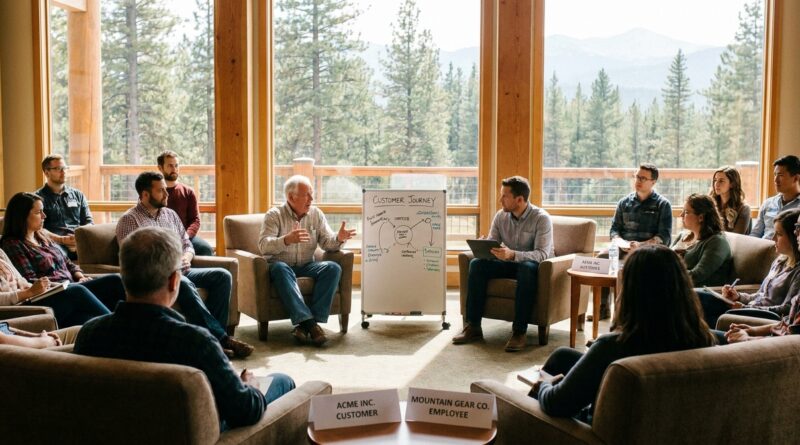
From Offsite To Purpose-Paired Retreat: Why 2026’s Smartest Teams Now Bring Customers Into The Room
You can feel the problem before the retreat even starts. Flights booked. Hotel block locked in. Agenda full of sessions about “customer closeness.” Then everyone arrives, talks about user needs for three days, and heads home without meeting a single actual customer. That is why so many retreats now land with a thud. They sound useful on paper, but once people are back on Zoom, the ideas feel vague and the spend looks hard to defend. One of the clearest post pandemic corporate retreat trends with customers is simple: stop treating the customer like a slide deck and bring them into the room. The smartest teams in 2026 are building what you could call a purpose-paired retreat. It is not a random offsite plus a nice dinner. It is a retreat organized around one live customer moment, planned in advance, shared by the whole team, and used to drive real decisions after everyone gets home.
⚡ In a Hurry? Key Takeaways
- A purpose-paired retreat works better because it centers the trip on one real customer interaction, not abstract discussion.
- Pick a single customer moment before the event, prepare the team around it, and end the retreat with named decisions, owners, and deadlines.
- This format makes travel easier to justify because it produces evidence you can show later, from product changes to sales stories and clearer priorities.
Why the old offsite now feels thin
For years, a lot of retreats ran on the same formula. A strategy session. A values workshop. A few icebreakers. Maybe a keynote. Maybe trust falls with better catering.
That used to be enough. It is not enough now.
After the pandemic, teams got used to asking a blunt question about any in-person event. Why are we traveling for this? If the answer could have been a six-person video call and a shared doc, people know it. Fast.
That is the real shift. Leaders are not just buying togetherness anymore. They are expected to buy outcomes.
And when the stated goal is “get closer to the customer,” a retreat without a customer in sight starts to look a little silly.
What a purpose-paired retreat actually is
A purpose-paired retreat is built around one anchor experience with a real customer or user. Not ten scattered activities. One focal point.
That customer moment might be:
- a live customer panel
- an on-site client visit
- a guided observation of customers using the product
- a roundtable with lost prospects
- a service recovery conversation with a frustrated account
The key is that the retreat is paired to a purpose. Not just “team bonding.” Not just “big picture thinking.” A specific business question.
For example:
- Why is adoption stalling after onboarding?
- What do customers still not understand about our pricing?
- Where does our product create friction in real life?
- Why do buyers love the demo but hesitate on rollout?
Now the retreat has a spine. People arrive knowing what they are there to learn.
Why this works better for non-techies and techies alike
Here is the simple version. Real customers cut through company theater.
Inside any business, people build stories. Marketing has one story. Product has another. Sales has a third. Support has a fourth. By the time everyone gets to the retreat, those stories are often polished, rehearsed, and a little self-serving.
A customer conversation resets the room.
It gives everyone the same raw material. The same quotes. The same body language. The same awkward pause when a client says, “Honestly, we still do that part in a spreadsheet.”
That shared reality matters. It keeps the retreat from floating off into jargon.
The big change in 2026: retreats are becoming working systems
The smartest teams are also figuring out that one event cannot do all the work by itself. If the retreat is meant to change how a company listens, decides, and follows through, it has to connect to habits before and after the trip.
That is why this trend overlaps with another one: designing gatherings as repeatable practices instead of isolated experiences. If that idea sounds familiar, it is worth reading From Offsite To Ritual Retreat: Why 2026’s Smartest Teams Design Gatherings As Ongoing Practices, Not One‑Off Trips. It makes the point that people are tired of one-time magic shows. They want a format that keeps working after the luggage is unpacked.
A purpose-paired retreat fits that mood perfectly. It gives the team one live moment to rally around, then turns that moment into a repeatable decision process.
How to build one without making it weird for the customer
1. Start with one question, not a vague ambition
If your retreat goal is “understand the customer better,” that is too mushy. Better goals are narrow and useful.
Try this instead:
- Understand why implementation takes longer than promised.
- Find the top three points of confusion in first-time use.
- Learn what makes existing customers expand, or walk away.
One clean question beats eight fuzzy ones.
2. Pick the right customer format
Not every company needs the same setup.
If you are a software company, a live product walkthrough with customers can be gold. If you are in services, a candid panel about handoff pain points may be better. If you sell enterprise tools, bringing in one champion customer and one skeptic can be more useful than a room full of superfans.
The trick is balance. You want honesty, not performance.
3. Prepare the customer like a guest, not a prop
This part matters more than people think.
Customers should know why they are there, what will be asked, how long it will take, and what is in it for them. Respect their time. Pay travel if needed. Offer a thank-you that fits your industry and compliance rules. Give them a real host.
Most of all, do not parade them in front of 80 employees with no structure. That is uncomfortable for everyone.
4. Prepare your team to listen
This is where many companies blow it.
They invite the customer, but they do not coach the team. So people interrupt, defend old choices, ask leading questions, or turn the whole thing into a stealth sales pitch.
Set simple rules before the session:
- Ask open questions.
- Do not argue with feedback.
- Write down exact customer language.
- Look for patterns, not personal blame.
This turns the session from a show into useful field research.
5. End with decisions, not inspiration
A moving customer story is nice. A changed roadmap is better.
Before the retreat ends, force the group to answer:
- What did we hear?
- What surprised us?
- What will we change in the next 30 days?
- Who owns each change?
- How will we know if it helped?
If you skip this part, the retreat becomes memory foam. Soft, pleasant, and impossible to measure.
What this looks like in practice
Picture a 60-person product and customer success team meeting for two days.
Day one is not packed with generic workshops. Instead, the morning is spent reviewing recent customer feedback, support tickets, and onboarding drop-off data. Everyone goes into the afternoon with the same facts.
Then comes the anchor moment. Two customers join for a moderated session. One is a power user. One struggled during rollout. The moderator asks about setup, training, handoff, feature confusion, and what nearly made them quit.
Everyone listens. No fixing. No spin.
Day two is for action. The product team drafts three interface changes. Customer success rewrites onboarding checkpoints. Marketing updates one message that customers clearly misunderstood. Leadership agrees on two metrics to watch for the next quarter.
Now the retreat has earned its airfare.
Common mistakes to avoid
Turning the customer session into a pep rally
If you only invite customers who love you, the team learns less. Positive stories are helpful, but friction teaches more.
Inviting too many customers at once
More is not always better. A smaller number often leads to better discussion and less stage-management.
Making the event about optics
If the real aim is to get nice photos and say “customer-centric” on LinkedIn, people can smell it. So can customers.
Forgetting the follow-up
The retreat should produce a short after-action report. Not a giant deck no one opens. A simple record of what was heard, what changed, who owns it, and when it will be reviewed.
How to prove ROI without sounding like an accountant at a campfire
You do not need heroic math. You need a few credible signals.
Track things like:
- product fixes shipped because of retreat feedback
- time-to-onboard improvements
- renewal or expansion stories influenced by what the team learned
- fewer support tickets in the problem area discussed
- sales messaging changes that improved conversion
This is where a lot of culture leaders get stuck. They know the retreat felt valuable, but they struggle to explain that value to finance or the board.
A purpose-paired retreat gives you better proof. You are not saying, “People connected more.” You are saying, “After hearing customers describe onboarding confusion live, we changed the setup flow, reduced time-to-value, and gave sales a clearer expectation-setting story.” That is a much stronger sentence.
Who should be in the room
Not just executives.
If possible, mix the people who shape the customer experience day to day:
- product
- sales
- customer success
- support
- operations
- a decision-maker who can unblock changes
This matters because customer issues rarely belong to one team. The customer does not care which department “owns” the problem. They just experience the problem.
At a Glance: Comparison
| Feature/Aspect | Details | Verdict |
|---|---|---|
| Traditional offsite | Focuses on internal discussion, culture sessions, and strategy talk, often without direct customer input. | Good for bonding, weaker for proving business impact. |
| Purpose-paired retreat | Built around one live customer moment, tied to a clear business question and post-retreat action plan. | Best choice when travel spend must lead to visible outcomes. |
| Post-retreat follow-through | Includes owners, deadlines, measurable changes, and a simple review of what improved after the event. | Essential if you want the retreat to matter after everyone flies home. |
Conclusion
Teams do not need more expensive ways to have abstract conversations. They need reasons to gather in person that are hard to replace with a video call. Right now, that is the pressure point. Every travel dollar has to earn its keep. A purpose-paired retreat does exactly that. It gives culture builders a format they can defend: one live customer moment that everyone prepares for, experiences together, and then turns into decisions, product tweaks, and stories that hold up in the next board deck. Less fluff. More proof. And a much better chance that the retreat still matters once everyone is back on Zoom.