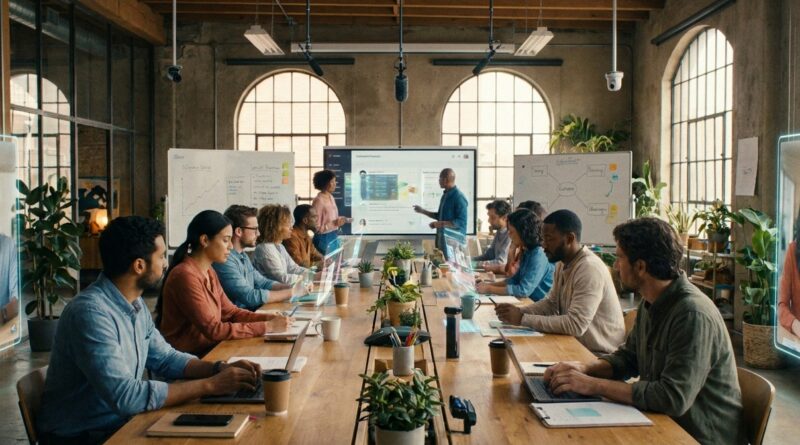
From Offsite To Blended-Reality Retreat: Why 2026’s Smartest Teams Now Design For In‑Room And Remote Humans At Once
Your last “hybrid” retreat probably failed in a very familiar way. The people in the room bonded over coffee, side chats and whiteboards. The people at home got a laggy stream, a few awkward check-ins and the creeping feeling that they were watching someone else’s event. That is frustrating for everyone. Leaders feel like they spent real money and still disappointed half the team. Remote staff feel invisible. In-person staff feel guilty, or worse, they stop noticing the gap at all. That is why the smartest teams are changing the plan for 2026. They are not treating remote attendance as a backup option anymore. They are designing for two audiences at the same time. Think of it less like broadcasting a meeting and more like producing a shared experience. The big shift in post pandemic hybrid corporate retreat trends 2026 is simple. If one group feels second class, the retreat is broken.
⚡ In a Hurry? Key Takeaways
- Blended-reality retreats work best when remote and in-room people are planned for equally, not when a livestream is added at the last minute.
- Start with shared activities, better room audio, camera-aware facilitation and digital-first agendas that every attendee can use.
- The value is trust and retention, not just convenience. A truly inclusive retreat makes budgets easier to defend and culture easier to rebuild.
Why “hybrid” retreats usually feel bad
Most retreat plans still start with the venue. Then the catering. Then the travel list. Only after all that does someone ask, “How do we include the remote folks?”
That question comes too late.
A retreat built for a room and streamed to a laptop is not a hybrid experience. It is a room event with witnesses. Remote attendees miss hallway context, table energy and the little moments where trust is actually built. Meanwhile, the people on-site often cannot hear remote comments well, see reactions clearly or remember to pause for them.
This is the core problem behind post pandemic hybrid corporate retreat trends 2026. Teams are no longer choosing between office life and remote life. They are living in both. Retreat design has to catch up.
What a blended-reality retreat actually means
Blended reality sounds fancy, but the idea is practical. It means the retreat is designed so that in-room and remote humans can contribute, react, learn and connect in ways that feel natural.
Not identical. Natural.
A remote attendee does not need the exact same lunch buffet or hotel lobby. But they do need equal access to the conversation, the decision-making and the social moments that matter.
It is not about more tech for the sake of tech
This is where some teams get stuck. They think blended reality means headsets, virtual worlds or some eye-wateringly expensive production setup.
Usually, it does not.
For most companies, it means:
- clear room audio that remote people can actually understand
- camera placement that shows faces, not just the back of heads
- facilitators who actively bring in remote voices
- shared digital workspaces for notes, polls and breakout tasks
- an agenda built around mixed participation, not separate tracks
That is less glamorous than a metaverse demo. It is also much more useful.
The 2026 shift: from event planning to experience design
The smartest teams are changing who owns the retreat plan. It is not just travel, venue and food anymore. HR, ops, IT, internal comms and department leaders are starting earlier and building around outcomes.
Ask these questions first:
- What should people know, feel and do differently after this retreat?
- Which sessions need deep collaboration, and which can be asynchronous?
- Where will remote staff naturally participate well, and where do they need a different format?
- How will we measure whether both groups felt included?
That last question matters. If you only survey “overall satisfaction,” you can miss a giant inclusion problem. Break feedback out by attendance type. Compare the answers. The gap will tell you the truth very quickly.
A simple blueprint for a blended-reality retreat
1. Design digital-first, even for the people in the room
This sounds backwards, but it works. Put the agenda, session materials, polls, worksheets and Q&A into a shared digital hub. Everyone uses the same source of truth, whether they are in the ballroom or at home.
That does two things. First, remote people are not hunting for scraps of context. Second, the room cannot drift into private side systems that exclude everyone else.
2. Fix the audio before you buy anything flashy
If remote attendees cannot hear clearly, nothing else matters.
Good microphones beat fancy visuals almost every time. Use table mics, ceiling mics or a proper speaker system. Do not depend on one laptop at the end of the room. That setup has ruined more “hybrid” sessions than bad coffee ever has.
3. Assign a remote advocate for every major session
This can be a moderator, producer or facilitator. Their job is to watch chat, bring remote hands into the discussion, flag technical issues and stop the room from forgetting the online audience.
Without this role, remote attendees usually become silent squares.
4. Build mixed groups on purpose
Do not split activities into “the room does this” and “remote people do that” unless there is a very good reason. Use breakout groups that mix both. Give them shared tasks. Put outputs into a common board. Make sure success depends on contributions from more than one location.
This is also where learning-focused retreats shine. If your event includes practical takeaways, not just bonding, people leave with something concrete. That is one reason more teams are pairing connection with capability building, as seen in From Offsite To Skill-Stamped Retreat: Why 2026’s Smartest Teams Now Bring Home A New Certification, Not Just A T‑Shirt.
5. Script the social layer too
This is the part leaders often miss. Formal sessions are easier to hybridize than social time. Yet social time is where remote people feel most excluded.
Try things like:
- hosted small-group coffee chats with mixed attendance
- guided welcome kits or shared tasting sessions
- short game blocks designed for both screen and room participation
- digital photo walls, team challenges or live voting moments
No, it will not feel exactly like standing around a fire pit together. But it can still feel real.
What leaders get wrong about budget
Many executives look at blended-reality planning and see added cost. More gear. More production. More coordination.
That is not wrong. But it is incomplete.
The better question is this: what is the cost of flying people in for a culture event that quietly tells remote staff they matter less?
That cost shows up later. In disengagement. In retention risk. In slower cross-team trust. In the unspoken feeling that some careers are built in hallways, while others are built in waiting rooms.
A well-designed retreat can justify itself if it improves alignment, trust and skill growth across the whole team. A badly designed one can waste money even if everyone loved the hotel.
Tools that help, without making it weird
You do not need a science-fiction setup. You need a few dependable layers.
Core tools
- high-quality room microphones and speakers
- wide-angle and speaker-tracking cameras
- shared docs, whiteboards and polling tools
- a moderator chat channel for behind-the-scenes coordination
- clear screens in the room so remote faces stay visible
Nice extras
- captioning for accessibility and clarity
- session recordings with quick summaries
- digital badges or post-retreat learning artifacts
- small shipped kits for remote attendees
The trick is to use tech that removes friction, not tech that demands attention. Nobody wants to spend half the retreat learning a platform.
How to know if your retreat was truly inclusive
Do not judge success by applause in the room.
Look for signs like these:
- remote participants spoke up without being forced
- shared documents show equal contribution from both groups
- people reference insights from remote colleagues in later sessions
- survey scores are similar across in-person and remote attendees
- teams keep using the same collaboration habits after the retreat ends
That last one is a big deal. A good retreat should improve how people work next month, not just how they felt for two days.
At a Glance: Comparison
| Feature/Aspect | Details | Verdict |
|---|---|---|
| Traditional hybrid retreat | In-person agenda first, remote stream added later, weak audio, little facilitation for online attendees | Cheap on paper, costly in trust |
| Blended-reality retreat | Shared digital tools, active moderation, inclusive activities, strong room setup and mixed participation by design | Best fit for distributed teams in 2026 |
| Learning-driven retreat add-on | Adds workshops, skill outcomes or certifications so the retreat produces measurable growth | Strong budget defense and lasting value |
Conclusion
The real lesson from post pandemic hybrid corporate retreat trends 2026 is not that offices are over or travel is pointless. It is that people now work in a mixed reality, and your retreat needs to match that truth. Companies that slip back into in-person first thinking with a token livestream are not just using old formats. They are sending an old message. A clear blended-reality plan helps HR and ops leaders spend smarter, rebuild trust with distributed teams and turn the annual offsite into a culture moment that actually fits modern work. If everyone can participate like they belong, the retreat stops being a compromise and starts being a real advantage.